
[Paper Review] Unifying Simulation and Inference with Normalizing Flows
This paper proposes a unified framework for detector calibration and uncertainty quantification using normalizing flows (NFs), where maximum likelihood estimation (MLE) from conditional NFs enables prior-independent energy regression and per-shower resolution estimation. The method outperforms direct regression by reducing bias and capturing non-Gaussian, asymmetric resolution functions, as demonstrated on a simulated ATLAS-like calorimeter dataset with improved calibration accuracy and reliable per-shower uncertainty estimates.
There have been many applications of deep neural networks to detector calibrations and a growing number of studies that propose deep generative models as automated fast detector simulators. We show that these two tasks can be unified by using maximum likelihood estimation (MLE) from conditional generative models for energy regression. Unlike direct regression techniques, the MLE approach is prior-independent and non-Gaussian resolutions can be determined from the shape of the likelihood near the maximum. Using an ATLAS-like calorimeter simulation, we demonstrate this concept in the context of calorimeter energy calibration.
Motivation & Objective
- To unify detector calibration and uncertainty quantification (UQ) in high-energy physics using deep generative models.
- To address the limitations of direct regression methods, which are prior-dependent and lack uncertainty estimates.
- To enable per-shower resolution estimation for improved calibration precision beyond point estimates.
- To demonstrate that normalizing flows can capture non-Gaussian, asymmetric resolution functions inaccessible to Gaussian approximations.
Proposed method
- The method uses conditional normalizing flows (NFs), specifically Masked Autoregressive Flows (MAFs) with Rational Quadratic Splines (RQS), to model the likelihood $ p(E_{\text{dep}} | E_{\text{inc}}) $, enabling both sampling and density estimation.
- The NF is trained via maximum likelihood estimation (MLE) to minimize $ -\log p_{1}(\vec{E} | E_{\text{inc}}) $, ensuring prior-independence and exact likelihood access.
- Input features are preprocessed: $ E_{\text{inc}} \to \log_{10}(E_{\text{inc}}/10\ \text{GeV}) $ and $ E_i \to 2(\log_{10}(E_i + 1\ \text{keV}) - 1) $ to stabilize training.
- A uniform noise of [0, 0.1] keV is applied to voxel energies during training and evaluation to prevent overfitting to minor features.
- The model is trained for 150 epochs with a batch size of 200 using Adam optimization and a multi-step learning rate schedule.
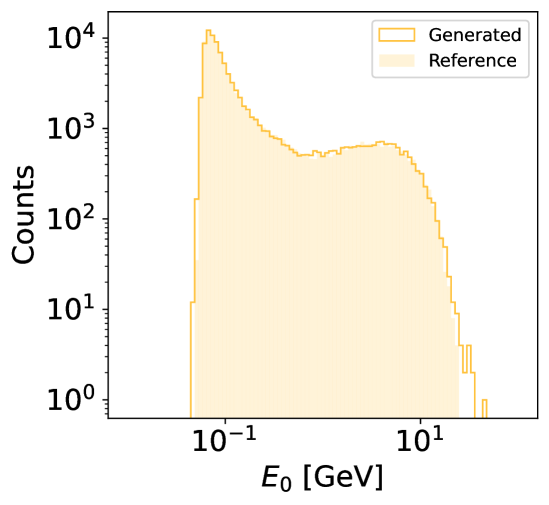
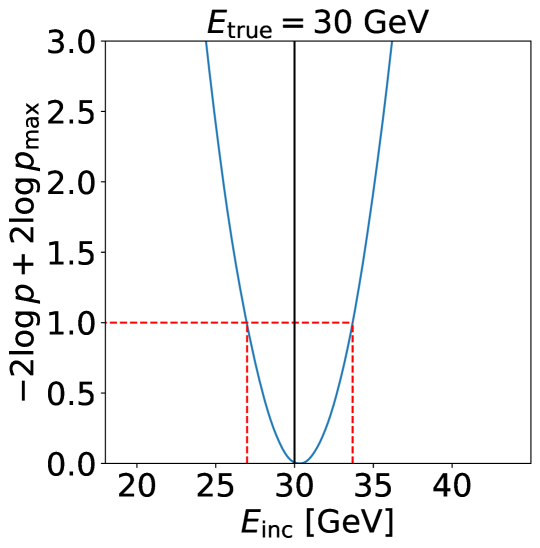
- Per-shower resolution is estimated from the curvature of the likelihood near the mode, enabling uncertainty quantification per event.
Experimental results
Research questions
- RQ1Can normalizing flows unify detector calibration and uncertainty quantification in a prior-independent manner?
- RQ2How does MLE-based calibration using NFs compare to direct regression in terms of bias and resolution estimation?
- RQ3Can NFs capture non-Gaussian, asymmetric resolution functions that the Gaussian Ansatz cannot?
- RQ4Does per-shower resolution estimation from NFs correlate with calibration accuracy, indicating reliability?
- RQ5Can the full likelihood from NFs improve calibration beyond point estimates and Gaussian approximations?
Key findings
- The NF-based calibration method (CaloFlow) showed significantly reduced bias compared to a direct DNN regression model on 100k pion showers from a simulated calorimeter.
- The average per-shower resolution estimated from CaloFlow closely matched the full resolution function, validating its reliability.
- Smaller per-shower resolutions from CaloFlow were associated with more accurate calibration, indicating that the uncertainty estimates are meaningful and reliable.
- The method captured non-Gaussian, asymmetric resolution functions, offering an advantage over the Gaussian Ansatz which assumes symmetric, Gaussian-shaped resolutions.
- The NF approach enables access to the complete resolution function, allowing for more accurate and flexible uncertainty quantification than previous methods.
Better researchstarts right now
From reading papers to final review, dramatically reduce your research time.
No credit card · Free plan available
This review was created by AI and reviewed by human editors.