
[Paper Review] Unitary transformation of the electronic Hamiltonian with an exact quadratic truncation of the Baker-Campbell-Hausdorff expansion
This paper introduces a novel unitary transformation for the electronic Hamiltonian using an exact quadratic truncation of the Baker-Campbell-Hausdorff expansion via an involutory linear combination (ILC) of anti-commuting Pauli products. The method preserves Hamiltonian hermiticity, incorporates strong electron correlation effects classically, and significantly reduces quantum resource demands in variational quantum eigensolver (VQE) applications, demonstrating improved efficiency for LiH, H₂O, and N₂ compared to conventional approaches.
Application of current and near-term quantum hardware to the electronic structure problem is highly limited by qubit counts, coherence times, and gate fidelities. To address these restrictions within the variational quantum eigensolver (VQE) framework, many recent contributions have suggested dressing the electronic Hamiltonian to include a part of electron correlation, leaving the rest to be accounted by VQE state preparation. We present a new dressing scheme that combines preservation of the Hamiltonian hermiticity and an exact quadratic truncation of the Baker-Campbell-Hausdorff expansion. The new transformation is constructed as the exponent of an involutory linear combination (ILC) of anti-commuting Pauli products. It incorporates important strong correlation effects in the dressed Hamiltonian and can be viewed as a classical preprocessing step alleviating the resource requirements of the subsequent VQE application. The assessment of the new computational scheme for electronic structure of the LiH, H$_2$O, and N$_2$ molecules shows significant increase in efficiency compared to conventional qubit coupled cluster dressings.
Motivation & Objective
- To reduce the quantum resource requirements of variational quantum eigensolver (VQE) for electronic structure calculations.
- To develop a unitary transformation that preserves Hamiltonian hermiticity while incorporating strong electron correlation effects.
- To enable exact quadratic truncation of the Baker-Campbell-Hausdorff expansion using an involutory linear combination (ILC) of anti-commuting Pauli products.
- To provide a classically efficient preprocessing step that alleviates the need for deep quantum circuits in VQE.
- To demonstrate improved efficiency and accuracy in ground state energy estimation for small molecules like LiH, H₂O, and N₂.
Proposed method
- The method constructs a unitary transformation as the exponential of an involutory linear combination (ILC) of anti-commuting Pauli products, ensuring exact quadratic truncation of the BCH expansion.
- The ILC unitary is applied to a reference computational basis state (Slater determinant), generating a superposition of orthogonal configurations via trigonometric functions of a single parameter τ.
- The energy minimization is reformulated as a standard orthogonal eigenvalue problem in a subspace of N+1 orthogonal states, with matrix elements computed classically using trigonometric polynomials of Bloch angles.
- An imaginary phase correction is applied via element-wise multiplication with a matrix M, transforming the problem into a generalized eigenvalue system for non-orthogonal bases when reference state relaxation occurs.
- A two-step iterative MCSCF-like procedure alternates between optimizing ILC amplitudes and Bloch angles, updating the subspace basis at each iteration until convergence.
- The method enables classical computation of optimal parameters τ and αi from the ground state eigenvector, with τ extracted via arccos(c₁) and αi via c_{j}/sin(τ).
Experimental results
Research questions
- RQ1Can an exact quadratic truncation of the Baker-Campbell-Hausdorff expansion be achieved in a unitary transformation that preserves Hamiltonian hermiticity?
- RQ2Can an involutory linear combination of anti-commuting Pauli products effectively embed strong electron correlation into the Hamiltonian classically?
- RQ3Does this transformation significantly reduce the quantum circuit depth and qubit requirements in VQE for molecular electronic structure?
- RQ4How does the performance of this method compare to conventional qubit coupled cluster dressings in terms of energy accuracy and convergence efficiency?
- RQ5Can the method be generalized to relaxed reference states while maintaining numerical stability and accuracy?
Key findings
- The proposed QCC-ILC transformation achieves exact quadratic truncation of the BCH expansion while preserving Hamiltonian hermiticity.
- The method enables classical computation of the optimal unitary transformation via a polynomially scaling eigenvalue problem in a small subspace of N+1 orthogonal states.
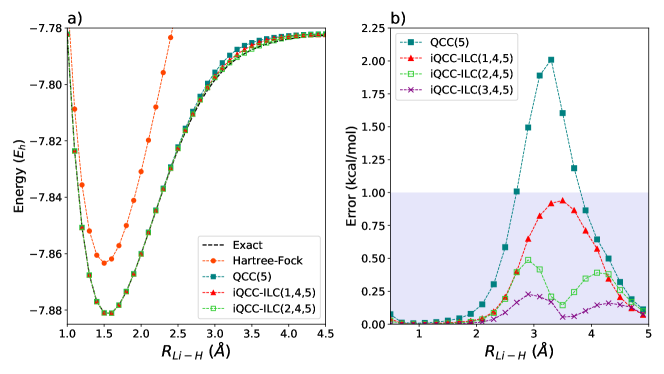
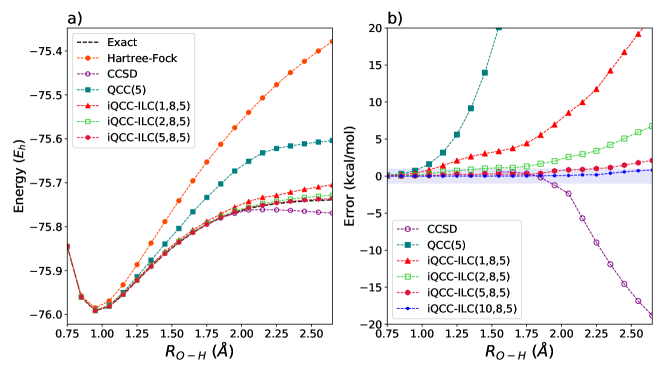
- For LiH, H₂O, and N₂, the method shows a significant increase in efficiency compared to conventional qubit coupled cluster dressings in VQE applications.
- The optimal parameters τ and αi are extracted from the ground state eigenvector using τ = arccos(c₁) and α_{j-1} = c_j / sin(τ), with τ guaranteed to be non-zero due to non-vanishing energy gradients at τ=0.
- The iterative MCSCF-like procedure converges to a relaxed reference state and optimized ILC amplitudes, with non-orthogonal basis states handled via a generalized eigenvalue formulation.
- The method provides a classically efficient preprocessing step that reduces the quantum resource burden in VQE by embedding strong correlation effects before quantum circuit execution.
Better researchstarts right now
From reading papers to final review, dramatically reduce your research time.
No credit card · Free plan available
This review was created by AI and reviewed by human editors.