
[Paper Review] Unveiling the Potential of AI for Nanomaterial Morphology Prediction
This study introduces a novel multi-modal dataset of 215 calcium carbonate-based nanomaterial syntheses with annotated SEM images and synthesis parameters, and evaluates classical machine learning and large language models (LLMs) for predicting nanoparticle morphology. It achieves 0.81 average accuracy using GPT-4 for shape prediction and prototypes a text-to-image generation system, demonstrating AI's potential to reduce experimental trial-and-error in nanomaterial design despite data limitations.
Creation of nanomaterials with specific morphology remains a complex experimental process, even though there is a growing demand for these materials in various industry sectors. This study explores the potential of AI to predict the morphology of nanoparticles within the data availability constraints. For that, we first generated a new multi-modal dataset that is double the size of analogous studies. Then, we systematically evaluated performance of classical machine learning and large language models in prediction of nanomaterial shapes and sizes. Finally, we prototyped a text-to-image system, discussed the obtained empirical results, as well as the limitations and promises of existing approaches.
Motivation & Objective
- To address the high experimental cost and time required to synthesize nanomaterials with specific morphologies by developing AI-driven prediction models.
- To generate a new, large-scale, multi-modal dataset combining synthesis parameters, SEM images, and expert-annotated morphology labels for calcium carbonate nanoparticles.
- To evaluate classical machine learning and state-of-the-art large language models (LLMs) for predicting nanoparticle shape and size under realistic data constraints.
- To prototype a text-to-image generation system that synthesizes nanoparticle images from synthesis procedure descriptions.
- To identify data quality and quantity as the primary bottleneck in AI-driven nanomaterial design and advocate for a unified, curated database.
Proposed method
- Generated 215 experimental syntheses of calcium carbonate nanoparticles with controlled parameters, including temperature, reagent concentrations, and reaction times.
- Collected and manually annotated SEM images, segmenting individual nanoparticles and labeling their shapes (e.g., spheres, rods, plates) and sizes.
- Trained classical machine learning models (e.g., XGBoost, Random Forest) on tabular synthesis parameters to predict morphology, achieving 0.77 and 0.80 accuracy for size and shape, respectively.
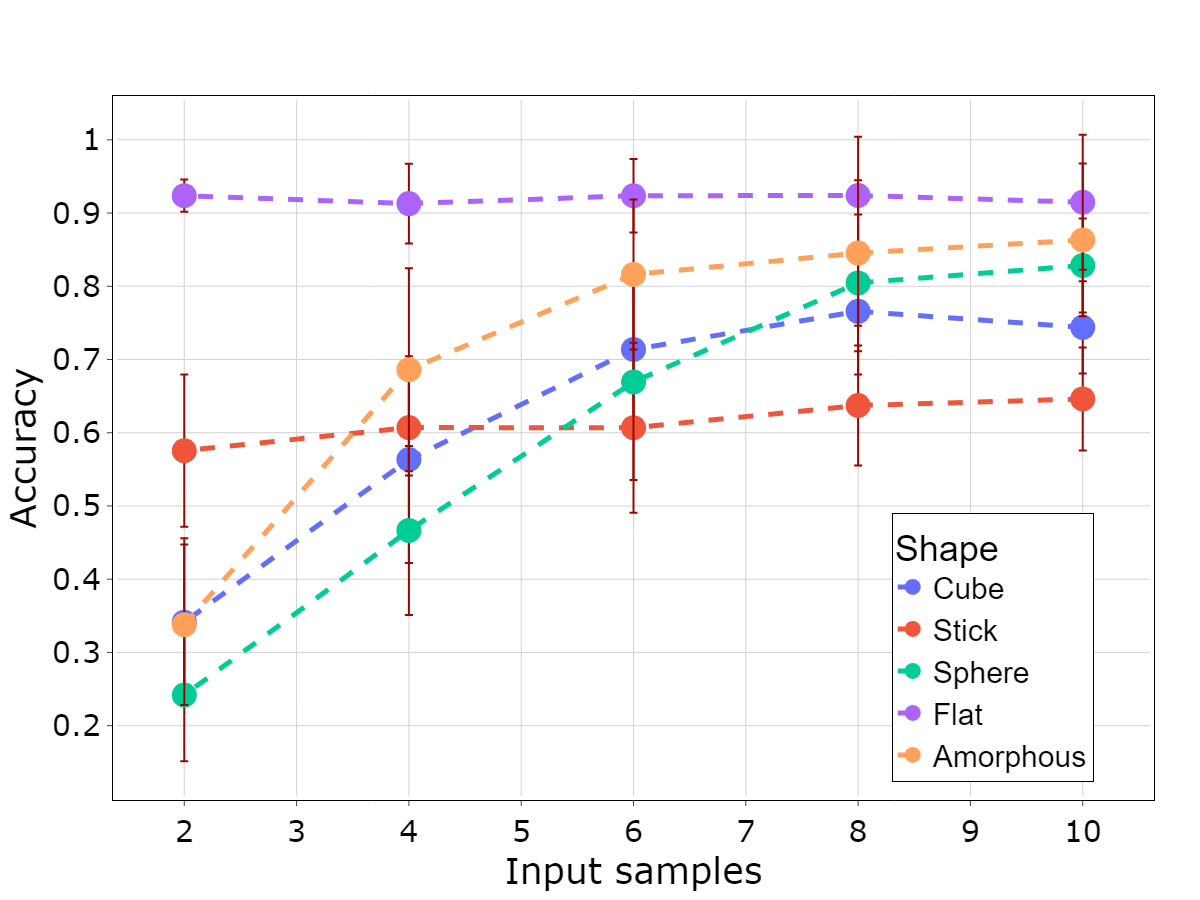
- Fine-tuned GPT-4 using few-shot prompting on synthesis descriptions to predict nanoparticle shapes, attaining 0.81 average accuracy.
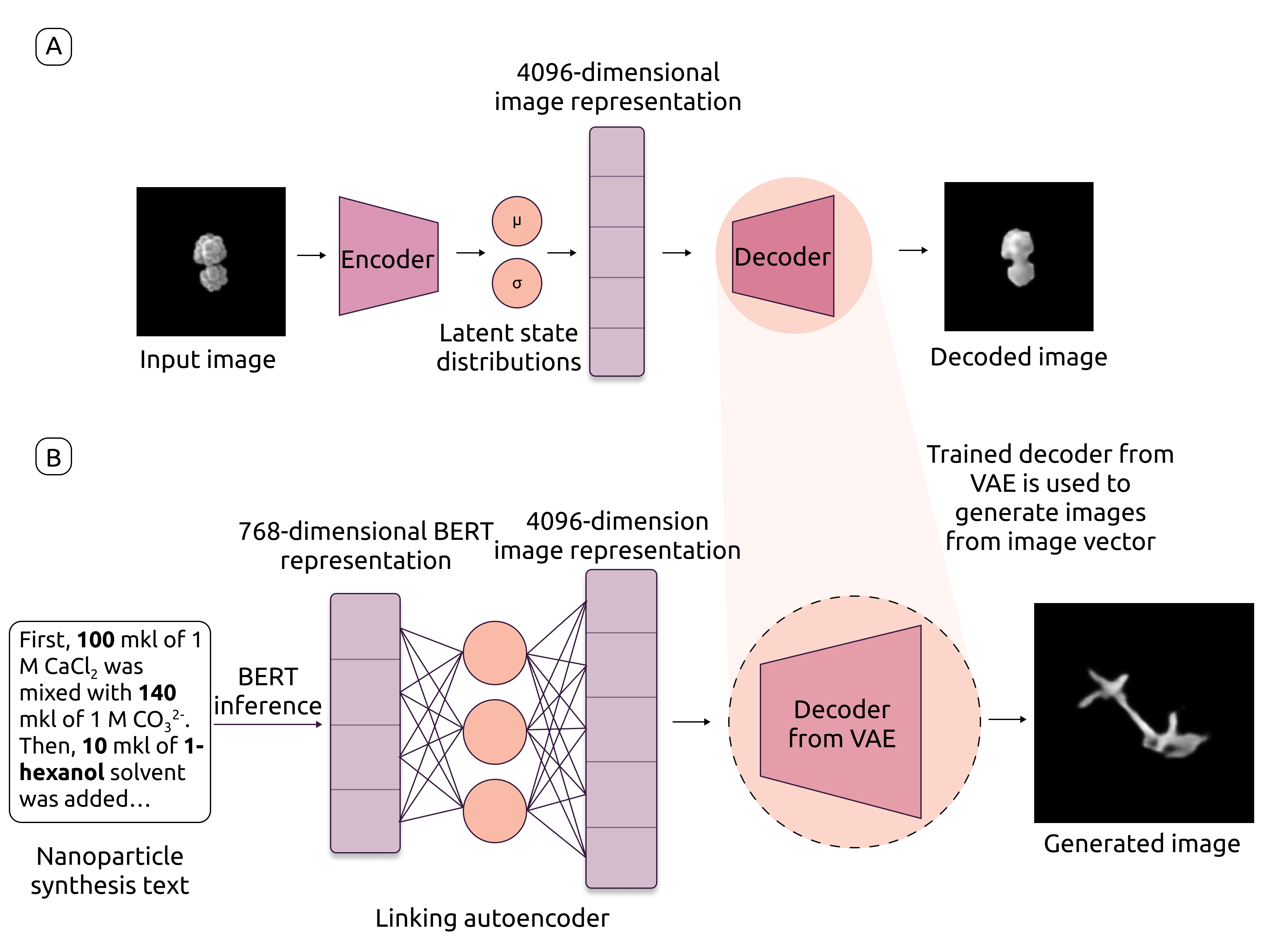
- Developed a variational autoencoder (VAE) with a 'linking' architecture to learn joint representations between text embeddings (from BERT) and image features, enabling text-to-image generation.
- Used UMAP to visualize the learned latent space of the VAE, identifying clusters corresponding to distinct morphological classes and analyzing feature dependencies.
Experimental results
Research questions
- RQ1Can large language models like GPT-4 effectively predict the morphology of nanoparticles from synthesis procedure descriptions, even with limited training data?
- RQ2How does the performance of classical machine learning models compare to LLMs in predicting nanoparticle size and shape from experimental parameters?
- RQ3To what extent can a text-to-image generative model produce realistic nanoparticle images based on synthesis descriptions, and what are its limitations?
- RQ4What are the key features in synthesis parameters that are most predictive of nanoparticle morphology, and how do they correlate with observed shapes?
- RQ5What are the primary data-related barriers to scaling AI models for nanomaterial morphology prediction, and how can they be addressed?
Key findings
- The study generated a new multi-modal dataset of 215 calcium carbonate-based nanomaterial syntheses, doubling the size of comparable existing datasets.
- Classical machine learning models achieved 0.77 and 0.80 average accuracy in predicting nanoparticle size and shape, respectively, from synthesis parameters.
- Large language models (GPT-4) achieved 0.81 average accuracy in shape prediction using few-shot prompting, outperforming classical models and demonstrating strong zero-shot generalization potential.
- The text-to-image prototype successfully generated plausible nanoparticle images from synthesis descriptions, though with limited diversity and quality due to data scarcity.
- Latent space visualization using UMAP revealed distinct clusters corresponding to different morphological classes, with synthesis temperature showing a notable correlation with cluster distribution.
- The study identifies insufficient, uncurated, and non-unified datasets as the primary bottleneck for AI in nanomaterial design, urging the creation of a centralized, standardized database.
Better researchstarts right now
From reading papers to final review, dramatically reduce your research time.
No credit card · Free plan available
This review was created by AI and reviewed by human editors.