
[Paper Review] Variations on the Tait-Kneser theorem
This paper presents a Lorentzian geometric proof of the Tait-Kneser theorem on nested osculating circles along plane curves with monotone non-vanishing curvature, extending the method to osculating Hooke and Kepler conics. It establishes that the associated curves in the space of conics are null, leading to a new 4-vertex theorem for Kepler conics, with connections to projective duality and central force laws via the Bohlin-Kasner transformation.
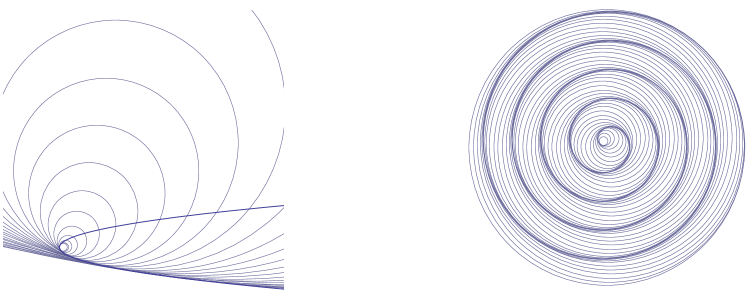
The Tait-Kneser theorem, first demonstrated by Peter G. Tait in 1896, states that the osculating circles along a plane curve with monotone non-vanishing curvature are pairwise disjoint and nested. This note contains a proof of this theorem using the Lorentzian geometry of the space of circles. We show how a similar proof applies to two variations on the theorem, concerning the osculating Hooke and Kepler conics along a plane curve. We also prove a version of the 4-vertex theorem for Kepler conics.
Motivation & Objective
- To provide a new proof of the Tait-Kneser theorem using Lorentzian geometry in the space of circles.
- To extend the Tait-Kneser theorem to osculating Hooke and Kepler conics along plane curves.
- To establish a 4-vertex theorem for Kepler conics using geometric and duality-based methods.
- To explore the connection between 3-parameter families of curves and null curves in pseudo-Riemannian geometry.
- To demonstrate how projective duality reduces Keplerian versions of the Tait-Kneser and 4-vertex theorems to their Euclidean counterparts.
Proposed method
- Represent circles in the plane as points in the pseudo-Euclidean space ℝ¹,² with metric −a² − b² + r², where (a,b) are center coordinates and r the radius.
- Define nesting of circles via the condition |v₁ − v₂|² ≥ 0, with equality if and only if circles are tangent.
- Show that the curve of osculating circles along a vertex-free curve is a null curve in ℝ¹,², using the derivative of the osculating circle map and the curvature condition.
- Prove that a regular null curve in ℝ¹,² satisfies |Γ(t₁) − Γ(t₀)|² ≥ 0, with equality iff the curve is a null line segment.
- Apply the same framework to Hooke and Kepler conics by identifying their parameter spaces with pseudo-Riemannian manifolds and showing their associated curves are null.
- Use projective duality and the Bohlin-Kasner transformation z ↦ z^{(a+3)/2} to relate Kepler conics to circles and transfer results from the Euclidean to the Keplerian case.
Experimental results
Research questions
- RQ1How can the Tait-Kneser theorem on nested osculating circles be re-proven using Lorentzian geometry in the space of circles?
- RQ2What conditions ensure that the osculating Hooke or Kepler conics along a curve are pairwise disjoint and nested?
- RQ3Does a 4-vertex theorem hold for Kepler conics, analogous to the classical 4-vertex theorem for circles?
- RQ4To what extent do the geometric properties of 3-parameter families of curves (e.g., parabolas, fractional-linear functions) generalize the Tait-Kneser phenomenon?
- RQ5How does projective duality relate the Euclidean and Keplerian versions of the Tait-Kneser and 4-vertex theorems?
Key findings
- The curve of osculating circles along a vertex-free plane curve with monotone non-vanishing curvature is a null curve in ℝ¹,², implying pairwise disjoint and nested circles.
- The condition |Γ(t₁) − Γ(t₀)|² ≥ 0 for a null curve in ℝ¹,² implies that the osculating circles at the endpoints are nested, with equality if and only if the curve of circles is a null line segment.
- The osculating Hooke conics along a curve with monotone curvature form a null curve in the corresponding 3-dimensional space, leading to a Tait-Kneser-type theorem for these conics.
- A 4-vertex theorem is established for Kepler conics: a smooth curve with monotone curvature has at least four vertices in the Kepler conic sense.
- The dual of a Kepler conic is a circle, and duality preserves tangency order and nesting, allowing the reduction of the Keplerian Tait-Kneser and 4-vertex theorems to their Euclidean analogues.
- The Bohlin-Kasner transformation z ↦ z^{(a+3)/2} maps trajectories under Hooke’s law (a=1) to those under Newton’s law (b=−2), linking the two force laws and their associated conic families.

Better researchstarts right now
From reading papers to final review, dramatically reduce your research time.
No credit card · Free plan available
This review was created by AI and reviewed by human editors.