
[Paper Review] VERITE: A Robust Benchmark for Multimodal Misinformation Detection Accounting for Unimodal Bias
This paper introduces VERITE, a robust benchmark for multimodal misinformation detection that mitigates unimodal bias by using real-world data, excluding asymmetric multimodal misinformation, and enforcing modality balancing. It also proposes CHASMA, a method for generating hard, realistic synthetic training data that preserves crossmodal relations, achieving a 9.2% accuracy gain on VERITE over baseline models.
Multimedia content has become ubiquitous on social media platforms, leading to the rise of multimodal misinformation (MM) and the urgent need for effective strategies to detect and prevent its spread. In recent years, the challenge of multimodal misinformation detection (MMD) has garnered significant attention by researchers and has mainly involved the creation of annotated, weakly annotated, or synthetically generated training datasets, along with the development of various deep learning MMD models. However, the problem of unimodal bias has been overlooked, where specific patterns and biases in MMD benchmarks can result in biased or unimodal models outperforming their multimodal counterparts on an inherently multimodal task, making it difficult to assess progress. In this study, we systematically investigate and identify the presence of unimodal bias in widely used MMD benchmarks, namely VMU-Twitter and COSMOS. To address this issue, we introduce the “VERification of Image-TExt pairs” (VERITE) benchmark for MMD which incorporates real-world data, excludes “asymmetric multimodal misinformation” and utilizes “modality balancing”. We conduct an extensive comparative study with a transformer-based architecture that shows the ability of VERITE to effectively address unimodal bias, rendering it a robust evaluation framework for MMD. Furthermore, we introduce a new method—termed Crossmodal HArd Synthetic MisAlignment (CHASMA)—for generating realistic synthetic training data that preserve crossmodal relations between legitimate images and false human-written captions. By leveraging CHASMA in the training process, we observe consistent and notable improvements in predictive performance on VERITE; with a 9.2% increase in accuracy.
Motivation & Objective
- To identify and address unimodal bias in existing multimodal misinformation detection (MMD) benchmarks such as VMU-Twitter and COSMOS.
- To develop a reliable, robust evaluation framework for MMD that prevents unimodal models from outperforming multimodal ones due to dataset biases.
- To introduce a new method, CHASMA, for generating synthetic training data that preserves realistic crossmodal relations between images and misleading captions.
- To demonstrate that modality-balanced evaluation and synthetic data generation significantly improve multimodal model performance on real-world benchmarks.
Proposed method
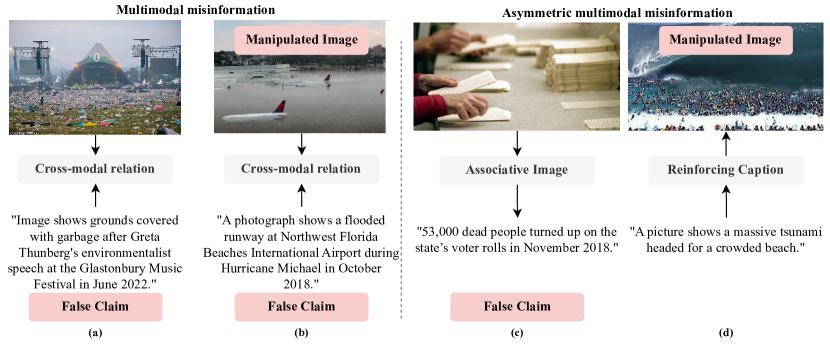
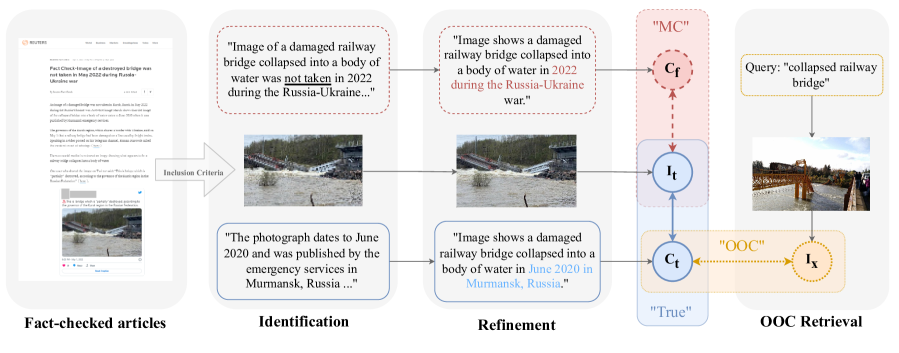
- VERITE is constructed using real-world image-caption pairs, excluding asymmetric multimodal misinformation where one modality dominates.
- Modality balancing ensures each image and caption appear twice—once in a truthful pair and once in a misleading pair—forcing models to consider both modalities.
- CHASMA generates synthetic training data by leveraging a pre-trained crossmodal alignment model to produce hard, realistic misalignments between legitimate images and false human-written captions.
- The method uses a large pre-trained model to ensure that generated false captions are semantically plausible and retain crossmodal coherence with their images.
- Models are trained using a combination of real data and CHASMA-generated synthetic data, with ablation studies comparing performance across different data combinations.
- A Transformer-based architecture is used for evaluation, with performance measured on VERITE using multiclass accuracy and bias analysis.
Experimental results
Research questions
- RQ1To what extent do existing MMD benchmarks like VMU-Twitter and COSMOS exhibit unimodal bias, and how does this affect model evaluation?
- RQ2Can a modality-balanced evaluation benchmark like VERITE effectively prevent unimodal models from outperforming multimodal models?
- RQ3How effective is CHASMA in generating synthetic training data that improves multimodal detection performance while preserving realistic crossmodal relations?
- RQ4Does the inclusion of CHASMA-generated data reduce unimodal bias in trained models, especially on real-world benchmarks like VERITE?
Key findings
- VERITE achieves a multiclass accuracy of 52.1% when training with CHASMA-generated data, representing a 9.2% improvement over the baseline CLIP-NESt + NC-t2t model.
- Models trained with CHASMA consistently outperform those without, with CHASMA + NC-t2t achieving 48.7% accuracy, compared to 47.7% for CLIP-NESt + NC-t2t.
- The text-side unimodal bias observed in models trained on CHASMA was absent on VERITE, indicating that VERITE successfully mitigates such biases during evaluation.
- Modality balancing in VERITE effectively prevents models from relying on a single modality, as each image and caption appear in both truthful and misleading contexts.
- The performance gain from CHASMA is consistent across different model variants, including both $D(I,C)$ and $D^{-}(I;C)$, confirming its robustness.
- VERITE is shown to be a reliable benchmark, as it prevents unimodal models from outperforming multimodal ones, unlike previous benchmarks such as COSMOS and VMU-Twitter.
Better researchstarts right now
From reading papers to final review, dramatically reduce your research time.
No credit card · Free plan available
This review was created by AI and reviewed by human editors.