
[Paper Review] Vibrational Entropy and Free Energy of Solid Lithium using Covariance of Atomic Displacements Enabled by Machine Learning
This paper presents a machine learning interatomic potential (MLIP)-based approach using the Covariance of Atomic Displacements (CAD) to accurately compute vibrational entropy and free energy in solid lithium. It demonstrates that the MLIP-CAD method reproduces experimental phonon dispersions, entropy, and the martensitic transition with high accuracy, offering a scalable and efficient alternative to traditional ab-initio methods for finite-temperature properties.
Vibrational properties of solids are key to determining stability, response and functionality. However, they are challenging to computationally predict at Ab-Initio accuracy, even for elemental systems. Ab-Initio methods for modeling atomic interactions are limited in the system sizes and simulation times that can be achieved. Due to these limitations, Machine Learning Interatomic Potentials (MLIPs) are gaining popularity and success as a faster, more scalable approach for modeling atomic interactions, potentially at Ab-Initio accuracy. Even with faster potentials, methodologies for predicting entropy, free energy and vibrational properties vary in accuracy, cost and difficulty to implement. Using the Covariance of Atomic Displacements (CAD) to predict entropy, free energy and finite-temperature phonon dispersions is a promising approach but thorough benchmarking has been hampered by the cost of Ab-Initio methods for sampling. In this work, we use a MLIP and the CAD to characterize the convergence of the predicted properties and determine optimal sampling strategies. We focus on solid lithium at zero pressure, showing that the MLIP-CAD approach reproduces experimental entropy, phonon dispersions and the martensitic transition while also comparing to more established methods.
Motivation & Objective
- To develop a scalable and accurate method for computing vibrational free energy and entropy in solids using machine learning potentials.
- To benchmark the Covariance of Atomic Displacements (CAD) method for finite-temperature properties in a challenging elemental system—lithium—where experimental data is available.
- To identify optimal sampling strategies for CAD-based entropy and free energy calculations using a high-accuracy MLIP.
- To validate the MLIP-CAD approach against experimental data, DFT, and established methods like Quasiharmonic Approximation and Thermodynamic Integration.
- To demonstrate the feasibility and accuracy of MLIP-CAD for predicting phase stability and structural transitions, such as the martensitic transition in lithium.
Proposed method
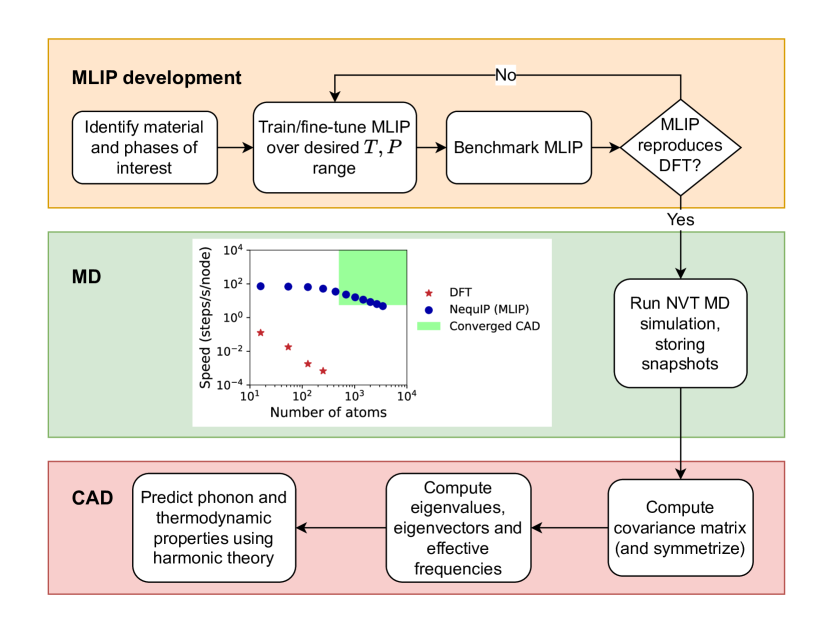
- The study employs a NequIP-based machine learning interatomic potential (MLIP) trained on ab-initio data to model atomic interactions in solid lithium with high accuracy and efficiency.
- The Covariance of Atomic Displacements (CAD) method is used to compute vibrational entropy and free energy from atomic displacement correlations in NPT and NVT molecular dynamics simulations.
- Simulations use 20,000 timesteps with a 2 fs timestep in LAMMPS, employing Nosé-Hoover thermostats and barostats for NVT and NPT ensembles.
- The method computes the Helmholtz free energy via the configurational integral of atomic displacements, with the vibrational contribution derived from the covariance matrix of atomic displacements.
- The Gibbs free energy is computed as $ G = U(V) + F_{vib}(V,T) + F_{el}(T) $, where $ F_{vib} $ is obtained from CAD, and the minimum $ G $ determines the most stable phase.
- The approach is validated against experimental data, DFT, and established methods like Quasiharmonic Approximation and Thermodynamic Integration.
Experimental results
Research questions
- RQ1Can the CAD method with a trained MLIP accurately reproduce the vibrational entropy and free energy of solid lithium at finite temperatures?
- RQ2How does the MLIP-CAD approach compare to established methods such as Quasiharmonic Approximation and Thermodynamic Integration in predicting phonon dispersions and phase stability?
- RQ3What is the optimal sampling strategy (e.g., simulation length, ensemble type) for achieving converged CAD-based free energy and entropy in lithium?
- RQ4Does the MLIP-CAD method correctly predict the martensitic transition in lithium, as observed experimentally?
- RQ5To what extent does the CAD method maintain accuracy and efficiency compared to ab-initio methods for computing finite-temperature properties in elemental solids?
Key findings
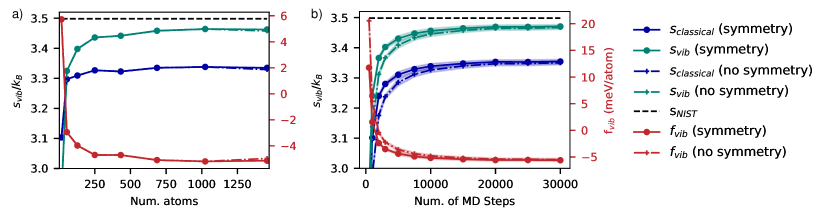
- The MLIP-CAD method reproduces experimental vibrational entropy of solid lithium with high accuracy, validating its predictive capability.
- The method accurately predicts the phonon dispersion relations of lithium, showing good agreement with experimental measurements.
- The MLIP-CAD approach successfully captures the martensitic transition in lithium, which is a key structural transformation at finite temperature.
- The CAD method achieves convergence in free energy and entropy with 20,000 timesteps in NPT simulations, indicating efficient sampling with the MLIP.
- The MLIP-CAD results are in strong agreement with those from Thermodynamic Integration and Quasiharmonic Approximation, confirming its reliability.
- The study demonstrates that MLIPs combined with CAD provide a scalable, accurate, and efficient alternative to ab-initio methods for computing finite-temperature properties in solids.
Better researchstarts right now
From reading papers to final review, dramatically reduce your research time.
No credit card · Free plan available
This review was created by AI and reviewed by human editors.