
[Paper Review] Vista-LLaMA: Reducing Hallucination in Video Language Models via Equal Distance to Visual Tokens
Vista-LLaMA proposes a novel video-language model that reduces hallucination by maintaining equal distance between all visual tokens and language tokens during attention computation, ensuring consistent visual influence regardless of text length. It introduces an equal-distance-to-visual-tokens (EDVT) attention mechanism and a sequential visual projector for improved temporal modeling, achieving state-of-the-art performance with 60.7 zero-shot accuracy on NExT-QA and 60.5 on MSRVTT-QA.
Recent advances in large video-language models have displayed promising outcomes in video comprehension. Current approaches straightforwardly convert video into language tokens and employ large language models for multi-modal tasks. However, this method often leads to the generation of irrelevant content, commonly known as "hallucination", as the length of the text increases and the impact of the video diminishes. To address this problem, we propose Vista-LLaMA, a novel framework that maintains the consistent distance between all visual tokens and any language tokens, irrespective of the generated text length. Vista-LLaMA omits relative position encoding when determining attention weights between visual and text tokens, retaining the position encoding for text and text tokens. This amplifies the effect of visual tokens on text generation, especially when the relative distance is longer between visual and text tokens. The proposed attention mechanism significantly reduces the chance of producing irrelevant text related to the video content. Furthermore, we present a sequential visual projector that projects the current video frame into tokens of language space with the assistance of the previous frame. This approach not only captures the temporal relationship within the video, but also allows less visual tokens to encompass the entire video. Our approach significantly outperforms various previous methods (e.g., Video-ChatGPT, MovieChat) on four challenging open-ended video question answering benchmarks. We reach an accuracy of 60.7 on the zero-shot NExT-QA and 60.5 on the zero-shot MSRVTT-QA, setting a new state-of-the-art performance. This project is available at https://jinxxian.github.io/Vista-LLaMA.
Motivation & Objective
- Address the problem of hallucination in video-language models, where generated text becomes increasingly detached from video content as text length grows.
- Mitigate the diminishing visual influence on text generation in long-context video-LMs by ensuring consistent attention distance between visual and language tokens.
- Improve temporal modeling in video understanding by capturing frame-to-frame relationships through a sequential visual projector.
- Achieve state-of-the-art performance on zero-shot open-ended video question-answering benchmarks without requiring fine-tuning.
Proposed method
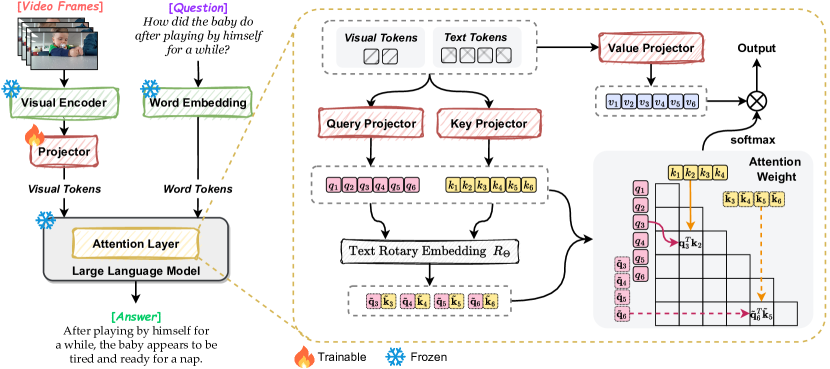
- Introduce an equal-distance-to-visual-tokens (EDVT) attention mechanism that omits rotary position embeddings when computing attention between visual and language tokens, preserving equal effective distance.
- Retain rotary position embeddings only for language-to-language attention to preserve relative token order and context within the text sequence.
- Design a sequential visual projector that generates visual tokens for each frame conditioned on the previous frame’s projected representation, enabling temporal modeling without extra parameters.
- Project video frames into the language space using a trainable visual projector, with initialization from pre-trained models like BLIP-2 to improve visual representation learning.
- Use a single-stream transformer architecture where visual tokens and language tokens coexist in the same sequence, with EDVT attention ensuring visual tokens consistently influence generation.
- Sample video frames at regular intervals and project them into visual tokens, reducing the number of visual tokens needed to represent long videos while preserving temporal dynamics.
![Figure 1 : Video language processing with LLaMA [ 24 ] and our Vista-LLaMA . The vanilla LLaMA treats visual tokens ( ) the same as other language tokens ( ), weakening the impact for tokens in long distance. Our model retains the same mechanism for language tokens and strengthens the impact of the](https://ar5iv.labs.arxiv.org/html/2312.08870/assets/x1.png)
Experimental results
Research questions
- RQ1Can maintaining equal attention distance between visual tokens and all language tokens reduce hallucination in long-context video-language generation?
- RQ2How does the absence of relative position encoding between visual and language tokens affect the model’s ability to attend to visual content across long sequences?
- RQ3To what extent does a sequential visual projector improve temporal reasoning in video-language models compared to independent frame projection?
- RQ4Can the proposed EDVT attention and sequential projector design achieve state-of-the-art performance on zero-shot video question-answering benchmarks?
- RQ5Does the model’s performance generalize across different types of video questions, particularly temporal, descriptive, and causal reasoning tasks?
Key findings
- Vista-LLaMA achieves a new state-of-the-art zero-shot accuracy of 60.7 on the NExT-QA benchmark, significantly outperforming prior methods like Video-ChatGPT and MovieChat.
- On the MSRVTT-QA benchmark, Vista-LLaMA achieves 60.5 zero-shot accuracy, demonstrating strong generalization to open-ended video question answering.
- The sequential visual projector (SeqQ-Former) outperforms both linear and standard Q-Former visual projectors, especially on temporal reasoning questions, indicating improved modeling of video dynamics.
- The model reduces hallucination in text generation: in qualitative comparisons, it correctly identifies object positions and actions (e.g., phone orientation, person posture) where Video-ChatGPT fails.
- Increasing the number of visual tokens improves overall accuracy but harms performance on temporal questions, suggesting that current models struggle with temporal reasoning even with more visual input.
- The EDVT attention mechanism effectively maintains visual influence on text generation, even for distant tokens, reducing the risk of irrelevant or hallucinated content.
Better researchstarts right now
From reading papers to final review, dramatically reduce your research time.
No credit card · Free plan available
This review was created by AI and reviewed by human editors.