
[Paper Review] Warm inflation with bulk viscous pressure for different solutions of an anisotropic universe
This paper investigates warm inflation in anisotropic Bianchi I spacetime with bulk viscous pressure, analyzing different expansion models (intermediate, logamediate, exponential) under constant and variable dissipative parameters. It finds observational consistency with Planck and BK14 data for specific ranges of the anisotropy parameter $m$, particularly $1 \leq m \leq 3.5$ in the variable $\Gamma$, $\xi$ case, and shows non-Gaussianity parameters $f_{NL}$ approach zero for $N>20$, while swampland constraints remain narrow.
We study a warm inflationary model for different expansions assuming an anisotropic universe described by Bianchi I metric. The universe is filled with a scalar field or inflaton, radiation, and bulk viscous pressure. We carry out the inflationary analysis for different solutions of such universe in two different cases of the bulk viscosity coefficient $ξ$ and the dissipation coefficient $Γ$ as constant and variable parameters, respectively. We compare the obtained results with the recent observations, in order to find the observational constraints on the parameters space of the models. Moreover, we attempt to present a better judgment among the considered models by calculation of the non-linear parameter $f_{NL}$ describing the non-Gaussianity property of the models. Additionally, we investigate the warm inflationary models with viscous pressure from the Weak Gravity Conjecture approach, considering the swampland criteria.
Motivation & Objective
- To explore warm inflation in anisotropic Bianchi I spacetime with bulk viscous pressure, extending beyond standard isotropic models.
- To assess the viability of different exact inflationary solutions (intermediate, logamediate, exponential) under warm inflation with viscous effects.
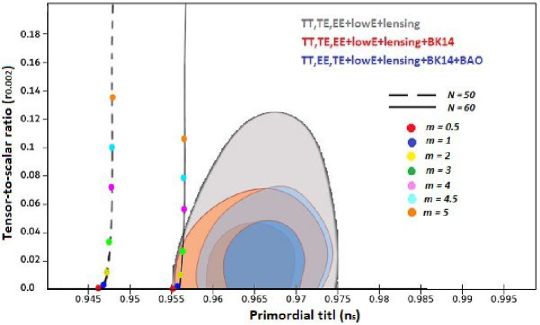
- To constrain model parameters using recent CMB data (Planck, BK14) and evaluate consistency with observational bounds on $n_s$ and $r$.
- To analyze non-Gaussianity via $f_{NL}$ in different dissipative regimes and assess model discrimination.
- To test compatibility with swampland criteria, particularly the Weak Gravity Conjecture, by evaluating $c$ and $c'$ parameters.
Proposed method
- Modeling the anisotropic universe via the Bianchi I metric with scalar field, radiation, and bulk viscous pressure.
- Analyzing inflation using two cases: constant and variable bulk viscosity coefficient $\xi$ and dissipation coefficient $\Gamma$.
- Applying the slow-roll approximation and Hamilton-Jacobi formalism to derive background dynamics and scalar field evolution.
- Reconstructing the effective potential $V(\varphi)$ for specific models (e.g., exponential case) and deriving $\varphi(t)$ in terms of special functions.
- Computing cosmological observables: spectral index $n_s$, tensor-to-scalar ratio $r$, and non-Gaussianity parameter $f_{NL}$ from perturbation spectra.
- Applying observational constraints from Planck 2018, BK14, and combined datasets to determine allowed parameter ranges for $m$.
Experimental results
Research questions
- RQ1Which inflationary expansion models (intermediate, logamediate, exponential) remain observationally viable under warm inflation with bulk viscous pressure in an anisotropic Bianchi I universe?
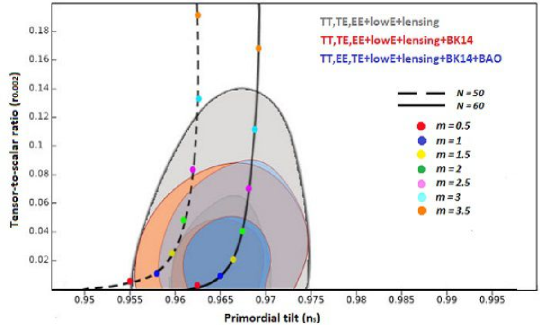
- RQ2How do the observational constraints on the anisotropy parameter $m$ vary across different data combinations (Planck, BK14, full CMB datasets) and $e$-fold numbers $N=50$ and $N=60$?
- RQ3What is the behavior of the non-Gaussianity parameter $f_{NL}$ in strong and weak dissipative regimes, and how does it depend on $m$ and $N$?
- RQ4How do the swampland criteria parameters $c$ and $c'$ constrain the models, and what does this imply for the theoretical viability of the proposed inflationary scenarios?
- RQ5How does the inclusion of bulk viscous pressure affect the reconstruction of the effective potential $V(\varphi)$ and scalar field evolution $\varphi(t)$ in different models?
Key findings
- For the logamediate model with constant $\Gamma$ and $\xi$, observational constraints from Planck alone yield $1.5 \leq m < 5$ at 68% CL for $N=50$, tightening to $1.5 \leq m \leq 3$ at 95% CL.
- In the variable $\Gamma$ and $\xi$ case for the logamediate model, $1 < m < 4$ is favored at 68% CL for $N=60$ from full CMB data, with $2 \leq m \leq 3.5$ at 95% CL.
- For the exponential model with variable $\Gamma$ and $\xi$, $0.5 < m < 2$ is consistent with Planck + BK14 at 68% CL for $N=60$, and $f_{NL} \sim 0$ in the strong dissipation regime.
- The non-Gaussianity parameter $f_{NL}$ approaches zero for $N > 20$ in all models, indicating negligible non-Gaussianity at late inflationary stages.
- Swampland parameters $c$ and $c'$ show a very narrow range for $c$ and large values for $c'$, suggesting strong theoretical constraints on model viability.
- The intermediate model with variable $\Gamma$ and $\xi$ shows $1 < m < 2.5$ at 68% CL for $N=50$ from full data, with $f_{NL}$ emerging only for $m \geq 0.5$ in strong dissipation.
Better researchstarts right now
From reading papers to final review, dramatically reduce your research time.
No credit card · Free plan available
This review was created by AI and reviewed by human editors.