
[Paper Review] Wave function network description and Kolmogorov complexity of quantum many-body systems
The paper introduces wave function networks to describe quantum many-body snapshots, uses them to estimate Kolmogorov complexity, and demonstrates scale-free networks and cross-platform certification in Rydberg quantum simulators.
Programmable quantum devices are now able to probe wave functions at unprecedented levels. This is based on the ability to project the many-body state of atom and qubit arrays onto a measurement basis which produces snapshots of the system wave function. Extracting and processing information from such observations remains, however, an open quest. One often resorts to analyzing low-order correlation functions - i.e., discarding most of the available information content. Here, we introduce wave function networks - a mathematical framework to describe wave function snapshots based on network theory. For many-body systems, these networks can become scale free - a mathematical structure that has found tremendous success in a broad set of fields, ranging from biology to epidemics to internet science. We demonstrate the potential of applying these techniques to quantum science by introducing protocols to extract the Kolmogorov complexity corresponding to the output of a quantum simulator, and implementing tools for fully scalable cross-platform certification based on similarity tests between networks. We demonstrate the emergence of scale-free networks analyzing data from Rydberg quantum simulators manipulating up to 100 atoms. We illustrate how, upon crossing a phase transition, the system complexity decreases while correlation length increases - a direct signature of build up of universal behavior in data space. Comparing experiments with numerical simulations, we achieve cross-certification at the wave-function level up to timescales of 4 $μ$ s with a confidence level of 90%, and determine experimental calibration intervals with unprecedented accuracy. Our framework is generically applicable to the output of quantum computers and simulators with in situ access to the system wave function, and requires probing accuracy and repetition rates accessible to most currently available platforms.
Motivation & Objective
- Motivate a structured, information-rich description of many-body wave-function snapshots beyond low-order correlations.
- Develop a network representation (wave function networks) for spin, bosonic, and fermionic systems that retains full information content.
- Show that the resulting networks can be scale-free and use this structure to extract Kolmogorov complexity.
- Demonstrate cross-platform certification of quantum simulators using network-based similarity tests.
Proposed method
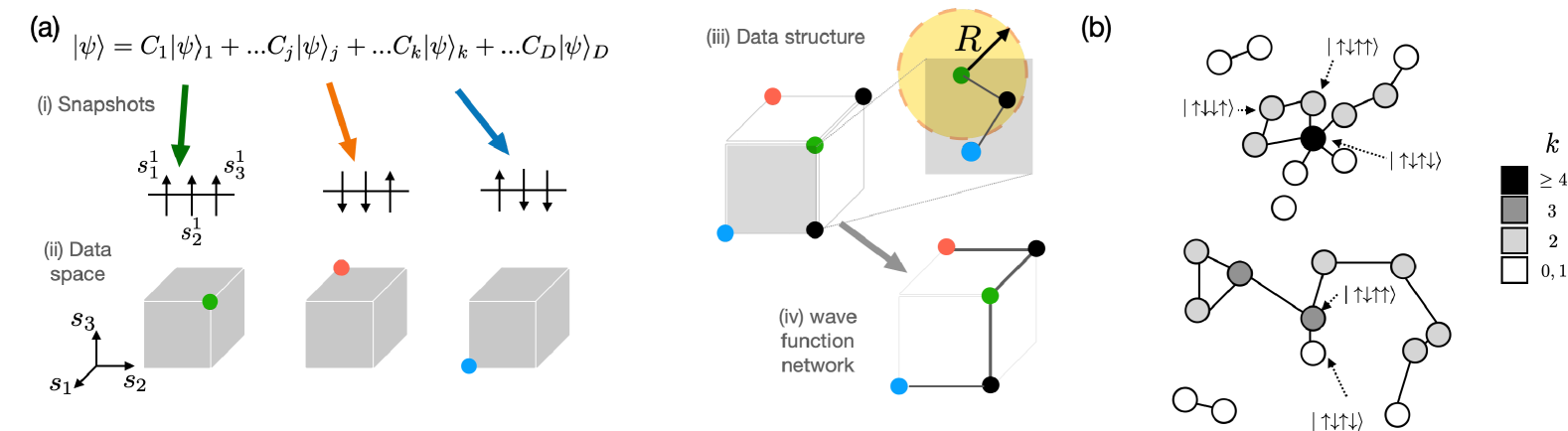
- Map collections of wave-function snapshots to a network where each snapshot is a node and links are drawn if the Hamming distance between configurations is less than a cutoff R.
- Define the cutoff R as the average nearest-neighbor distance to stabilize network sparsity.
- Use the Hamming distance to capture both short- and long-range correlations in configurations.
- Estimate Kolmogorov complexity of wave-function snapshots via the 2-NN (two-nearest-neighbor) intrinsic-dimension method.
- Apply the Epps-Singleton test to compare networks across platforms and identify time scales where cross-verification holds.
Experimental results
Research questions
- RQ1Can wave-function snapshots be faithfully represented by networks that reveal underlying correlations and critical behavior?
- RQ2Do wave-function networks exhibit scale-free properties near quantum phase transitions, and how do these properties relate to real-space correlations?
- RQ3Can network-based Kolmogorov complexity quantify information content and its evolution in quantum simulators?
- RQ4How effective is network-based cross-platform certification in identifying systematic discrepancies across experimental and numerical data?
Key findings
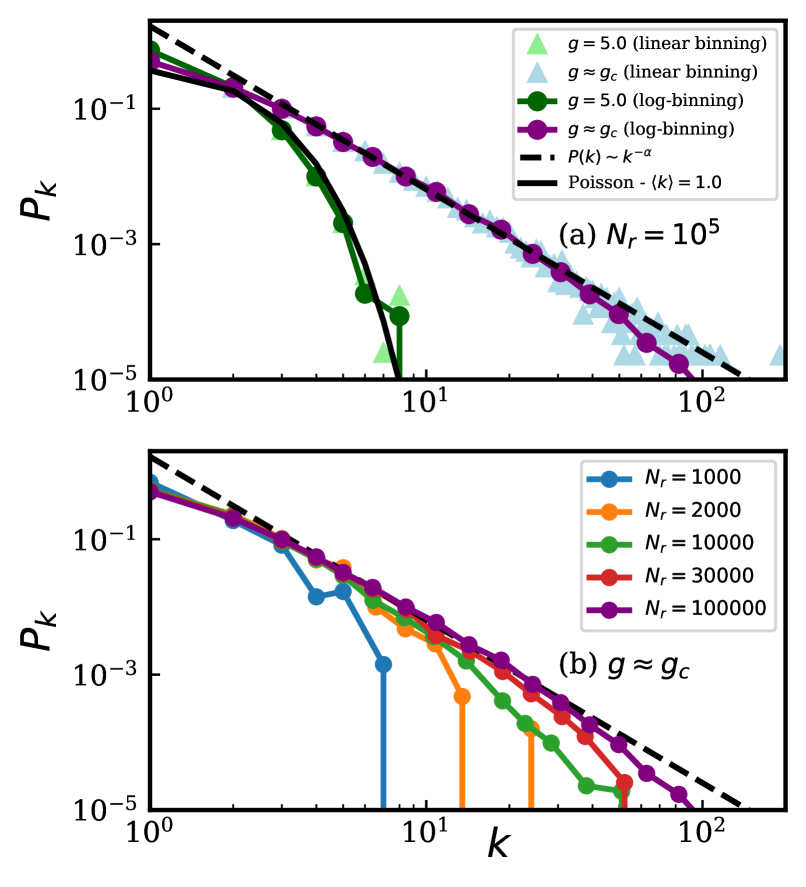
- Wave-function networks can become scale-free near correlated regimes, while Paramagnetic (ER-like) regimes resemble Erdos-Renyi networks.
- In the 2D quantum Ising model, the degree distribution Pk is Poisson in the paramagnetic phase and follows a power law with exponent α ≈ 2.4 near the critical point.
- Experiments with a Rydberg quantum simulator show Pk evolving from exponential decay at short times to a robust power-law tail (α < 2) at later times.
- Including ~3% defects in the array does not destroy the scale-free structure, indicating robustness of the network signature.
- Cross-platform verification using network-based tests can certify wave-function-level behavior up to about 4 μs with ~90% confidence.
- Kolmogorov complexity of wave-function snapshots can be estimated via the 2-NN intrinsic-dimension approach, revealing emergent simplicity as universal behavior builds up.
Better researchstarts right now
From paper design to paper writing, dramatically reduce your research time.
No credit card · Free plan available
This review was created by AI and reviewed by human editors.