
[Paper Review] Wavelength-accurate and wafer-scale process for nonlinear frequency mixers in thin-film lithium niobate
This paper presents an etch-before-pole fabrication process for thin-film lithium niobate (TFLN) nonlinear frequency mixers that improves wavelength accuracy by enabling pre- and post-etch metrology to calibrate waveguide geometry. Using this method, 73% of second harmonic generation devices achieved target wavelengths within ±5 nm, with thermo-optic tuning bringing ~96% into specification, enabling scalable integration of high-precision TFLN photonic circuits.
Recent advancements in thin-film lithium niobate (TFLN) photonics have led to a new generation of high-performance electro-optic devices, including modulators, frequency combs, and microwave-to-optical transducers. However, the broader adoption of TFLN-based devices that rely on all-optical nonlinearities have been limited by the sensitivity of quasi-phase matching (QPM), realized via ferroelectric poling, to fabrication tolerances. Here, we propose a scalable fabrication process aimed at improving the wavelength-accuracy of optical frequency mixers in TFLN. In contrast to the conventional pole-before-etch approach, we first define the waveguide in TFLN and then perform ferroelectric poling. This sequence allows for precise metrology before and after waveguide definition to fully capture the geometry imperfections. Systematic errors can also be calibrated by measuring a subset of devices to fine-tune the QPM design for remaining devices on the wafer. Using this method, we fabricated a large number of second harmonic generation devices aimed at generating 737 nm light, with 73% operating within 5 nm of the target wavelength. Furthermore, we also demonstrate thermo-optic tuning and trimming of the devices via cladding deposition, with the former bringing ~96% of tested devices to the target wavelength. Our technique enables the rapid growth of integrated quantum frequency converters, photon pair sources, and optical parametric amplifiers, thus facilitating the integration of TFLN-based nonlinear frequency mixers into more complex and functional photonic systems.
Motivation & Objective
- To address the challenge of wavelength inaccuracy in TFLN-based nonlinear frequency mixers due to fabrication-induced geometry variations.
- To enable wafer-scale, high-precision fabrication of quasi-phase-matched (QPM) devices by decoupling poling from etching.
- To reduce reliance on trial-and-error design by introducing systematic error calibration using metrology of waveguide geometry.
- To demonstrate scalable wavelength tuning and trimming for integration into complex photonic circuits.
- To enable high-yield, wavelength-accurate devices for applications like quantum frequency conversion and photon pair sources.
Proposed method
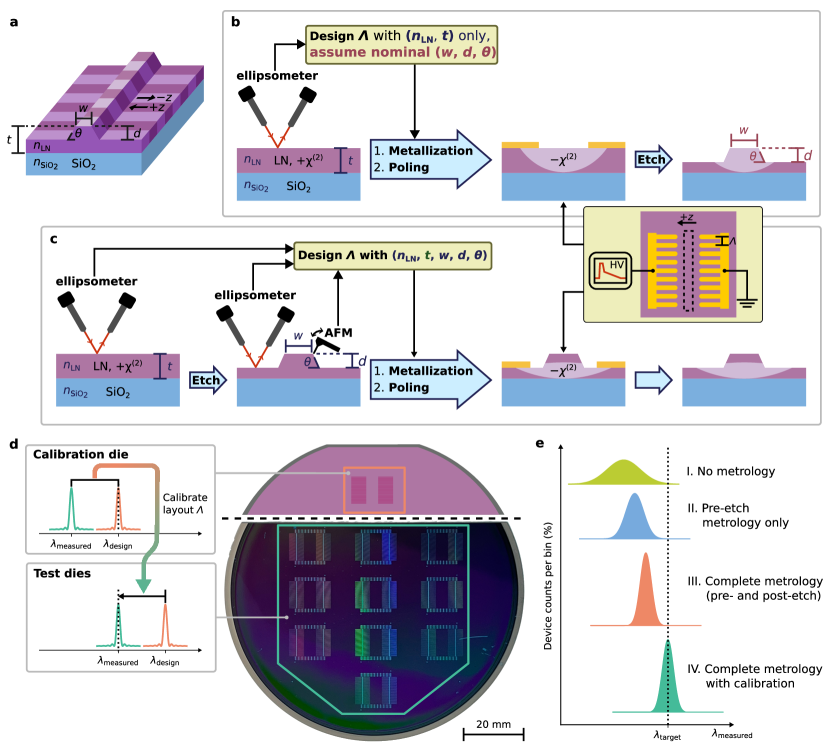
- The method reverses the conventional pole-before-etch sequence by first defining waveguides via dry-etching before ferroelectric poling.
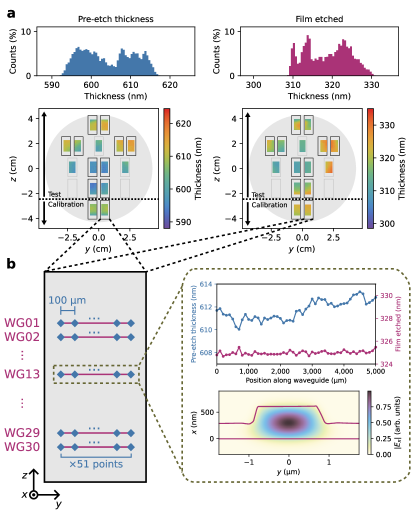
- Pre- and post-etch film thickness and waveguide geometry are measured using atomic force microscopy (AFM) at multiple points across the wafer.
- A locally varying QPM grating period is calculated based on measured waveguide cross-sections to compensate for geometry imperfections.
- Systematic errors are calibrated by measuring a subset of devices to adjust QPM design parameters for the remaining devices on the wafer.
- Thermo-optic tuning is applied via off-chip ceramic heaters to shift operating wavelengths across a 120 °C range.
- Cladding deposition of SiO₂ is used for wavelength trimming, with the blue-shift rate decreasing at higher thicknesses.
Experimental results
Research questions
- RQ1Can a wafer-scale fabrication process improve wavelength accuracy in TFLN nonlinear frequency mixers by decoupling poling from etching?
- RQ2To what extent can pre- and post-etch metrology reduce wavelength deviation in QPM devices?
- RQ3Can systematic error calibration based on measured device geometry improve yield and accuracy across a wafer?
- RQ4How effective is thermo-optic tuning in correcting residual wavelength errors in high-precision TFLN devices?
- RQ5Can cladding deposition provide a scalable, low-loss method for fine-tuning the operating wavelength of nonlinear mixers?
Key findings
- 73% of second harmonic generation devices achieved an operating wavelength within ±5 nm of the target 737 nm after systematic calibration.
- Thermo-optic tuning shifted the operating wavelength by up to 12.1 nm, bringing approximately 96% of tested devices into the target wavelength range.
- Cladding deposition of SiO₂ induced a blue-shift of over 100 nm in the operating wavelength, with the tuning rate decreasing at higher thicknesses.
- The etch-before-pole process enabled precise calibration of QPM grating periods using local waveguide geometry measurements, reducing wavelength spread compared to conventional methods.
- The method achieved a high yield of wavelength-accurate devices across two wafer runs, with 600 and 300 non-calibration devices fabricated, respectively.
- Spectra broadening at high cladding thicknesses indicated increasing group velocity mismatch, but this had minimal impact for typical trimming ranges (<50 nm).
Better researchstarts right now
From reading papers to final review, dramatically reduce your research time.
No credit card · Free plan available
This review was created by AI and reviewed by human editors.