
[Paper Review] Weak Crystallization of Fluctuating Skyrmion Textures in MnSi
This study demonstrates that non-trivial topological skyrmion textures with lifetimes exceeding 10 ns and spatial scales above 1000 Å preexist in the paramagnetic phase of MnSi prior to the skyrmion lattice transition. Using multimodal neutron and microwave spectroscopy, the authors establish that the transition follows a Landau soft-mode mechanism of weak crystallization, where triangular modulation vectors of fluctuating magnetization fields already encode the topological winding characteristic of the long-range-ordered skyrmion lattice.
We report an experimental study of the emergence of nontrivial topological winding and long-range order across the paramagnetic-to-skyrmion lattice transition in the transition metal helimagnet MnSi. Combining measurements of the susceptibility with small-angle neutron scattering, neutron-resonance spin-echo spectroscopy, and all-electrical microwave spectroscopy, we find evidence of skyrmion textures in the paramagnetic state exceeding 10³ Å, with lifetimes above several 10⁻⁹s. Our experimental findings establish that the paramagnetic-to-skyrmion lattice transition in MnSi is well described by the Landau softmode mechanism of weak crystallization, originally proposed in the context of the liquid-to-crystal transition. As a key aspect of this theoretical model, the modulation vectors of periodic small-amplitude components of the magnetization form triangles that add to zero. In excellent agreement with our experimental findings, these triangles of the modulation vectors entail the presence of the nontrivial topological winding of skyrmions already in the paramagnetic state of MnSi when approaching the skyrmion lattice transition.
Motivation & Objective
- To investigate the emergence of topological skyrmion order in MnSi across the paramagnetic to skyrmion lattice transition.
- To determine whether non-trivial topological winding and long-range order develop simultaneously or if skyrmion-like textures preexist in the paramagnetic state.
- To test whether the transition is governed by a weak crystallization mechanism akin to the liquid-to-crystal transition, as proposed by Landau and Brazovski.
- To identify the role of fluctuating multi-{ρ}Q modes in encoding topological signatures before long-range order sets in.
Proposed method
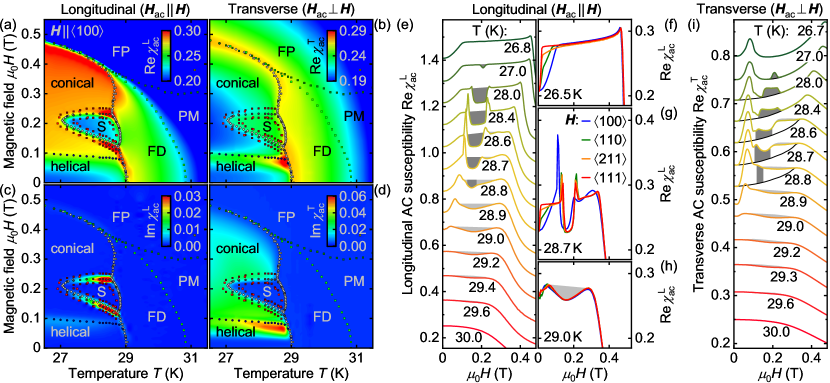
- Combines ac susceptibility measurements to probe dynamic response near the transition.
- Employs small-angle neutron scattering (SANS) to detect fluctuating textures with characteristic length scales exceeding 1000 Å.
- Uses neutron resonance spin echo spectroscopy to measure relaxation times of fluctuating magnetization components, yielding lifetimes above 10 ns.
- Applies all-electrical microwave spectroscopy to detect collective modes and dynamic correlations in the paramagnetic phase.
- Analyzes the free energy functional using the Landau weak crystallization framework, focusing on cubic terms in Fourier components of magnetization: ∑_{q1+q2+q3=0} (m_{q1}⋅m_{q2})(m_{q3}⋅m_{q1})δ_{q1+q2+q3,0}.
- Compares the observed fluctuation dynamics to the Brazovski scenario of fluctuation-induced first-order transitions and tricritical behavior at ~0.4 T.
Experimental results
Research questions
- RQ1Do topologically non-trivial skyrmion textures exist in the paramagnetic phase of MnSi prior to long-range skyrmion lattice order?
- RQ2Is the paramagnetic to skyrmion lattice transition governed by a weak crystallization mechanism, as described by Landau's soft-mode theory?
- RQ3Do fluctuating multi-{ρ}Q modes in the paramagnetic state already carry the topological winding characteristic of the skyrmion lattice?
- RQ4Can the emergence of skyrmion lattice order be understood as a fluctuation-driven transition with a tricritical point at intermediate magnetic fields?
Key findings
- Fluctuating skyrmion textures with spatial scales exceeding 1000 Å are observed in the paramagnetic phase of MnSi, indicating preformed topological order.
- These textures exhibit lifetimes above 10 ns, demonstrating long-lived dynamic correlations in the paramagnetic state.
- The paramagnetic to skyrmion lattice transition is well-described by the Landau soft-mode mechanism of weak crystallization, with triangular modulation vectors of the magnetization forming closed triangles in momentum space.
- The presence of such triangular wavevector configurations in the paramagnetic phase directly entails the non-trivial topological winding characteristic of the skyrmion lattice, even before long-range order emerges.
- The transition exhibits a tricritical point near 0.4 T, where the transition becomes second-order, consistent with the Brazovski scenario of fluctuation-induced first-order transitions.
- The experimental findings confirm that the key topological signatures of the skyrmion lattice are encoded in the fluctuating modes of the paramagnetic state, supporting a unified description of skyrmion formation via weak crystallization.
![Figure 2: Small-angle neutron scattering in an applied magnetic field parallel [ (a)–(c) ] and perpendicular [ (d)–(f) ] to the neutron beam. (a),(d) Typical SANS patterns for temperatures within the skyrmion lattice state, just above $T_{c}$ , and well above $T_{c}$ (from left to right). (b),(e) Te](https://ar5iv.labs.arxiv.org/html/1911.05095/assets/figure2-v3.png)
Better researchstarts right now
From reading papers to final review, dramatically reduce your research time.
No credit card · Free plan available
This review was created by AI and reviewed by human editors.