
[Paper Review] Weakly supervised segmentation of intracranial aneurysms using a novel 3D focal modulation UNet
Introduces FocalSegNet, a 3D focal modulation UNet for weakly supervised UIA segmentation on TOF-MRA, with CRF post-processing outperforming baseline UNet variants.
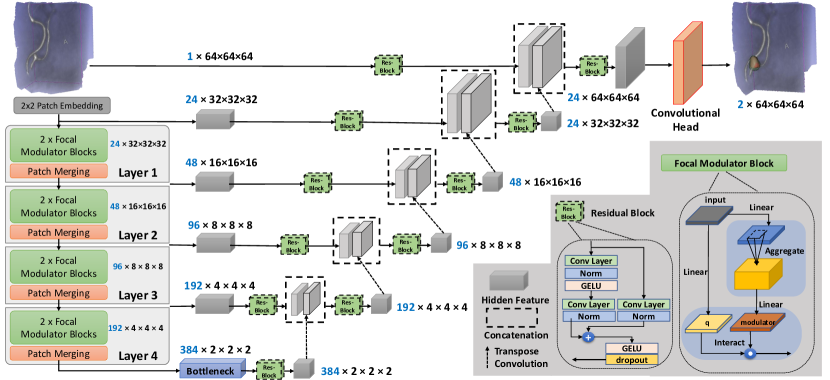
Accurate identification and quantification of unruptured intracranial aneurysms (UIAs) is crucial for the risk assessment and treatment of this cerebrovascular disorder. Current 2D manual assessment on 3D magnetic resonance angiography (MRA) is suboptimal and time-consuming. In addition, one major issue in medical image segmentation is the need for large well-annotated data, which can be expensive to obtain. Techniques that mitigate this requirement, such as weakly supervised learning with coarse labels are highly desirable. In the paper, we propose FocalSegNet, a novel 3D focal modulation UNet, to detect an aneurysm and offer an initial, coarse segmentation of it from time-of-flight MRA image patches, which is further refined with a dense conditional random field (CRF) post-processing layer to produce a final segmentation map. We trained and evaluated our model on a public dataset, and in terms of UIA detection, our model showed a low false-positive rate of 0.21 and a high sensitivity of 0.80. For voxel-wise aneurysm segmentation, we achieved a Dice score of 0.68 and a 95% Hausdorff distance of ~0.95 mm, demonstrating its strong performance. We evaluated our algorithms against the state-of-the-art 3D Residual-UNet and Swin-UNETR, and illustrated the superior performance of our proposed FocalSegNet, highlighting the advantages of employing focal modulation for this task.
Motivation & Objective
- Motivate accurate UIA segmentation from TOF-MRA under weak supervision due to limited finely annotated data.
- Propose a novel 3D focal modulation UNet (FocalSegNet) for weakly supervised segmentation.
- Investigate the effect of focal modulation versus self-attention in 3D UIA segmentation.
- Enhance segmentation with a fully connected CRF post-processing step.
- Provide ablation studies to identify key factors affecting UIA segmentation performance.
Proposed method
- Develop a 3D FocalSegNet by replacing the encoder in a Swin-UnetR-like UNet with 3D focal modulation blocks.
- Train on coarse UIA labels from TOF-MRA and use Dice/IoU-based losses with cross-entropy and boundary loss to address class imbalance.
- Apply a fully connected CRF as post-processing to refine initial predictions.
- Compare FocalSegNet against 3D UNet and Swin-UNETR baselines under weak labeling.
- Perform patch-wise segmentation with anatomically informed patch extraction and data augmentation to mitigate data sparsity.
Experimental results
Research questions
- RQ1Can a 3D focal modulation UNet improve weakly supervised segmentation of UIAs on TOF-MRA compared to self-attention-based models?
- RQ2What is the impact of CRF post-processing on segmentation accuracy and detection reliability for UIAs?
- RQ3How do loss function components (cross-entropy, generalized Dice, boundary loss) affect performance in highly unbalanced UIA segmentation?
- RQ4Does focal modulation offer advantages over traditional self-attention in the 3D medical imaging segmentation task?
Key findings
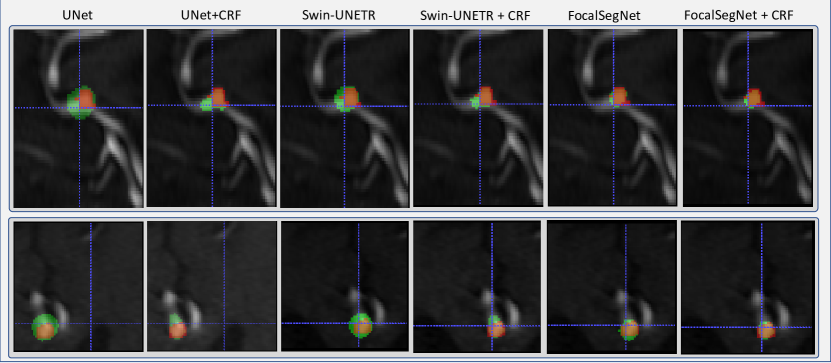
- FocalSegNet with CRF achieves Dice 0.678±0.141 and 95-HD 2.148±1.082 on UIA segmentation, outperforming UNet baselines.
- FocalSegNet shows lower false positive rate (0.212±0.464) and competitive sensitivity (0.801±0.399) compared to Swin-UNETR and UNet variants.
- Without CRF, FocalSegNet already provides strong performance, with CRF post-processing further boosting accuracy across models.
- Compared to Swin-UNETR, FocalSegNet yields comparable or better segmentation metrics and significantly lowers FP rate (p<0.05 in FP comparison).
- Ablation shows that CRF post-processing and a combination of CE, generalized Dice, and boundary loss are important for peak performance.
Better researchstarts right now
From paper design to paper writing, dramatically reduce your research time.
No credit card · Free plan available
This review was created by AI and reviewed by human editors.