
[Paper Review] WebFace260M: A Benchmark Unveiling the Power of Million-Scale Deep Face Recognition
This paper presents WebFace260M (4M identities, 260M faces) and its cleaned counterpart WebFace42M (2M identities, 42M faces) with CAST cleaning, plus FRUITS time-constrained evaluation to study million-scale face recognition and distributed training.
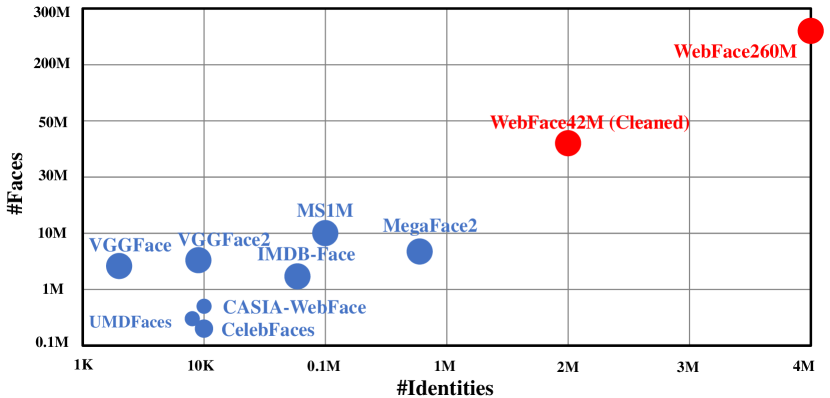
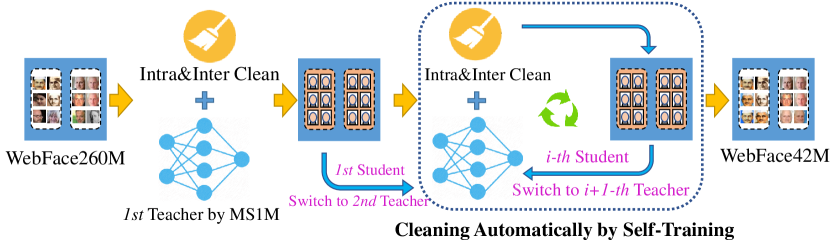
In this paper, we contribute a new million-scale face benchmark containing noisy 4M identities/260M faces (WebFace260M) and cleaned 2M identities/42M faces (WebFace42M) training data, as well as an elaborately designed time-constrained evaluation protocol. Firstly, we collect 4M name list and download 260M faces from the Internet. Then, a Cleaning Automatically utilizing Self-Training (CAST) pipeline is devised to purify the tremendous WebFace260M, which is efficient and scalable. To the best of our knowledge, the cleaned WebFace42M is the largest public face recognition training set and we expect to close the data gap between academia and industry. Referring to practical scenarios, Face Recognition Under Inference Time conStraint (FRUITS) protocol and a test set are constructed to comprehensively evaluate face matchers. Equipped with this benchmark, we delve into million-scale face recognition problems. A distributed framework is developed to train face recognition models efficiently without tampering with the performance. Empowered by WebFace42M, we reduce relative 40% failure rate on the challenging IJB-C set, and ranks the 3rd among 430 entries on NIST-FRVT. Even 10% data (WebFace4M) shows superior performance compared with public training set. Furthermore, comprehensive baselines are established on our rich-attribute test set under FRUITS-100ms/500ms/1000ms protocol, including MobileNet, EfficientNet, AttentionNet, ResNet, SENet, ResNeXt and RegNet families. Benchmark website is https://www.face-benchmark.org.
Motivation & Objective
- Address the data gap between academia and industry in face recognition by creating million-scale training data.
- Develop a scalable automatic cleaning pipeline (CAST) to produce high-quality training sets from noisy web data.
- Propose FRUITS, a time-constrained evaluation protocol, plus a rich test set to reflect real-world deployment scenarios.
- Demonstrate the benefits of million-scale training and distributed training for both large and lightweight backbones.
- Provide comprehensive baselines across architectures under the FRUITS protocol to guide future research.
Proposed method
- Collect a 4M celebrity name list and download 260M images from the web.
- Clean WebFace260M using the Cleaning Automatically via Self-Training (CAST) pipeline to obtain WebFace42M.
- Train models with a distributed framework to achieve near-linear acceleration on large data.
- Design FRUITS (Face Recognition Under Inference Time conStraint) with 100/500/1000 ms tracks and a rich attribute test set.
- Evaluate multiple backbones (e.g., ResNet-100, ResNet-14) and losses (CosFace, ArcFace, CurricularFace) on FRUITS and standard benchmarks.
Experimental results
Research questions
- RQ1How does training data scale (WebFace260M vs WebFace42M and subsets) impact recognition performance under time-constrained evaluation?
- RQ2How effective is CAST at cleaning enormous noisy web-scale data for high-quality face recognition training?
- RQ3What performance gains are achievable with million-scale training on both large and lightweight networks under FRUITS?
- RQ4Can distributed training close the data and compute gap between academia and industry for million-scale face recognition?
- RQ5How does WebFace42M perform on challenging benchmarks (IJB-C, NIST-FRVT) compared to public datasets?
Key findings
- WebFace42M achieves TAR@FAR=1e-4 of 97.70% on IJB-C under standard ResNet-100 configurations, reducing error rate by about 40% relative to public SOTA.
- Using WebFace4M (10% of WebFace42M) already yields superior performance compared with public training sets like MS1M families and MegaFace2.
- WebFace42M ranks 3rd among 430 entries on NIST-FRVT; this demonstrates competitiveness of million-scale data for timing-constrained benchmarks.
- WebFace42M provides the largest publicly available cleaned training set to date, enabling substantial improvements in both heavy-weight and light-weight models.
- Distributed training with mixed-precision and feature/center parallelization achieves near-linear speedups (e.g., up to 32 nodes) with minimal performance loss.
- Under FRUITS, a range of baselines across Lightweight to Heavyweight models reveal meaningful gaps and room for improvement, especially on FRUITS-100 (lightweight) and FRUITS-1000 (heavyweight) tracks.
Better researchstarts right now
From reading papers to final review, dramatically reduce your research time.
No credit card · Free plan available
This review was created by AI and reviewed by human editors.