
[Paper Review] Wellposedness, exponential ergodicity and numerical approximation of fully super-linear McKean--Vlasov SDEs and associated particle systems
This paper establishes wellposedness, propagation of chaos, and exponential ergodicity for a class of McKean--Vlasov SDEs with fully super-linear drift and diffusion coefficients depending on the law of the solution through convolution-type kernels. It introduces a split-step Euler scheme with strong convergence rate 1/2 and mean-square contraction, applicable even without differentiability or non-degeneracy assumptions.
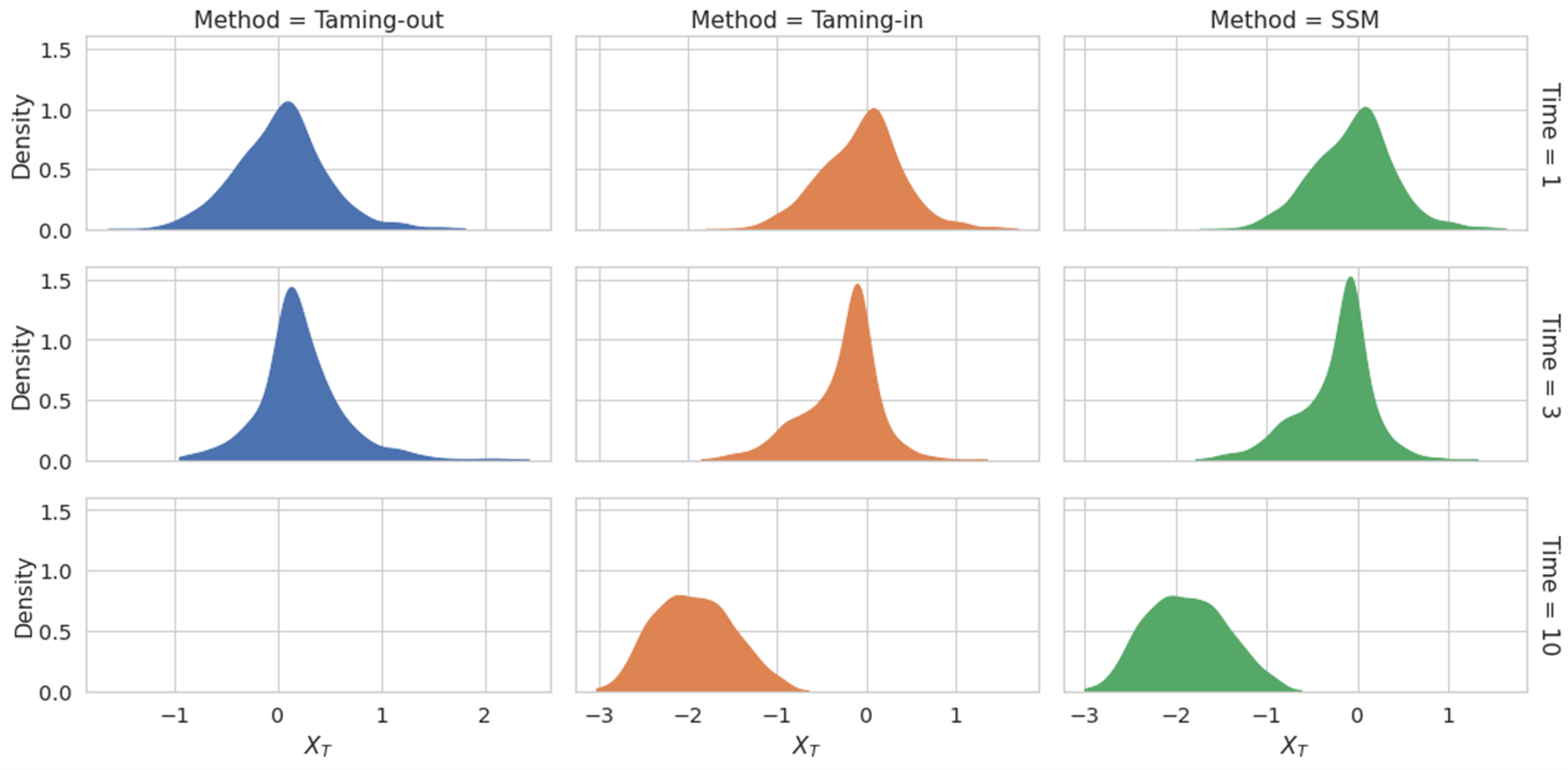
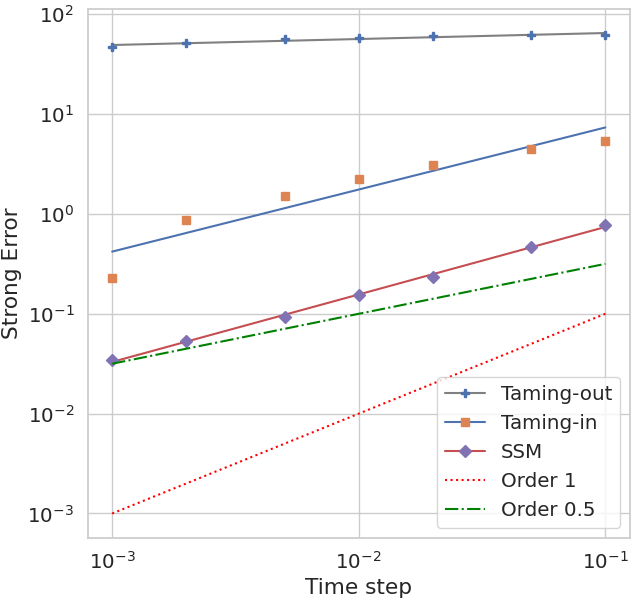
We study a class of McKean--Vlasov Stochastic Differential Equations (MV-SDEs) with drifts and diffusions having super-linear growth in measure and space -- the maps have general polynomial form but also satisfy a certain monotonicity condition. The combination of the drift's super-linear growth in measure (by way of a convolution) and the super-linear growth in space and measure of the diffusion coefficient requires novel technical elements in order to obtain the main results. We establish wellposedness, propagation of chaos (PoC), and under further assumptions on the model parameters, we show an exponential ergodicity property alongside the existence of an invariant distribution. No differentiability or non-degeneracy conditions are required. Further, we present a particle system based Euler-type split-step scheme (SSM) for the simulation of this type of MV-SDEs. The scheme attains, in stepsize, the strong error rate $1/2$ in the non-path-space root-mean-square error metric and we demonstrate the property of mean-square contraction. Our results are illustrated by numerical examples including: estimation of PoC rates across dimensions, preservation of periodic phase-space, and the observation that taming appears to be not a suitable method unless strong dissipativity is present.
Motivation & Objective
- To establish wellposedness of McKean--Vlasov SDEs with super-linear growth in both space and measure, including convolution-type drift and diffusion coefficients.
- To prove propagation of chaos for the associated particle system, ensuring mean-field limits are well-approximated by finite particle systems.
- To demonstrate exponential ergodicity and existence of an invariant distribution under additional dissipativity assumptions, without requiring differentiability or non-degeneracy.
- To develop a split-step Euler-type numerical scheme for simulating these SDEs with strong convergence rate 1/2 and mean-square contraction properties.
- To provide numerical validation of theoretical results, including PoC rates, phase-space preservation, and limitations of taming methods without strong dissipativity.
Proposed method
- The analysis relies on a monotonicity condition on the convolution kernels $f$ and $f_{ ho}$, ensuring control over super-linear growth in measure and space.
- Wellposedness is established via a priori moment estimates and a fixed-point argument in a suitable Banach space of processes with finite $m$-th moments ($m>2$).
- Propagation of chaos is proven by bounding the Wasserstein distance between the law of the SDE solution and the empirical measure of the particle system.
- Exponential ergodicity is derived using a Lyapunov-type argument under additional dissipativity conditions on the drift and diffusion coefficients.
- A split-step Euler scheme is proposed, decoupling drift and diffusion updates to handle super-linear growth, with stability and convergence analyzed via discrete Itô-type estimates.
- Mean-square contraction is shown by proving that the scheme reduces the expected squared distance between solutions over time steps, even under degenerate noise.
Experimental results
Research questions
- RQ1Under what conditions does a McKean--Vlasov SDE with fully super-linear drift and diffusion coefficients in both space and measure admit a unique strong solution?
- RQ2How does the particle system approximation converge to the mean-field limit, and what is the rate of propagation of chaos?
- RQ3Can exponential ergodicity be established for such SDEs without requiring non-degenerate diffusion or differentiability of coefficients?
- RQ4What numerical scheme ensures strong convergence with rate $1/2$ and mean-square contraction for these fully super-linear MV-SDEs?
- RQ5Is taming a suitable method for such SDEs, or are strong dissipativity conditions essential for stability?
Key findings
- Wellposedness is established for MV-SDEs with super-linear drift and diffusion coefficients depending on the law via convolution-type kernels, under mild monotonicity and growth conditions.
- Propagation of chaos holds with a rate that depends on the dimension and the number of particles, as validated numerically across different dimensions.
- Exponential ergodicity is proven under additional dissipativity assumptions, implying the existence of a unique invariant distribution and geometric convergence to it.
- The proposed split-step Euler scheme achieves a strong convergence rate of $1/2$ in the root-mean-square error metric over the path space.
- The scheme exhibits mean-square contraction, ensuring stability over time steps even when the diffusion coefficient is degenerate.
- Numerical experiments show that taming is ineffective unless strong dissipativity is present, highlighting the necessity of structural assumptions for numerical stability.
Better researchstarts right now
From reading papers to final review, dramatically reduce your research time.
No credit card · Free plan available
This review was created by AI and reviewed by human editors.