
[Paper Review] What is the scale of new physics behind the muon $g-2$?
This paper investigates the scale of new physics underlying the muon $g-2$ anomaly using perturbative unitarity bounds in both Standard Model Effective Field Theory (SMEFT) and simplified renormalizable models. It finds that unitarity is saturated at approximately 1 PeV in SMEFT, implying new physics must be probed up to this scale, while renormalizable models suggest on-shell states below 200 TeV. The results set conservative upper limits on new physics scales, challenging the feasibility of resolving the anomaly via direct collider searches beyond the TeV scale.
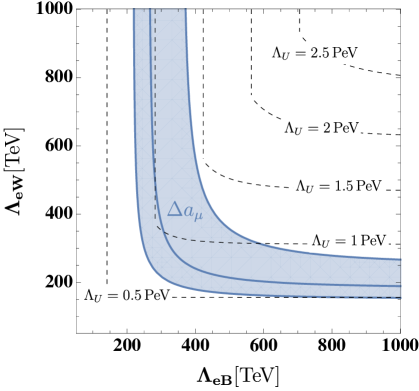
We study the constraints imposed by perturbative unitarity on the new physics interpretation of the muon g−2 anomaly. Within a Standard Model effective field theory approach, we find that scattering amplitudes sourced by effective operators saturate perturbative unitarity at about 1 PeV. This corresponds to the highest energy scale that needs to be probed in order to resolve the new physics origin of the muon g−2 anomaly. On the other hand, simplified models (e.g., scalar-fermion Yukawa theories) in which renormalizable couplings are pushed to the boundary of perturbativity still imply new on-shell states below 200 TeV. We finally suggest that the highest new physics scale responsible for the anomalous effect can be reached in nonrenormalizable models at the PeV scale.
Motivation & Objective
- To determine the maximum energy scale at which new physics could resolve the muon $g-2$ anomaly without violating perturbative unitarity.
- To compare unitarity constraints in model-independent SMEFT with those in specific renormalizable models featuring new on-shell states.
- To assess the feasibility of directly probing the origin of the $g-2$ anomaly at future high-energy colliders.
Proposed method
- Applying partial wave unitarity to scattering amplitudes sourced by SMEFT operators contributing to the muon anomalous magnetic moment.
- Computing unitarity bounds on Wilson coefficients in SMEFT, translating them into upper limits on the new physics scale $\Lambda_{U}$.
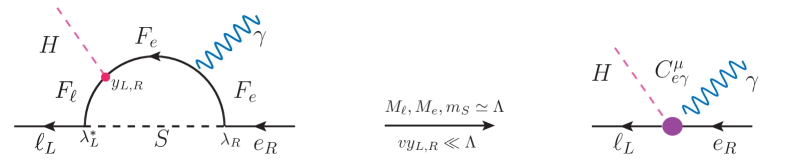
- Analyzing simplified renormalizable models (e.g., scalar-fermion Yukawa theories) to derive perturbativity bounds on couplings and infer upper limits on on-shell state masses.
- Matching renormalizable models onto SMEFT to compare results across frameworks.
- Using high-energy scattering processes to identify the most constraining channels for unitarity saturation.
- Deriving bounds via diagonalization of $\mathcal{T}$-matrices in various quantum number sectors, particularly $J=0$ and $J=1/2$ partial waves.
Experimental results
Research questions
- RQ1What is the highest new physics scale consistent with perturbative unitarity in the SMEFT description of the muon $g-2$ anomaly?
- RQ2How do unitarity bounds in renormalizable models compare to those in SMEFT for the same anomaly?
- RQ3Can direct collider searches at multi-TeV energies resolve the origin of the $g-2$ anomaly, given unitarity constraints?
- RQ4What is the role of loop factors and coupling structures in determining the scale of new physics?
- RQ5Can non-renormalizable models saturate the unitarity bounds derived in SMEFT?
Key findings
- Perturbative unitarity is saturated at approximately 1 PeV in the SMEFT framework, setting the highest scale that must be probed to resolve the muon $g-2$ anomaly.
- In renormalizable models such as scalar-fermion Yukawa theories, unitarity bounds imply the existence of on-shell new states below 200 TeV.
- The SMEFT approach yields the most conservative bound on the new physics scale, as it is model-independent and accounts for all possible operator contributions.
- Unitarity bounds in SMEFT are derived from scattering amplitudes involving $\mu^+\mu^-\to Z(\gamma)h$ and $\mu^+\mu^-\to t\bar{t}$, which are relevant for muon collider searches.
- Non-renormalizable models can realize the full unitarity bound of 1 PeV, suggesting such scales are theoretically viable for explaining the anomaly.
- The strongest constraints arise from $J=1/2$ partial waves in SMEFT and $J=0$ channels in renormalizable models, particularly involving $\ell_R$, $t_R$, and $q_L$ states.
Better researchstarts right now
From reading papers to final review, dramatically reduce your research time.
No credit card · Free plan available
This review was created by AI and reviewed by human editors.