
[Paper Review] Wilson-Loop Characterization of Inversion-Symmetric Topological Insulators
This paper establishes a $η^{–}$ classification for inversion-symmetric topological insulators in 1D and 2D, introducing a relative winding number $W$ protected solely by inversion symmetry. Using Wilson loops and Berry phases, it identifies a topological invariant analogous to the $ν_{2}$ invariant in time-reversal-symmetric systems, with $W$ quantized as a non-negative integer and determined by inversion eigenvalues at high-symmetry momenta.
The ground state of translationally-invariant insulators comprise bands which can assume topologically distinct structures. There are few known examples where this distinction is enforced by a point-group symmetry alone. In this paper we show that 1D and 2D insulators with the simplest point-group symmetry - inversion - have a $Z^{\geq}$ classification. In 2D, we identify a relative winding number that is solely protected by inversion symmetry. By analysis of Berry phases, we show that this invariant has similarities with the first Chern class (of time-reversal breaking insulators), but is more closely analogous to the $Z_2$ invariant (of time-reversal invariant insulators). Implications of our work are discussed in holonomy, the geometric-phase theory of polarization, the theory of maximally-localized Wannier functions, and in the entanglement spectrum.
Motivation & Objective
- To identify topological invariants in inversion-symmetric insulators that are protected solely by point-group symmetry.
- To establish a classification scheme for 1D and 2D topological insulators with only inversion symmetry.
- To define and characterize a new topological invariant, the relative winding number $W$, using Wilson loops and Berry phases.
- To connect the topological structure to geometric phases, polarization, and Wannier function localization.
Proposed method
- The study employs Wilson loops as gauge-invariant holonomies to probe the topological structure of occupied bands in momentum space.
- It analyzes the eigenspectrum of Wilson loops along closed paths in the Brillouin zone, focusing on eigenvalues fixed at $-1$ due to inversion symmetry.
- The relative winding number $W$ is defined as the net change in the phase winding of Wilson loop eigenvalues along a path, quantized as a non-negative integer.
- The method uses symmetry constraints at inversion-invariant momenta ($k=0,\pi$) to compute $W$ from the number of odd-parity bands at these points.
- It establishes a duality between $W$ and the Chern number $C_1$, showing that $W$ is robust under continuous deformation preserving inversion symmetry.
- The analysis is extended to Wannier center trajectories, proving that $W$ is isotropic in both $k_x$ and $k_y$ directions via symmetry and gauge invariance.
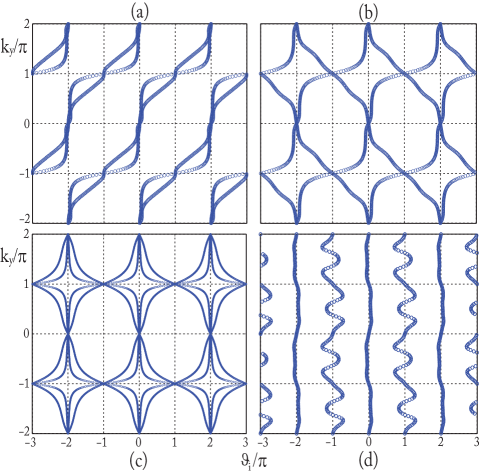
Experimental results
Research questions
- RQ1Can a topological invariant be defined for inversion-symmetric insulators that is protected solely by point-group symmetry?
- RQ2What is the nature of the topological invariant in 1D and 2D inversion-symmetric insulators, and how does it differ from invariants in time-reversal-breaking or time-reversal-invariant systems?
- RQ3How is the relative winding number $W$ related to the Wilson loop eigenvalue spectrum and inversion eigenvalues at high-symmetry points?
- RQ4Can the topological classification be expressed in terms of geometric phases and Wannier function localization?
- RQ5Is the winding number $W$ invariant under adiabatic evolution and robust to perturbations preserving inversion symmetry?
Key findings
- The paper establishes a $\mathbb{Z}^{\geq}$ classification for 1D and 2D inversion-symmetric topological insulators, with the invariant $N_{(-1)}$ counting the number of Wilson loop eigenvalues fixed at $-1$.
- The relative winding number $W$ is identified as a topological invariant protected solely by inversion symmetry, quantized as a non-negative integer.
- The invariant $W$ is determined by the difference in the number of odd-parity bands at $k=0$ and $k=\pi$, with $W = \left| n_{(-)}(\pi) - n_{(-)}(0) \right|$ in the absence of complex-conjugate pairs.
- The relative winding number $W$ is shown to be isotropic: it is the same when computed along $k_x$ or $k_y$ paths, due to the combined constraints of inversion and time-reversal symmetries.
- The Wilson loop eigenvalue spectrum at $k=0$ and $k=\pi$ fully determines the topological invariant, linking it to the symmetry representation of occupied bands.
- The invariant $W$ is found to be analogous to the $\mathbb{Z}_2$ invariant in time-reversal-invariant systems, rather than the Chern number, due to its robustness under inversion symmetry alone.
Better researchstarts right now
From reading papers to final review, dramatically reduce your research time.
No credit card · Free plan available
This review was created by AI and reviewed by human editors.