
[Paper Review] X-Ray Detection of the Galaxy's Missing Baryons in the Circum-Galactic Medium of L$^*$ Galaxies
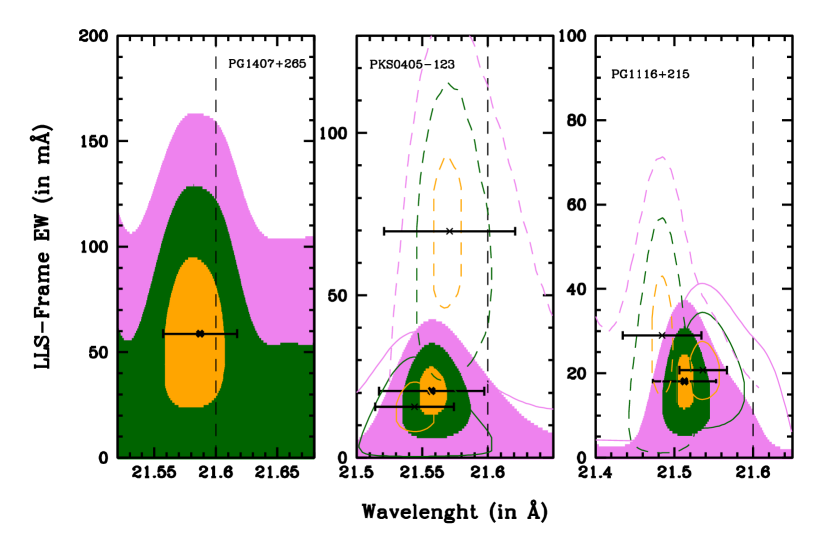
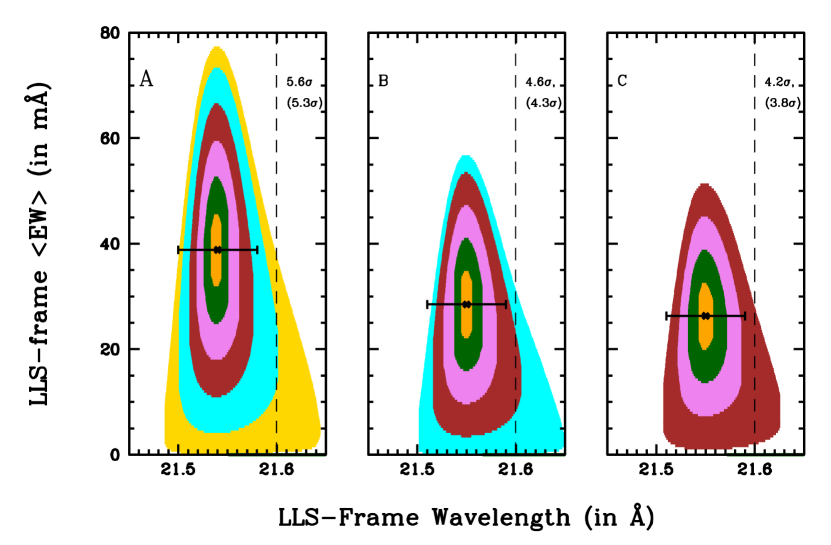
This study presents the first high-significance detection (4.2–5.6σ) of O vii Kα absorption in stacked XMM-Newton and Chandra spectra of L∗ galaxies, identifying a hot, virialized circum-galactic medium (CGM) at log T ≈ 5.8–6.3 K (T ≈ 10⁶ K). The detected X-ray halo contains 70–120% of the missing baryons in typical L∗ galaxies, resolving a major component of the long-standing galaxy missing baryon problem.
The amount of baryons hosted in the disks of galaxies is lower than expected based on the mass of their dark-matter halos and the fraction of baryon-to-total matter in the universe, giving rise to the so called galaxy missing-baryon problem. The presence of cool circum-galactic matter gravitationally bound to its galaxy's halo up to distances of at least ten times the size of the galaxy's disk, mitigates the problem but is far from being sufficient for its solution. It has instead been suggested, that the galaxy missing baryons may hide in a much hotter gaseous phase of the circum-galactic medium, possibly near the halo virial temperature and co-existing with the cool phase. Here we exploit the best available X-ray spectra of known cool circum-galactic absorbers of L$^*$ galaxies to report the first direct high-statistical-significance (best estimates ranging from $4.2-5.6σ$, depending on fitting methodology)} detection of associated OVII absorption in the stacked XMM and Chandra spectra of three quasars. We show that these absorbers trace hot medium in the X-ray halo of these systems, at logT(in k)$\simeq 5.8-6.3$ K (comprising the halo virial temperature T$_{vir} \simeq 10^6$ K). We estimate masses of the X-ray halo within 1 virial radius within the interval M$_{hot-CGM}\simeq (1-1.7) imes 10^{11} (Z/0.3 Z_{\odot})^{-1}$ M$_{\odot}$. For these systems, this corresponds to galaxy missing baryon fractions in the range $ξ_b = M_{hot-CGM}/M_{missing}\simeq (0.7-1.2) (Z/0.3 Z_{\odot})^{-1}$, thus potentially closing the galaxy baryon census in typical L$^*$ galaxies. Our measurements contribute significantly to the solution of the long-standing galaxy missing baryon problem and to the understanding of the continuous cycle of baryons in-and-out of galaxies throughout the life of the universe.
Motivation & Objective
- To resolve the galaxy missing baryon problem, where observed baryons in galaxy disks fall short of cosmological predictions.
- To test the hypothesis that the missing baryons reside in a hot, virialized phase of the circum-galactic medium (CGM) near the halo virial temperature.
- To detect and characterize the hot CGM phase using high-resolution X-ray spectroscopy of quasar absorption lines.
- To estimate the mass and baryon fraction of the hot CGM in L∗ galaxies and assess its contribution to the total missing baryon budget.
Proposed method
- Stacked X-ray spectra from XMM-Newton (RGS) and Chandra (LETG) observations of three quasars behind L∗ galaxies with known cool-CGM absorbers.
- Performed high-resolution spectroscopy to detect O vii Kα and Kβ absorption lines at rest-frame wavelengths of 18.96 Å and 15.01 Å.
- Used statistical significance tests (4.2–5.6σ) to confirm the detection of O vii absorption, accounting for fitting methodology variations.
- Modeled ionization states using collisional ionization equilibrium (CIE) and photoionization equilibrium (PIE) to interpret the observed ion abundances.
- Estimated the hot CGM mass within one virial radius using the observed O vii column density and temperature constraints.
- Calculated the baryon fraction of the hot CGM relative to the total missing baryons, correcting for metallicity (Z).
Experimental results
Research questions
- RQ1Is there direct X-ray evidence for a hot, virialized phase of the circum-galactic medium in L∗ galaxies?
- RQ2What is the temperature and mass of the hot CGM phase, and does it match the halo virial temperature?
- RQ3To what extent does the hot CGM account for the missing baryons in typical L∗ galaxies?
- RQ4How do the observed O vii absorption lines compare with predictions from CIE and PIE models?
Key findings
- The study reports the first high-significance detection (4.2–5.6σ) of O vii Kα absorption in the stacked X-ray spectra of three L∗ galaxies.
- The detected gas has a temperature of log T ≈ 5.8–6.3 K, consistent with the halo virial temperature (Tvir ≈ 10⁶ K) for L∗ galaxies.
- The mass of the hot CGM within one virial radius is estimated at Mhot-CGM ≈ (1–1.7) × 10¹¹ M⊙ (Z/0.3Z⊙)⁻¹.
- The hot CGM accounts for 70–120% of the missing baryons in L∗ galaxies, with ξb ≈ (0.7–1.2)(Z/0.3Z⊙)⁻¹.
- The ionization state of the gas is best explained by collisional ionization equilibrium (CIE), with O vii being the dominant oxygen ion at the observed temperature.
- The results suggest that the hot CGM phase closes the baryon census in typical L∗ galaxies, resolving a long-standing problem in galaxy evolution.
Better researchstarts right now
From reading papers to final review, dramatically reduce your research time.
No credit card · Free plan available
This review was created by AI and reviewed by human editors.