
[Paper Review] YbV$_3$Sb$_4$ and EuV$_3$Sb$_4$, vanadium-based kagome metals with Yb$^{2+}$ and Eu$^{2+}$ zig-zag chains
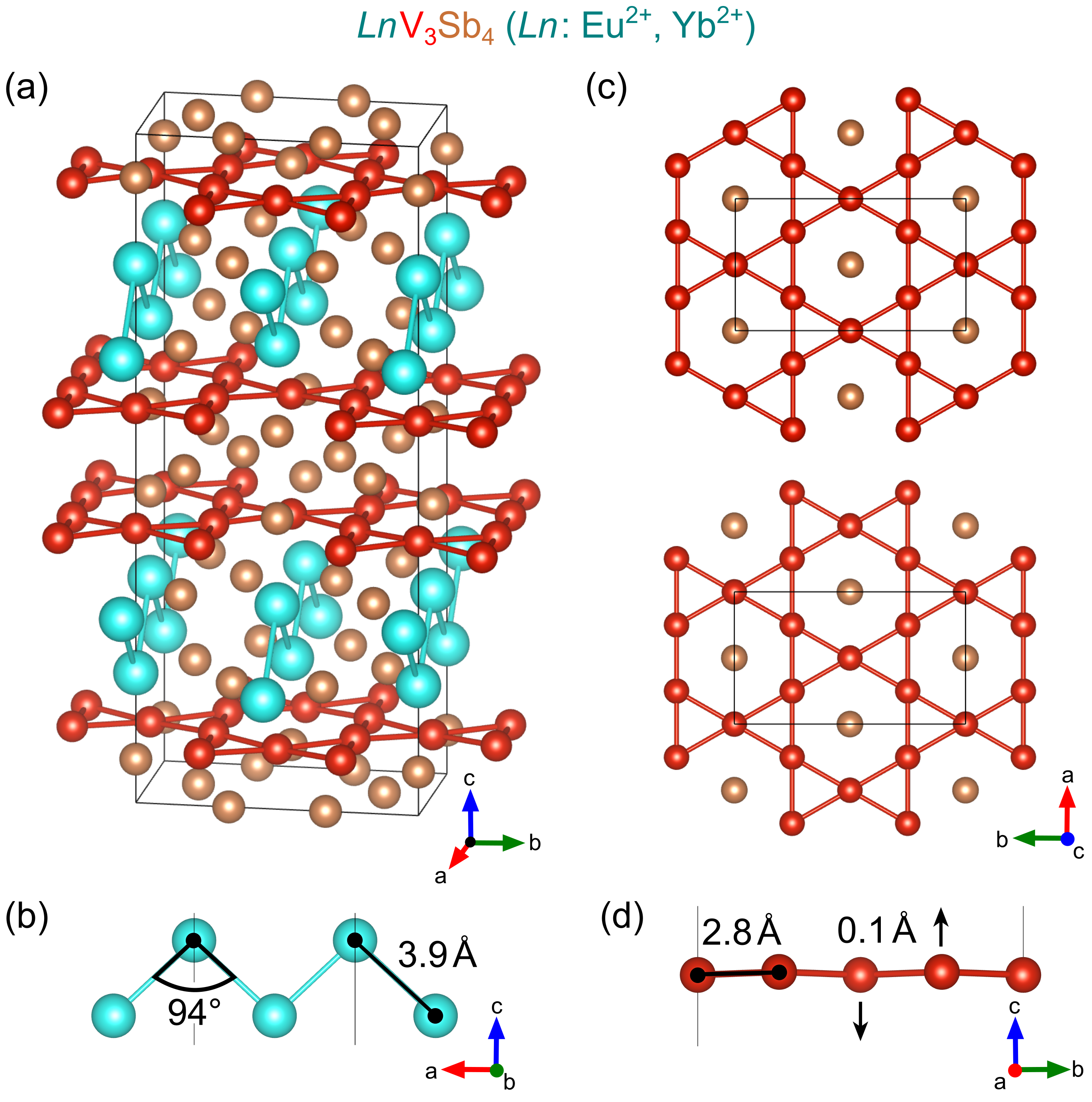
This study reports the synthesis and characterization of YbV₃Sb₄ and EuV₃Sb₄, two new vanadium-based kagome metals with zig-zag chains of divalent Yb²⁺ and Eu²⁺ ions. While YbV₃Sb₄ remains a nonmagnetic metal with no phase transitions down to 60 mK, EuV₃Sb₄ exhibits a ferromagnetic-like transition at T_C = 32 K with easy-plane anisotropy and hints of a modulated magnetic ground state, establishing a new platform for tuning magnetic order in kagome lattices.
Here we present YbV$_3$Sb$_4$ and EuV$_3$Sb$_4$, two new compounds exhibiting slightly distorted vanadium-based kagome nets interleaved with zig-zag chains of divalent Yb$^{2+}$ and Eu$^{2+}$ ions. Single crystal growth methods are reported alongside magnetic, electronic, and thermodynamic measurements. YbV$_3$Sb$_4$ is a nonmagnetic metal with no collective phase transitions observed between 60mK and 300K. Conversely, EuV$_3$Sb$_4$ is a magnetic kagome metal exhibiting easy-plane ferromagnetic-like order below $T_ ext{C}$=32K with signatures of noncollinearity under low field. Our discovery of YbV$_3$Sb$_4$ and EuV$_3$Sb$_4$ demonstrate another direction for the discovery and development of vanadium-based kagome metals while incorporating the chemical and magnetic degrees of freedom offered by a rare-earth sublattice.
Motivation & Objective
- To expand the family of vanadium-based kagome metals by incorporating rare-earth ions with tunable magnetic moments.
- To explore the interplay between itinerant kagome band structures and localized magnetic moments from rare-earth sublattices.
- To investigate how magnetic order in rare-earth zig-zag chains influences electronic and magnetic properties in kagome metals.
- To establish a new class of kagome materials (AV₃Sb₄) with chemical and magnetic tunability via A-site cations.
Proposed method
- Single crystal growth of YbV₃Sb₄ and EuV₃Sb₄ using flux methods to achieve high-quality samples.
- Magnetic characterization via SQUID magnetometry to measure temperature- and field-dependent magnetization and susceptibility.
- Heat capacity measurements using a relaxation technique to probe thermodynamic transitions and extract magnetic entropy.
- X-ray diffraction and crystal structure refinement to confirm the AM₃X₄ structure with slightly distorted kagome nets and zig-zag A-site chains.
- Analysis of magnetic data using Curie-Weiss law and comparison with nonmagnetic YbV₃Sb₄ to isolate magnetic contributions.
- Use of YbV₃Sb₄ as a nonmagnetic phonon reference to extract magnetic heat capacity and entropy in EuV₃Sb₄.
Experimental results
Research questions
- RQ1Can divalent rare-earth ions (Yb²⁺, Eu²⁺) be incorporated into the AV₃Sb₄ structure to form stable kagome metals with tunable magnetism?
- RQ2Does the presence of Eu²⁺ induce long-range magnetic order in the vanadium kagome lattice, and if so, what is its nature and transition temperature?
- RQ3How does the magnetic ground state of EuV₃Sb₄ differ from simple ferromagnetism, and what evidence supports the presence of modulated or canted order?
- RQ4To what extent do the magnetic properties of EuV₃Sb₄ deviate from those expected for an S = 7/2 system, and what might cause such deviations?
- RQ5Can the magnetic entropy in EuV₃Sb₄ be quantitatively accounted for, and does it approach the expected value for a fully ordered 8-fold degenerate ground state?
Key findings
- YbV₃Sb₄ is a nonmagnetic metal with no bulk phase transitions observed between 60 mK and 300 K, consistent with Pauli paramagnetism.
- EuV₃Sb₄ exhibits a ferromagnetic-like transition at T_C = 32 K, with easy-plane anisotropy and a cusp in magnetization below T_C suggesting complex magnetic order.
- Magnetic heat capacity analysis reveals that the magnetic entropy in EuV₃Sb₄ reaches 16.8 J mol⁻¹ K⁻¹, corresponding to 97% of the expected R ln 8 value for S = 7/2 Eu²⁺ ions.
- The susceptibility data for H ∥ c indicate a more complex ground state than simple ferromagnetism, possibly involving moment canting or helical order.
- Isothermal magnetization data show a 1 μB moment deficit even after mass correction, suggesting possible unaccounted contributions from vanadium or dynamic effects.
- The heat capacity anomaly at T_C broadens and shifts to lower temperatures under magnetic fields, indicating field-dependent magnetic fluctuations.
Better researchstarts right now
From reading papers to final review, dramatically reduce your research time.
No credit card · Free plan available
This review was created by AI and reviewed by human editors.