
[Paper Review] $Z^0$ boson associated b-jet production in high-energy nuclear collisions
This study presents the first theoretical investigation of Z⁰ boson-tagged b-jet production in Pb+Pb collisions using a Monte Carlo transport model with a hydrodynamic background. It reveals that b-jets exhibit weaker azimuthal angular correlation suppression and larger nuclear modification factors (I_{AA}) than light quark jets, indicating reduced energy loss due to the mass effect in quark-gluon plasma, offering a clean probe for jet quenching mass hierarchy.
The production of vector boson tagged heavy quark jets potentially provides new tools to probe the jet quenching effect. In this paper, we present the first theoretical study on the angular correlations ($Δϕ_{bZ}$), transverse momentum imbalance ($x_{bZ}$), and nuclear modification factor ($I_{AA}$) of $Z^0$ boson tagged b-jets in heavy-ion collisions, which was performed using a Monte Carlo transport model. We find that the medium modification of the $Δϕ_{bZ}$ for $Z^0\,+\,$b-jet has a weaker dependence on $Δϕ_{bZ}$ than that for $Z^0\,+\,$jet, and the modification patterns are sensitive to the initial jet $p_T$ distribution. Additionally, with the high purity of the quark jet in $Z^0\,+\,$(b-)jet production, we calculate the momentum imbalance $x_{bZ}$ and the nuclear modification factor $I_{AA}$ of $Z^0\,+\,$b-jet in Pb+Pb collisions. We observe a smaller $Δ\left\langle x_{jZ} ight angle$ and larger $I_{AA}$ of $Z^0\,+\,$b-jet in Pb+Pb collisions relative to those of $Z^0\,+\,$jet, which may be an indication of the mass effect of jet quenching and can be tested in future measurements.
Motivation & Objective
- To investigate the medium modification of Z⁰-tagged b-jets in Pb+Pb collisions as a probe of jet quenching.
- To compare the in-medium behavior of Z⁰+jet and Z⁰+b-jet systems to isolate the mass effect on energy loss.
- To analyze angular correlations (Δϕ_{bZ}), momentum imbalance (x_{bZ}), and nuclear modification factor (I_{AA}) in central Pb+Pb collisions at √s_{NN} = 5.02 TeV.
- To provide testable predictions for future LHC measurements using high-purity quark-jet tagging via Z⁰ bosons.
- To clarify the unresolved puzzle of jet quenching mass hierarchy by comparing suppression patterns between light and heavy quark jets.
Proposed method
- Used a Monte Carlo transport model with elastic and inelastic jet-medium interactions within a hydrodynamic background to simulate jet evolution in QGP.
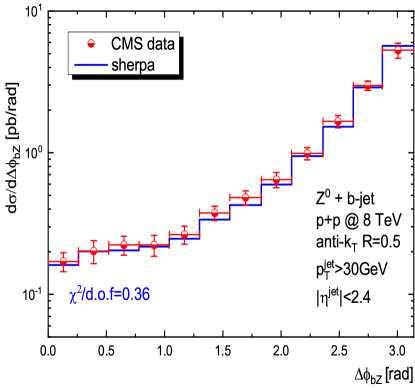
- Employed the NLO+PS event generator SHERPA to generate the p+p baseline for Z⁰+b-jet production, validated against CMS data.
- Simulated Z⁰+jet and Z⁰+b-jet production in 0–10% central Pb+Pb collisions at √s_{NN} = 5.02 TeV.
- Calculated the azimuthal angular correlation Δϕ_{bZ} and momentum imbalance x_{bZ} to probe jet-medium interactions.
- Computed the nuclear modification factor I_{AA} to quantify medium-induced suppression of jet yields.
- Analyzed the dependence of medium modifications on initial jet p_T distribution and Z⁰ boson transverse momentum.

Experimental results
Research questions
- RQ1How does the medium modification of Δϕ_{bZ} in Z⁰+b-jets compare to that in Z⁰+jets, and what does this reveal about jet-medium interactions?
- RQ2To what extent does the initial p_T distribution of jets influence the observed medium modifications in angular correlations?
- RQ3Does the Z⁰+b-jet system show a smaller I_{AA} than Z⁰+jets, indicating reduced energy loss due to the b-quark mass?
- RQ4Can the momentum imbalance x_{bZ} serve as a sensitive observable to distinguish between light and heavy quark jet quenching?
- RQ5Is there a measurable difference in the suppression pattern of Z⁰+b-jets versus Z⁰+jets that would confirm the mass effect in jet quenching?
Key findings
- The suppression of Δϕ_{bZ} in Z⁰+b-jets shows weaker dependence on the azimuthal angle compared to Z⁰+jets, due to b-tagging suppressing multiple-jet contributions.
- The initial p_T distribution of jets in p+p collisions strongly influences the medium modification pattern of Δϕ_{bZ} in Pb+Pb collisions.
- The momentum imbalance x_{bZ} shows a larger shift for Z⁰+jets than for Z⁰+b-jets, indicating stronger energy loss in light quark jets.
- The nuclear modification factor I_{AA} is smaller for Z⁰+jets than for Z⁰+b-jets across all p_T regions, confirming reduced suppression for b-jets.
- In the high-Z⁰ p_T region (80–120 GeV), I_{AA} for Z⁰+jets exceeds 1 at low jet p_T due to enhanced cross-section steepness and in-medium p_T shift.
- The results support the existence of a mass effect in jet quenching, with b-jets losing less energy than light quark jets, consistent with recent ATLAS measurements.
Better researchstarts right now
From reading papers to final review, dramatically reduce your research time.
No credit card · Free plan available
This review was created by AI and reviewed by human editors.