
[论文解读] A Bright First Day for Tidal Disruption Event
本研究利用三维辐射流体动力学模拟表明,潮汐撕裂事件(TDEs)中的流体-流体碰撞可通过将超过5%的流体动能转化为辐射,驱动明亮的超前峰值光学辐射,产生约10⁴²–10⁴⁴ erg s⁻¹的光度。碰撞形成一个超爱丁顿辐射区域,从而喷射出非球对称的喷流,光球层尺寸扩大1–2个数量级,温度达到约10⁴ K,与观测到的TDE一致。
Stream-stream collision may be an important pre-peak energy dissipation mechanism in tidal disruption events (TDEs). We perform local three-dimensional radiation hydrodynamic simulations in a wedge geometry including the gravity to study stream self-crossing, with emphasis on resolving the collision and following the subsequent outflow. We find that the collision can contribute to pre-peak optical emissions by converting $\gtrsim5\%$ of stream kinetic energy to radiation, yielding prompt emission of $\sim10^{42-44} m erg~s^{-1}$. The radiative efficiency is sensitive to stream mass fallback rates, and strongly depends on the downstream gas optical depth. Even for a sub-Eddington ($10\%$) mass fallback rate, the strong radiation pressure produced in the collision can form a local super-Eddington region near the collision site, where a fast, aspherical outflow is launched. Higher mass fallback rate usually leads to more optically-thick outflow and lower net radiative efficiency. For $\dot{M}\gtrsim0.1\dot{M}_{ m Edd}$, the estimated photosphere size of the outflow can expand by one to two orders of magnitudes reaching $\sim10^{14} m cm$. The average gas temperature at this photospheric surface is a few $ imes10^{4}$K, roughly consistent with inferred pre-peak photosphere properties for some optical TDEs. We find that the dynamics is sensitive to collision angle and collision radius, but the radiative efficiency or outflow properties show more complex dependency than is often assumed in ballistic models.
研究动机与目标
- 研究流体-流体碰撞在潮汐撕裂事件(TDEs)中超前峰值能量耗散机制中的作用。
- 量化TDE中流体自交叉导致的辐射效率和喷流特性。
- 评估质量回落率和光学深度对辐射产生及喷流动力学的影响。
- 通过高分辨率辐射流体动力学模拟验证碰撞驱动辐射模型的鲁棒性。
提出的方法
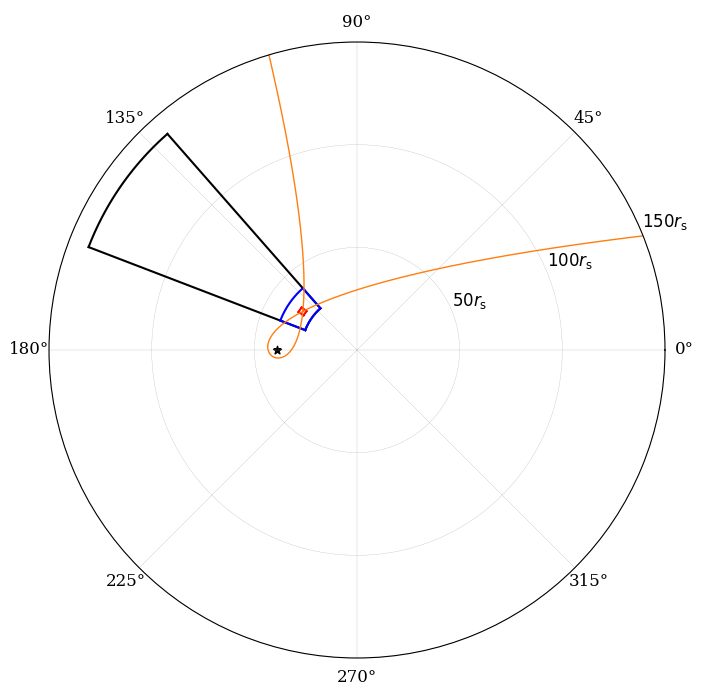
- 在楔形几何中执行局部三维辐射流体动力学模拟,包含引力和辐射传输。
- 在激波区域采用六级自适应网格加密(AMR),辐射场区域采用四级加密。
- 使用弹道轨迹并引入近日点进动以模拟流体自相交。
- 通过辐射压力和热化过程追踪动能向辐射能量的转化。
- 通过改变空间和角度分辨率进行分辨率研究,以评估数值收敛性。
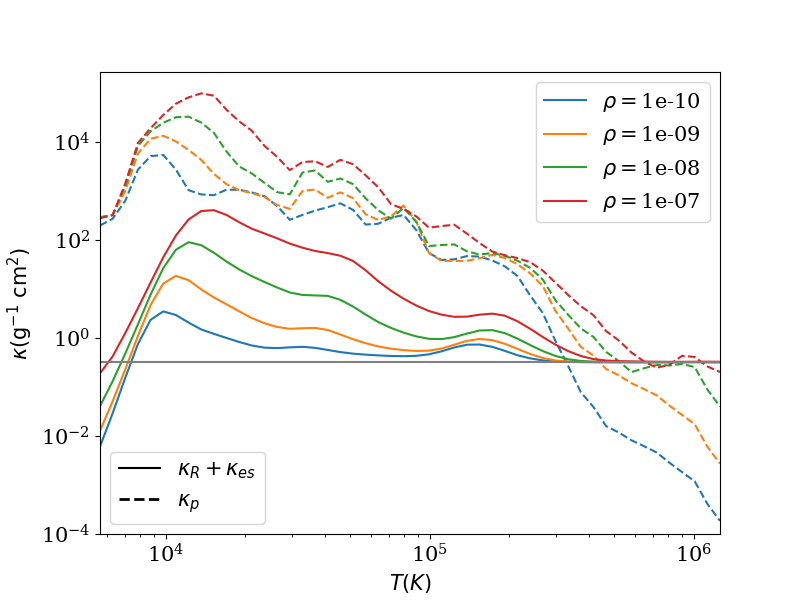
- 在光学深度τ=1处定义光球半径,并基于辐射能量密度分布计算温度和光度。
实验结果
研究问题
- RQ1在TDE的流体-流体碰撞过程中,有多少比例的流体动能被转化为辐射?
- RQ2辐射效率如何依赖于质量回落率和下游光学深度?
- RQ3流体-流体碰撞能否产生与TDE光曲线一致的可观测超前峰值光学辐射?
- RQ4由碰撞区辐射压力驱动的喷流具有何种特性?
- RQ5分辨率和数值设置如何影响辐射介质激波的模拟?
主要发现
- 流体-流体碰撞可将超过5%的流体动能转化为辐射,产生约10⁴²–10⁴⁴ erg s⁻¹的瞬时辐射。
- 即使在爱丁顿速率的10%时,辐射压力仍可在碰撞点附近形成局部超爱丁顿区域。
- 喷流呈非球对称性,且由于碰撞区强烈的辐射压力而以高速喷射。
- 当质量回落率≥0.1 M_Edd时,光球半径扩大1–2个数量级,达到约10¹⁴ cm。
- 平均光球温度约为10⁴ K,与超前峰值光学TDE中推断的温度一致。
- 由于光学深度增加和喷流更不透明,辐射效率随质量回落率升高而降低。
阅读本论文
在 Nubint 阅读器中打开原文,边读边就任意段落提问。
在 Nubint 中阅读本论文本解读由 AI 根据论文原文生成,引用前请核对原文。