
[论文解读] A comparative analysis of transient finite-strain coupled diffusion-deformation theories for hydrogels
本文提出了一套统一的热力学框架,用于有限应变、瞬态扩散-变形模型的水凝胶,通过一致的变分格式和基于FEniCS的有限元实现,对比了现有理论。结果表明,通常被忽视的体积响应模型选择对溶胀行为有显著影响,尽管各理论共享相同的热力学基础,但在基准仿真中仍表现出显著差异。
This work presents a comparative review and classification between some well-known thermodynamically consistent models of hydrogel behavior in a large deformation setting, specifically focusing on solvent absorption/desorption and its impact on mechanical deformation and network swelling. The proposed discussion addresses formulation aspects, general mathematical classification of the governing equations, and numerical implementation issues based on the finite element method. The theories are presented in a unified framework demonstrating that, despite not being evident in some cases, all of them follow equivalent thermodynamic arguments. A detailed numerical analysis is carried out where Taylor-Hood elements are employed in the spatial discretization to satisfy the inf-sup condition and to prevent spurious numerical oscillations. The resulting discrete problems are solved using the FEniCS platform through consistent variational formulations, employing both monolithic and staggered approaches. We conduct benchmark tests on various hydrogel structures, demonstrating that major differences arise from the chosen volumetric response of the hydrogel. The significance of this choice is frequently underestimated in the state-of-the-art literature but has been shown to have substantial implications on the resulting hydrogel behavior.
研究动机与目标
- 为水凝胶的瞬态、大变形扩散-变形模型提供一个统一的、热力学一致的框架。
- 基于数学结构和本构假设,对现有宏观尺度多孔弹性理论进行分类与比较。
- 通过使用Taylor-Hood元满足inf-sup条件,研究单体和交替有限元格式的数值性能。
- 证明体积响应模型的选择——在文献中常被低估——对水凝胶行为具有显著且非平凡的影响。
提出的方法
- 利用中间构型和弹性右Cauchy-Green张量,基于统一热力学框架描述耦合的化学-机械响应。
- 从热力学第二定律推导控制方程,通过自由能函数Ψₑᴿ(Fₑ, cᴿ)和活性化学势μₐcₜ强制熵不等式。
- 在FEniCS有限元平台中使用一致的变分格式实现弱形式,采用Taylor-Hood元稳定混合格式。
- 使用单体和交替时间积分格式求解所得离散问题,以评估其鲁棒性和精度。
- 通过流体体积分数J_f = (1 + Ωc_R)^{1/3}定义体积响应,通过弹性拉伸将变形与浓度关联。
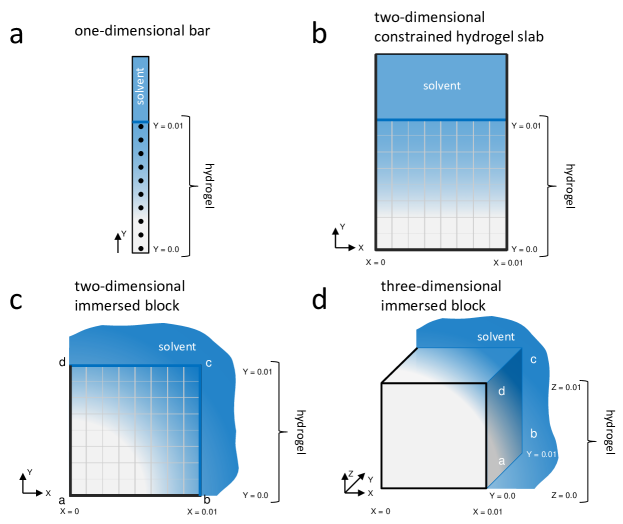
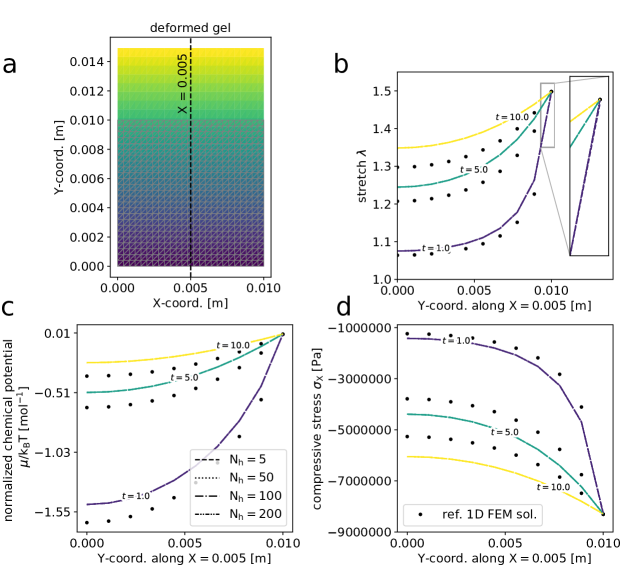
- 通过水凝胶结构的基准仿真验证框架,比较不同体积响应假设下的结果。
实验结果
研究问题
- RQ1不同有限应变、热力学一致的水凝胶扩散-变形理论在数学结构和本构假设方面如何比较?
- RQ2体积响应模型的选择——特别是J_f对c_R的函数依赖关系——在多大程度上影响预测的溶胀和变形行为?
- RQ3能否推导出一个统一的变分格式,在同一热力学框架下恢复所有所考虑的理论?
- RQ4对于瞬态、非线性、耦合的化学-机械问题,单体和交替有限元方法在稳定性和精度方面表现如何?
- RQ5在应力和势能定义中忽略中间构型与当前构型之间的区别会产生什么影响?
主要发现
- 所有考虑的理论在热力学上是一致的,且可统一于基于中间构型和自由能Ψₑᴿ(Fₑ, cᴿ)的单一框架下。
- 活性化学势μₐcₜ = ∂Ψₑᴿ/∂cᴿ确保了热力学一致性,并将化学势与弹性响应联系起来。
- 体积响应模型,特别是J_f = (1 + Ωc_R)^{1/3}的函数形式,对预测的溶胀行为具有主导影响,在基准仿真中观察到显著差异。
- Taylor-Hood元有效满足了inf-sup条件,防止了混合格式中的虚假压力振荡。
- 单体和交替有限元方法均收敛于一致解,但单体格式在高度非线性区域表现出更好的稳定性。
- 在假设的运动学约束下,PK1应力张量P_e与原始P = ∂Ψ_R/∂F之间的等价性得到严格证明,验证了框架的一致性。
阅读本论文
在 Nubint 阅读器中打开原文,边读边就任意段落提问。
在 Nubint 中阅读本论文本解读由 AI 根据论文原文生成,引用前请核对原文。