
[论文解读] A Comprehensive Survey on Knowledge Distillation of Diffusion Models
对扩散模型蒸馏方法的综述,将扩散到场(diffusion-to-field)、扩散到生成器(diffusion-to-generator)和无训练蒸馏(training-free distillation)进行分类,并给出无训练采样的洞见与多种蒸馏策略。
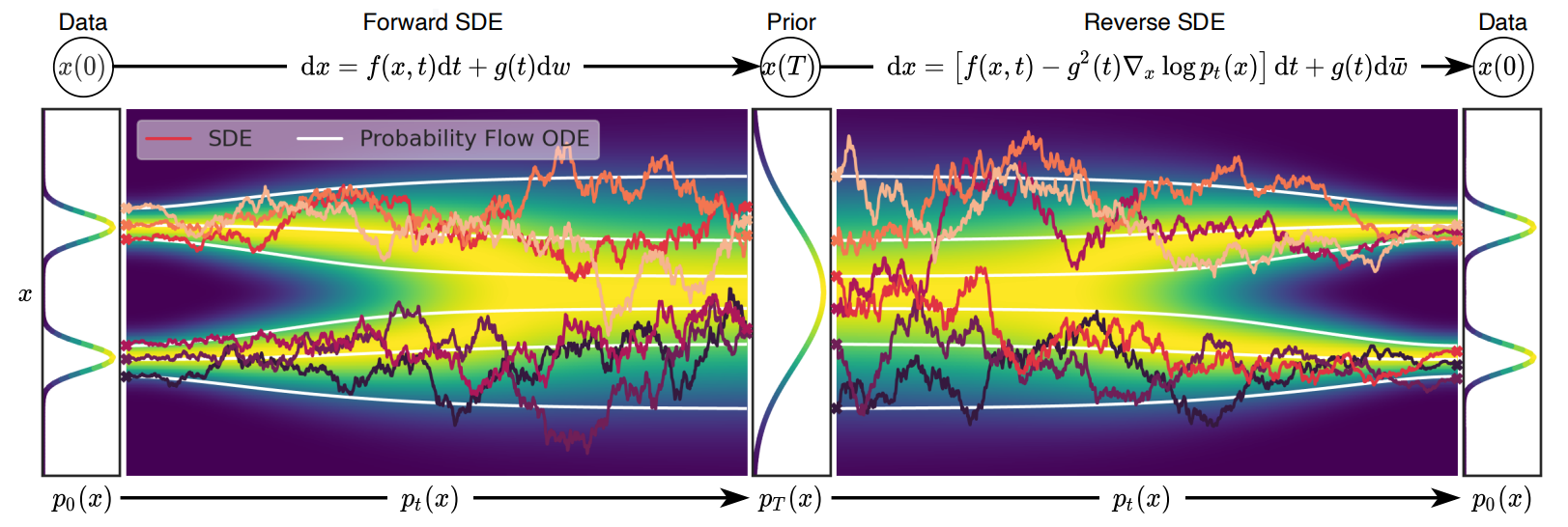
Diffusion Models (DMs), also referred to as score-based diffusion models, utilize neural networks to specify score functions. Unlike most other probabilistic models, DMs directly model the score functions, which makes them more flexible to parametrize and potentially highly expressive for probabilistic modeling. DMs can learn fine-grained knowledge, i.e., marginal score functions, of the underlying distribution. Therefore, a crucial research direction is to explore how to distill the knowledge of DMs and fully utilize their potential. Our objective is to provide a comprehensible overview of the modern approaches for distilling DMs, starting with an introduction to DMs and a discussion of the challenges involved in distilling them into neural vector fields. We also provide an overview of the existing works on distilling DMs into both stochastic and deterministic implicit generators. Finally, we review the accelerated diffusion sampling algorithms as a training-free method for distillation. Our tutorial is intended for individuals with a basic understanding of generative models who wish to apply DM's distillation or embark on a research project in this field.
研究动机与目标
- Explain diffusion models and the challenges in distilling them into neural vector fields.
- Review existing works on distilling diffusion models into stochastic and deterministic implicit generators.
- Summarize accelerated diffusion sampling algorithms as training-free distillation methods.
- Organize distillation approaches into Diffusion-to-Field, Diffusion-to-Generator, and Training-Free categories.
提出的方法
- Introduce diffusion models as score-based models and contrast with ARMs and EBMs.
- Describe Fisher divergence and score matching as training objectives for SBMs.
- Explain forward diffusion SDEs (VP and VE) and their marginal kernels, and how DDIM/ODE-based sampling enables distillation.
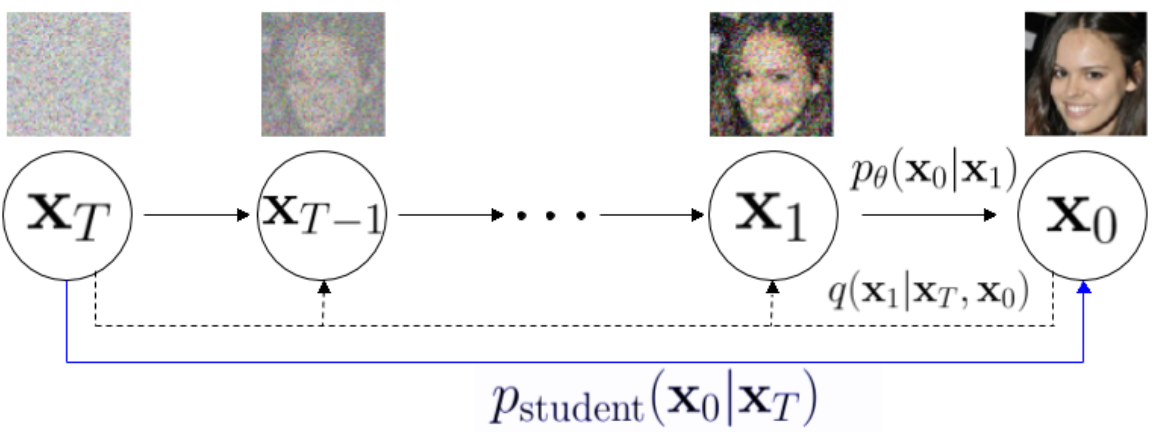
- Summarize three distillation categories: D2F (output and path distillation), D2G, and TF distillation, with representative methods and objectives.
- Present progressive distillation (PD) and related feature/consistency-based distillation approaches and their sampling efficiency gains.
实验结果
研究问题
- RQ1What are effective strategies to distill diffusion models into lower-NFE samplers without substantial loss in performance?
- RQ2How can knowledge from teacher diffusion models be transferred to lightweight student generators or vector fields?
- RQ3What training-free or near-training-free approaches exist to accelerate diffusion sampling?
- RQ4How do different distillation pipelines (D2F, D2G, TF) compare in terms of efficiency and fidelity across tasks?
主要发现
- Output distillation can train a student to mimic the teacher ODE output with larger steps, achieving substantially fewer NFEs (e.g., one NFE in some cases).
- Progressive distillation can reduce NFEs by half per stage, e.g., reaching as few as 4 NFEs with minor accuracy loss (about a 5% FID drop in reported cases).
- Two-stage distillation can enable conditional diffusion models with classifier-free guidance to maintain conditioning while reducing sampling steps.
- Feature-space distillation (CFD) aligns student outputs with multi-step teacher features rather than pixel-space outputs, improving efficiency.
- Two-stage distillation approaches have been applied to pixel-space and latent-space conditional diffusion, achieving competitive or superior FID with fewer NFEs.
- Self-consistency distillation (consistency model) uses a few steps of a generative ODE to enforce path-level consistency.
阅读本论文
在 Nubint 阅读器中打开原文,边读边就任意段落提问。
在 Nubint 中阅读本论文本解读由 AI 根据论文原文生成,引用前请核对原文。