
[论文解读] A Comprehensive Survey on Source-free Domain Adaptation
本综述对源域自适应(SFDA)方法提供了全面且统一的分类,分析了在 Office-31、Office-Home 和 VisDA 基准上超过 30 种代表性方法。该综述将 SFDA 分为基于数据的方法(例如,域重建、风格迁移)和基于模型的方法,突出关键技术路径,并识别出在理论、应用、数据集和扩展设置方面的未来研究方向。
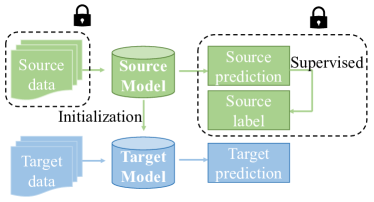
Over the past decade, domain adaptation has become a widely studied branch of transfer learning that aims to improve performance on target domains by leveraging knowledge from the source domain. Conventional domain adaptation methods often assume access to both source and target domain data simultaneously, which may not be feasible in real-world scenarios due to privacy and confidentiality concerns. As a result, the research of Source-Free Domain Adaptation (SFDA) has drawn growing attention in recent years, which only utilizes the source-trained model and unlabeled target data to adapt to the target domain. Despite the rapid explosion of SFDA work, yet there has no timely and comprehensive survey in the field. To fill this gap, we provide a comprehensive survey of recent advances in SFDA and organize them into a unified categorization scheme based on the framework of transfer learning. Instead of presenting each approach independently, we modularize several components of each method to more clearly illustrate their relationships and mechanics in light of the composite properties of each method. Furthermore, we compare the results of more than 30 representative SFDA methods on three popular classification benchmarks, namely Office-31, Office-home, and VisDA, to explore the effectiveness of various technical routes and the combination effects among them. Additionally, we briefly introduce the applications of SFDA and related fields. Drawing from our analysis of the challenges facing SFDA, we offer some insights into future research directions and potential settings.
研究动机与目标
- 为快速发展的源域自适应(SFDA)领域中缺乏及时且全面的综述提供解决方案。
- 基于迁移学习原理,将 SFDA 方法组织为统一的分类框架,区分基于数据和基于模型的方法。
- 在三个主要基准——Office-31、Office-Home 和 VisDA 上,对超过 30 种 SFDA 方法进行实证比较,以评估技术有效性及组合效应。
- 识别 SFDA 方法论中尚未充分探索的领域,例如自注意力机制、对比学习和熵最小化。
- 提出在理论基础、实际应用、数据集多样性以及扩展设置(如开集或多元源适应)方面的未来研究方向。
提出的方法
- 作者将 SFDA 方法分为两大类:基于数据的方法(例如,虚拟域生成、图像风格迁移、邻域聚类)和基于模型的方法(例如,扰动域监督、局部结构聚类)。
- 他们对每种方法进行模块化分解,以揭示其内在组件与关系,强调复合特性而非孤立看待各类方法。
- 该综述使用标准基准评估了三十余种 SFDA 方法,通过在 Office-31、Office-Home 和 VisDA 上的性能比较,评估不同技术路径的有效性。
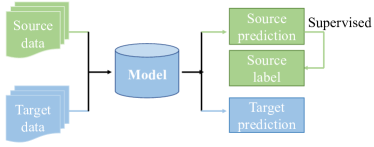
- 讨论了基于域的重建技术作为无监督域自适应(UDA)的扩展,通过重建类似源域的数据,使 UDA 风格的方法能够在 SFDA 中运行。
- 图像风格迁移利用源分类器中的批量归一化层,将目标图像转换为源域风格表示,以提升兼容性。
- 邻域聚类与局部结构聚类利用目标数据中的内在数据关系,假设困难样本位于源模型决策边界的附近。
实验结果
研究问题
- RQ1SFDA 中的主流方法类别是什么?它们与传统 UDA 方法有何关联?
- RQ2不同技术组件(如风格迁移、聚类或重建)如何影响 SFDA 在标准基准上的性能表现?
- RQ3当前 SFDA 方法论中的关键局限与尚未充分探索的机会是什么,特别是在自注意力机制和对比学习方面?
- RQ4数据不平衡与噪声如何影响 SFDA 模型的鲁棒性?这对实际部署有何影响?
- RQ5在理论、应用与评估方面,哪些未来研究方向最具前景?
主要发现
- 在 Office-31、Office-Home 和 VisDA 上系统评估了三十余种 SFDA 方法,揭示了不同技术路径之间的性能差异及组合效应。
- 基于域的重建与图像风格迁移方法与现有 UDA 框架具有强兼容性,可在无源数据条件下实现有效适应。
- 邻域聚类与局部结构聚类通过利用数据内在几何结构表现出有效性,即使未显式进行域对齐亦能奏效。
- 对比学习与图像风格迁移仍以相对同质化的方式实现,表明在新技术应用方面仍有创新空间。
- 熵最小化仍被广泛使用,但通常作为辅助损失被动应用,缺乏更深层次的方法论创新。
- 单源、闭集 SFDA 设置仍占主导地位,但未来工作应探索开集、多源及测试时适应等扩展设置。
阅读本论文
在 Nubint 阅读器中打开原文,边读边就任意段落提问。
在 Nubint 中阅读本论文本解读由 AI 根据论文原文生成,引用前请核对原文。