
QUICK REVIEW
[论文解读] A decoder-only foundation model for time-series forecasting
Abhimanyu Das, Weihao Kong|arXiv (Cornell University)|Oct 14, 2023
一句话总结
TimesFM 是一个仅解码器的时序基础模型,在真实数据与合成数据上进行预训练,在跨领域的未见数据集上实现接近最先进的零样本预测。
ABSTRACT
Motivated by recent advances in large language models for Natural Language Processing (NLP), we design a time-series foundation model for forecasting whose out-of-the-box zero-shot performance on a variety of public datasets comes close to the accuracy of state-of-the-art supervised forecasting models for each individual dataset. Our model is based on pretraining a patched-decoder style attention model on a large time-series corpus, and can work well across different forecasting history lengths, prediction lengths and temporal granularities.
研究动机与目标
- 推动构建一个适用于多样化时序数据、无需数据集特定协变量的一般化零样本预测器。
- 设计一种带输入补丁的解码器风格 Transformer,适用于变化的上下文和预测区间长度。
- 展示一个拥有 200M 参数、在约 100B 时间点上进行训练的模型,能够接近在未见数据上的有监督状态准确性。
- 展示在不同领域、粒度和时间跨度上的零样本性能。
- 提供消融研究来证明架构选择和预训练数据影响的合理性。
提出的方法
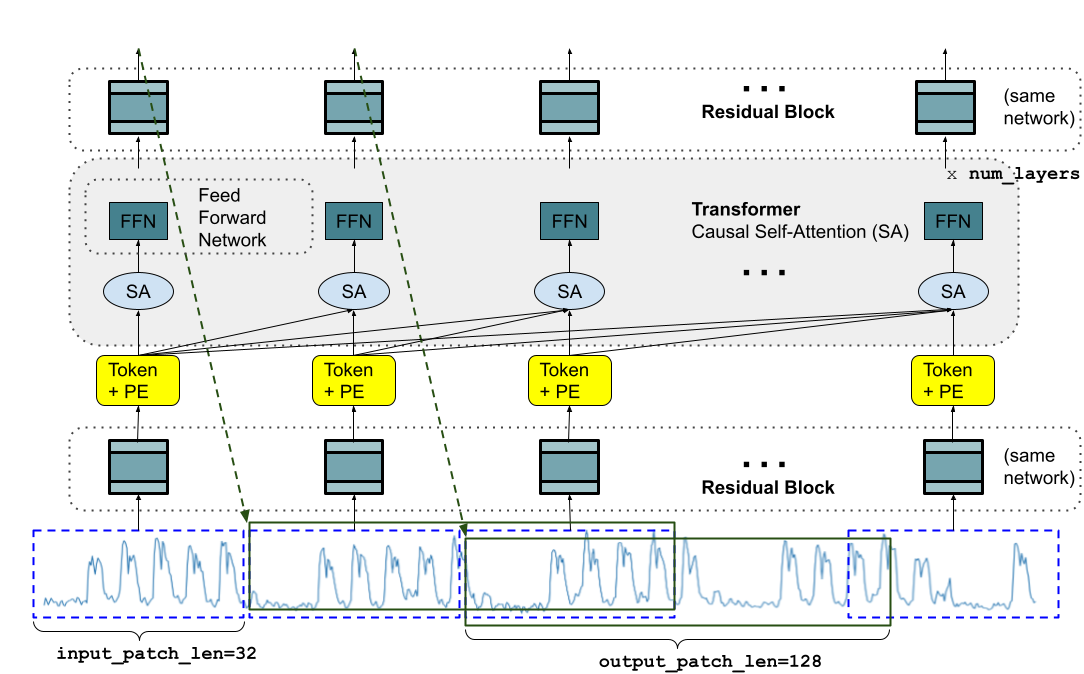
- 基于补丁的输入处理,将时序数据转换为补丁并输入到解码器仅使用的 Transformer 中。
- 使用更长的输出补丁来预测更长的预测区间,从而减少自回归步骤。
- 在训练中应用补丁屏蔽,以实现从1到最大上下文长度的可变上下文长度。
- 训练一个解码器仅模型(TimesFM),采用残差块和因果多头自注意力。
- 在大量现实世界数据(Google Trends、Wiki Pageviews)与合成时序数据的混合语料上进行预训练(约 100B 时间点)。
- 使用均方误差损失进行点预测,未来工作中有潜在引入概率头的可能。
实验结果
研究问题
- RQ1单一的预训练时序基础模型是否能够在跨领域的未见数据集上实现强大的零样本预测?
- RQ2哪些架构选择(补丁化、解码器式设计、补丁长度的权衡)能够在时序预测中实现有效的零样本泛化?
- RQ3数据源和预训练规模如何影响在不同时间跨度和粒度上的零样本预测性能?
- RQ4在基础模型设置中,更长的输出补丁解码是否有利于长时域预测?
- RQ5补丁大小和屏蔽策略对上下文长度鲁棒性与精度有何影响?
主要发现
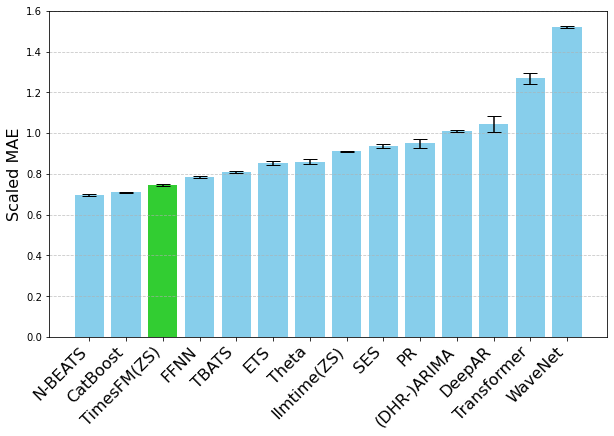
- TimesFM 在多样且此前未见的数据集上实现接近最先进有监督模型的零样本预测性能。
- 该模型拥有 200M 参数,在约 ~100B 时间点上进行预训练,能够在不同的时间跨度和粒度上泛化。
- TimesFM 在零样本设置下与 Monash、Darts 和 Informer 数据集组的顶尖基线具有竞争力。
- 消融研究显示参数规模提升可改善性能,较长的输出补丁减少自回归步骤并提高长时 horizon 的准确性。
- 相比仅真实数据的较小规模预训练,Large、多样化的预训练数据(真实 + 合成)显著提升了零样本性能。
阅读本论文
在 Nubint 阅读器中打开原文,边读边就任意段落提问。
在 Nubint 中阅读本论文本解读由 AI 根据论文原文生成,引用前请核对原文。