
[论文解读] A Dual-Augmentor Framework for Domain Generalization in 3D Human Pose Estimation
本文提出了一种用于3D人体姿态估计领域泛化的双增强器框架,利用弱增强器保留源域知识,强增强器探索分布外姿态,同时通过元优化在训练过程中模拟领域偏移。该方法实现了最先进性能,在3DHP数据集上将MPJPE降低2.4mm、AUC提升0.8%,并在多个基准测试中优于先前方法。
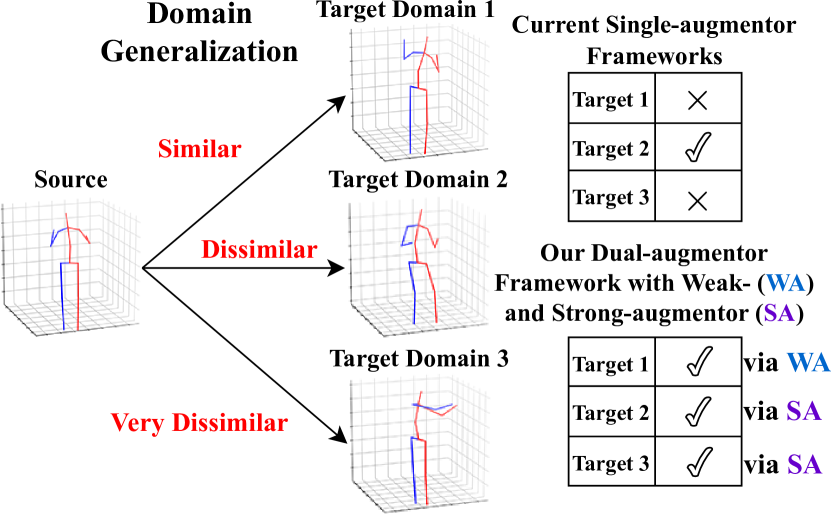
3D human pose data collected in controlled laboratory settings present challenges for pose estimators that generalize across diverse scenarios. To address this, domain generalization is employed. Current methodologies in domain generalization for 3D human pose estimation typically utilize adversarial training to generate synthetic poses for training. Nonetheless, these approaches exhibit several limitations. First, the lack of prior information about the target domain complicates the application of suitable augmentation through a single pose augmentor, affecting generalization on target domains. Moreover, adversarial training's discriminator tends to enforce similarity between source and synthesized poses, impeding the exploration of out-of-source distributions. Furthermore, the pose estimator's optimization is not exposed to domain shifts, limiting its overall generalization ability. To address these limitations, we propose a novel framework featuring two pose augmentors: the weak and the strong augmentors. Our framework employs differential strategies for generation and discrimination processes, facilitating the preservation of knowledge related to source poses and the exploration of out-of-source distributions without prior information about target poses. Besides, we leverage meta-optimization to simulate domain shifts in the optimization process of the pose estimator, thereby improving its generalization ability. Our proposed approach significantly outperforms existing methods, as demonstrated through comprehensive experiments on various benchmark datasets.Our code will be released at \url{https://github.com/davidpengucf/DAF-DG}.
研究动机与目标
- 解决3D人体姿态估计中的领域泛化问题,其中标注数据仅限于受控的实验室环境。
- 克服单增强器方法的局限性,后者难以在保留源域知识与探索分布外姿态之间取得平衡。
- 减少对对抗训练的依赖,后者强制要求源域与合成姿态之间保持相似性,从而限制了姿态多样性。
- 通过元优化在优化过程中模拟领域偏移,提升姿态估计器的泛化能力。
- 实现在无需目标域数据的情况下有效训练,仅依赖源域数据。
提出的方法
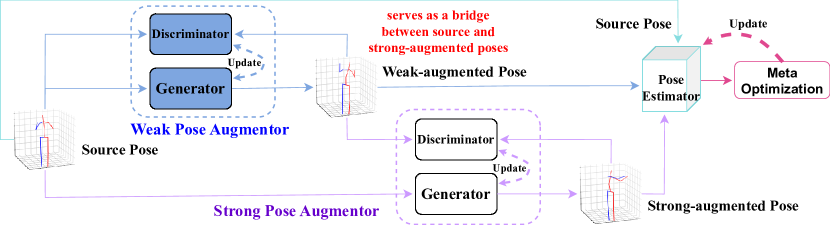
- 引入两种不同的姿态增强器:弱增强器用于保留类似源域的姿态,强增强器用于探索源域外的分布。
- 在生成与判别过程中采用差异化策略:弱增强姿态作为桥梁,使判别器能够区分强增强姿态与弱增强姿态。
- 使用邻近对(W-PP, S-PP)以保持局部姿态一致性,以及单状态间隙对(W-OG, S-OG)以强制弱生成器与强生成器输出之间的结构差异。
- 在源域、弱增强与强增强姿态之间应用元优化,以在训练过程中模拟领域偏移,提升领域不变特征学习能力。
- 采用对抗训练,但改进了判别器设置,避免强制要求源域与所有增强姿态之间保持相似性。
- 采用VPose作为主干网络,并在3DHP与3DPW数据集上使用标准指标(包括PCK、AUC与MPJPE)进行评估。
实验结果
研究问题
- RQ1与单增强器方法相比,双增强器框架是否能更好地平衡保留源域知识与探索分布外姿态?
- RQ2将弱增强器与强增强器的判别过程解耦,是否能在不依赖对抗相似性强制的前提下提升泛化能力?
- RQ3在源域、弱增强与强增强数据之间进行元优化,能在多大程度上增强姿态估计器对领域偏移的鲁棒性?
- RQ4邻近对与单状态间隙对组件在合成姿态的质量与多样性方面分别起到何种贡献?
- RQ5与最先进领域泛化方法相比,该双增强器框架是否在标准3D人体姿态估计基准上取得更优性能?
主要发现
- 与先前最先进方法相比,所提出的双增强器框架在3DHP数据集上实现了PCK提升1.2%、AUC提升0.8%,并使MPJPE降低2.4mm。
- 在3DPW数据集上,该方法将PA-MPJPE降低1.3mm,MPJPE降低1.8mm,表明在多个数据集上均保持一致的性能提升。
- 消融实验表明,若移除弱增强邻近对(W-PP),3DHP上的PCK将下降4.6%,MPJPE将上升9.5mm,凸显其在姿态一致性中的关键作用。
- 若在强增强器中排除单状态间隙对(S-OG),PCK将下降1.5%,MPJPE将上升3.4mm,表明其在区分生成器输出方面具有重要意义。
- 双增强器框架优于所有单增强器基线方法(WA与SA),其中WA在3DHP上的PCK仅为87.3%,SA为89.8%,而完整方法达到92.9%的PCK。
- 消融研究确认,所有组件——差异化生成、差异化判别与元优化——均不可或缺,任一组件的移除均导致性能显著下降。
阅读本论文
在 Nubint 阅读器中打开原文,边读边就任意段落提问。
在 Nubint 中阅读本论文本解读由 AI 根据论文原文生成,引用前请核对原文。