
[论文解读] A feature-based information-theoretic approach for detecting interpretable, long-timescale pairwise interactions from time series
本文提出了一种基于特征的信息-理论方法,通过建模时间序列特征(如均值、自相关性、众数)而非原始值来检测可解释的、长时间尺度的成对相互作用。在低样本量、高噪声和长记忆性场景下,该方法在性能上优于传统的基于原始数据的互信息方法,尤其在统计表面更平滑的特征上表现更优。
Quantifying relationships between components of a complex system is critical to understanding the rich network of interactions that characterize the behavior of the system. Traditional methods for detecting pairwise dependence of time series, such as Pearson correlation, Granger causality, and mutual information, are computed directly in the space of measured time-series values. But for systems in which interactions are mediated by statistical properties of the time series (`time-series features') over longer timescales, this approach can fail to capture the underlying dependence from limited and noisy time-series data, and can be challenging to interpret. Addressing these issues, here we introduce an information-theoretic method for detecting dependence between time series mediated by time-series features that provides interpretable insights into the nature of the interactions. Our method extracts a candidate set of time-series features from sliding windows of the source time series and assesses their role in mediating a relationship to values of the target process. Across simulations of three different generative processes, we demonstrate that our feature-based approach can outperform a traditional inference approach based on raw time-series values, especially in challenging scenarios characterized by short time-series lengths, high noise levels, and long interaction timescales. Our work introduces a new tool for inferring and interpreting feature-mediated interactions from time-series data, contributing to the broader landscape of quantitative analysis in complex systems research, with potential applications in various domains including but not limited to neuroscience, finance, climate science, and engineering.
研究动机与目标
- 为解决传统时间序列依赖度量(如皮尔逊相关系数和基于原始值的互信息)在检测噪声或短时间序列数据中长时间尺度、特征介导的相互作用时的局限性。
- 开发一种方法,以捕捉通过时间序列统计特性(特征)在长时间尺度上传递的相互作用,这类相互作用在神经动力学和金融市场等复杂系统中普遍存在。
- 通过明确识别哪些时间序列特征(如均值、众数、时间可逆性)介导了源过程与目标过程之间的依赖关系,提升方法的可解释性。
- 在时间序列长度短、噪声高和相互作用时间尺度长等挑战性条件下,提升检测的灵敏度与可靠性,而传统方法在此类场景下往往失效。
提出的方法
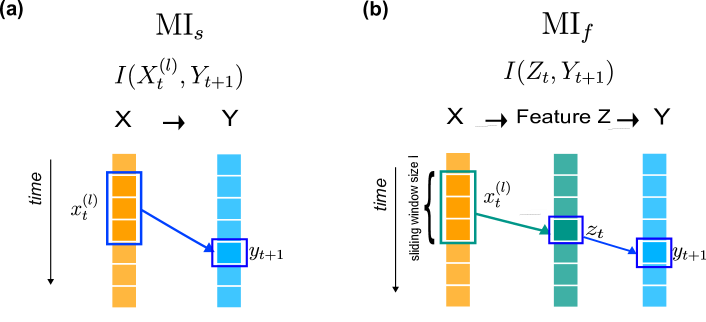
- 从源时间序列的滑动窗口中提取时间序列特征(如均值、标准差、自相关时间尺度、众数、时间可逆性)。
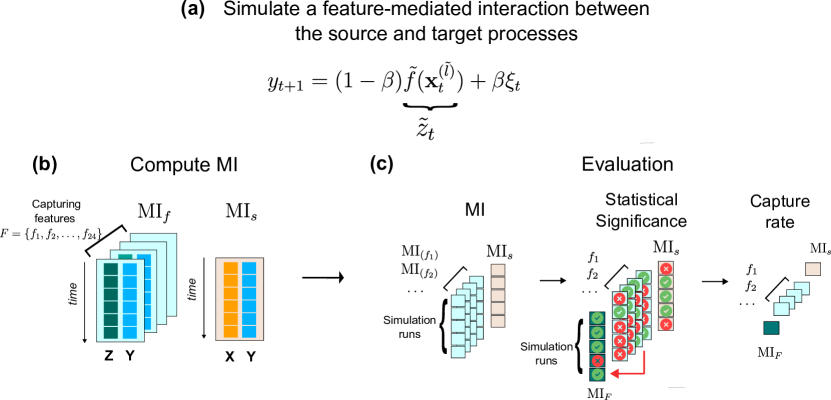
- 通过滑动窗口建模源的近期历史,计算目标过程与每个提取特征之间的互信息(MI)。
- 该方法将目标过程建模为对源过去某一时间序列特征的线性噪声响应,模拟中用于验证性能。
- 使用时间延迟嵌入法将源过程映射到高维空间,以支持在时间窗口内计算特征。
- 通过目标与特征向量之间的互信息评估依赖关系,从而检测非马尔可夫性、长记忆性的相互作用。
- 将该方法与基于原始值的标准互信息(MI_raw)进行对比,并评估在不同特征和数据条件下的敏感性。
实验结果
研究问题
- RQ1基于特征的信息-理论方法是否能比依赖原始时间序列值的标准方法更有效地检测长时间尺度、特征介导的相互作用?
- RQ2在不同噪声水平和时间序列长度下,该方法在不同时间序列特征(如均值、众数、自相关性)上的性能表现如何变化?
- RQ3时间延迟嵌入空间中特征表面的平滑度在多大程度上影响依赖关系检测的可靠性?
- RQ4当目标过程依赖于源过程在长时间尺度上的统计特性时,该方法是否能可靠检测到相互作用,即使数据量有限?
- RQ5与传统方法相比,该方法在识别介导相互作用的具体动力学特性方面,其可解释性如何?
主要发现
- 基于特征的互信息(MI_F)方法在检测长时间尺度相互作用方面显著优于基于原始值的标准互信息(MI_raw),尤其在高噪声和短时间序列长度条件下。
- 检测性能因特征类型而异,其中均值和标准差等平滑特征表现出更快的收敛速度和更高的捕获率,而众数_5等粗糙特征则表现较差。
- 众数_5的依赖捕获率随时间序列长度缓慢提升,表明涉及非平滑统计特性的特征介导相互作用更难检测。
- 该方法的性能与相互作用时间尺度和特征类型之间呈非单调关系,反映了数据长度、噪声水平与特征表面粗糙度之间的复杂相互作用。
- 理论分析表明,时间延迟嵌入空间中更平滑的特征表面对噪声不敏感,这解释了不同特征间性能差异的成因。
- 该方法通过明确识别介导相互作用的具体时间序列特征(如波动率、振荡频率),实现了可解释的检测,为理解潜在的动力学机制提供了洞见。
阅读本论文
在 Nubint 阅读器中打开原文,边读边就任意段落提问。
在 Nubint 中阅读本论文本解读由 AI 根据论文原文生成,引用前请核对原文。