
[论文解读] A fully hybrid integrated Erbium-based laser
展示了在 Er:Si3N4 上实现的完全集成芯尺度铒激光器,配备 Vernier 滤波器,具备亚 100 Hz 内在线宽、高 SMSR (>72 dB)、宽调谐 (>40 nm),以及 ~17 mW 输出功率,使用 III-V 泵浦激光。
Erbium-doped fiber lasers exhibit high coherence and low noise as required for applications in fiber optic sensing, gyroscopes, LiDAR, and optical frequency metrology. Endowing Erbium-based gain in photonic integrated circuits can provide a basis for miniaturizing low-noise fiber lasers to chip-scale form factor, and enable large-volume applications. Yet, while major progress has been made in the last decade on integrated lasers based on silicon photonics with III-V gain media, the integration of Erbium lasers on chip has been compounded by large laser linewidth. Recent advances in photonic integrated circuit-based high-power Erbium-doped amplifiers, make a new class of rare-earth-ion-based lasers possible. Here, we demonstrate a fully integrated chip-scale Erbium laser that achieves high power, narrow linewidth, frequency agility, and the integration of a III-V pump laser. The laser circuit is based on an Erbium-implanted ultralow-loss silicon nitride Si$_3$N$4$ photonic integrated circuit. This device achieves single-mode lasing with a free-running intrinsic linewidth of 50 Hz, a relative intensity noise of $<$-150 dBc/Hz at $>$10 MHz offset, and output power up to 17 mW, approaching the performance of fiber lasers and state-of-the-art semiconductor extended cavity lasers. An intra-cavity microring-based Vernier filter enables wavelength tunability of $>$ 40 nm within the C- and L-bands while attaining side mode suppression ratio (SMSR) of $>$ 70 dB, surpassing legacy fiber lasers in tuning and SMRS performance. This new class of low-noise, tuneable Erbium waveguide laser could find applications in LiDAR, microwave photonics, optical frequency synthesis, and free-space communications. Our approach is extendable to other wavelengths, and more broadly, constitutes a novel way to photonic integrated circuit-based rare-earth-ion-doped lasers.
研究动机与目标
- Motivate integration of Erbium gain on photonic chips to combine fiber-laser coherence with chip-scale form factors.
- Demonstrate a fully hybrid integrated Erbium laser using Er:Si3N4 circuitry with meter-scale Erbium gain for substantial net gain.
- Achieve single-mode lasing with narrow linewidth, low noise, and tunable operation within the Erbium emission band.
- Integrate a III-V pump laser to enable a compact, packaged laser platform.
提出的方法
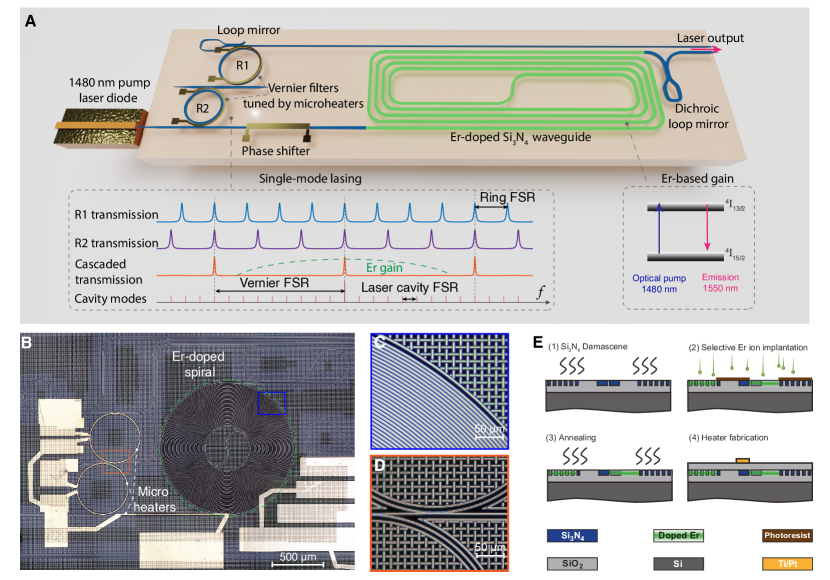
- Use Erbium-implanted ultralow-loss Si3N4 photonic integrated circuits to provide Er-based gain along a spiral waveguide.
- Implement a linear cavity with Sagnac loop mirrors and a dichroic pump/reflection loop to form an intra-cavity Vernier filter.
- Employ two cascaded add-drop microring resonators to create a Vernier filter with ~4.65 THz FSR and ~600 MHz 3-dB bandwidth for single-mode operation.
- Integrate microheaters and a phase shifter to tune the Vernier filter and align cavity modes with the filter passband.
- Package the device by edge-coupling a 1480 nm III-V pump laser and fiber-coupling the output, enabling a fully integrated laser assembly.
- Characterize frequency noise, intrinsic linewidth via delayed self-heterodyne, and RIN against a reference laser.
实验结果
研究问题
- RQ1Can Er3+-doped Si3N4 waveguides realize a low-noise, chip-scale Erbium laser with competitive linewidth and SMSR?
- RQ2What wavelength tuning range and SMSR can be achieved with an on-chip Vernier filter in a hybrid integrated Erbium laser?
- RQ3Is it feasible to integrate a pump laser and achieve stable, packaged operation with high output power in a chip-scale Erbium laser?
- RQ4How do the frequency noise and RIN of the fully integrated Erbium laser compare to conventional fiber and semiconductor lasers?
主要发现
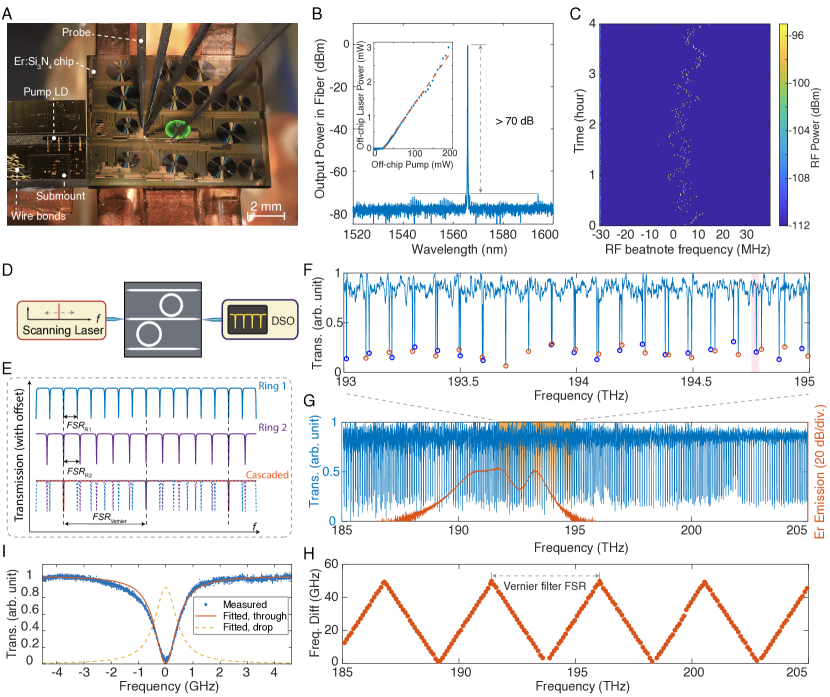
- Achieved single-mode lasing with an intrinsic linewidth of 50 Hz, and an output power up to 17 mW.
- Observed relative intensity noise (RIN) below -130 to -155 dBc/Hz over mid to high offset frequencies.
- Demonstrated a Vernier-filter-based wavelength tuning of over 40 nm in the C- and L-bands with SMSR > 70 dB.
- Packaged the device with a III-V pump laser achieving wavelength tuning and stable operation with frequency drift < 20 MHz over 4 hours and < 140 MHz over 24 hours.
- Measured a large Vernier filter FSR of 4.65 THz (37.1 nm) enabling continuous single-mode operation within the Er emission band.
- Reached a record high SMSR of 72 dB, surpassing many integrated and fiber-based Erbium laser implementations.
阅读本论文
在 Nubint 阅读器中打开原文,边读边就任意段落提问。
在 Nubint 中阅读本论文本解读由 AI 根据论文原文生成,引用前请核对原文。