
[论文解读] A Guide to Regression Discontinuity Designs in Medical Applications
本文为在生物医学研究中应用回归不连续设计(RD)提供了全面且实用的指南,重点涵盖基于连续性的方法和局部随机化方法,适用于连续和离散评分的精确RD与模糊RD。研究指出,RD的有效性取决于严格假设,并展示了诊断方法与代码,以确保在真实医疗场景中实现稳健的因果推断。
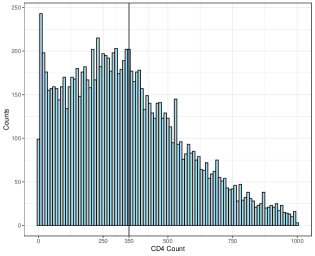
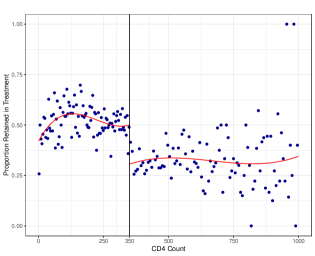
We present a practical guide for the analysis of regression discontinuity (RD) designs in biomedical contexts. We begin by introducing key concepts, assumptions, and estimands within both the continuity-based framework and the local randomization framework. We then discuss modern estimation and inference methods within both frameworks, including approaches for bandwidth or local neighborhood selection, optimal treatment effect point estimation, and robust bias-corrected inference methods for uncertainty quantification. We also overview empirical falsification tests that can be used to support key assumptions. Our discussion focuses on two particular features that are relevant in biomedical research: (i) fuzzy RD designs, which often arise when therapeutic treatments are based on clinical guidelines but patients with scores near the cutoff are treated contrary to the assignment rule; and (ii) RD designs with discrete scores, which are ubiquitous in biomedical applications. We illustrate our discussion with three empirical applications: the effect of CD4 guidelines for anti-retroviral therapy on retention of HIV patients in South Africa, the effect of genetic guidelines for chemotherapy on breast cancer recurrence in the United States, and the effects of age-based patient cost-sharing on healthcare utilization in Taiwan. We provide replication materials employing publicly available statistical software in Python, R and Stata, offering researchers all necessary tools to conduct an RD analysis.
研究动机与目标
- 解决在随机对照试验不可行或不道德的生物医学研究中日益增长的严谨因果推断需求。
- 为研究人员提供在临床指南和离散诊断评分背景下,实施RD设计的清晰、分步指南。
- 强调通过虚假检验和稳健推断方法验证RD假设的重要性。
- 展示当关键假设(如依从性和协变量平衡)被违反时,RD应用的局限性。
- 提供使用R、Stata和Python开发的易用、可复现的工具,以促进健康服务与结果研究中的广泛应用。
提出的方法
- 采用基于连续性的框架,通过在临界值附近对潜在结果建模为连续函数来估计治疗效应,依赖于局部多项式回归。
- 应用局部随机化框架,将临界值附近的单位视为随机分配,从而在较弱的光滑性假设下实现非参数推断。
- 采用带宽选择方法(如偏差校正、插值法或交叉验证)以优化估计的精度并减少偏差。
- 实施稳健的偏差校正推断程序,以量化不确定性,特别是在小样本或离散评分情况下的表现。
- 通过检查临界值附近的预处理协变量进行虚假检验,以验证条件独立性假设。
- 通过第一阶段估计依从性(例如,P(T=1|X≥c) − P(T=1|X<c))来评估模糊RD设计中工具变量的强度。
实验结果
研究问题
- RQ1如何在基于诊断阈值的临床指南背景下,可靠地将回归不连续设计应用于生物医学研究?
- RQ2在RD设计中,基于连续性的框架与局部随机化框架在估计与推断方面有何关键差异?
- RQ3在医学诊断中常见的离散评分如何影响RD分析的有效性与实施?
- RQ4虚假检验在多大程度上能够检测出RD设计中关键识别假设的违反?
- RQ5在何种条件下,模糊RD设计无法产生可靠的因果估计,以及如何诊断此类问题?
主要发现
- 将RD应用于乳腺癌患者化疗的基因检测指南时,未能通过诊断检查:即使在最小窗口内,关键的预处理协变量(如淋巴血管侵犯)仍存在不平衡。
- 达到Oncotype评分26分对接受化疗的影响第一阶段效应微弱,治疗概率仅提高0.15,Fisher精确检验p值为0.32,表明存在弱工具变量问题。
- 大样本F统计量为1.51,进一步证实了弱工具变量的存在,从而削弱了该应用中模糊RD估计的可靠性。
- 南非的ART与保留率研究通过了虚假检验,显示临界值附近无预处理协变量不平衡,支持了RD设计的有效性。
- 台湾的费用分担研究表明,当假设成立时,基于年龄的离散评分可有效通过RD方法进行分析。
- R、Stata和Python的复现材料与代码已公开,支持可复现性,并推动现代RD方法在生物医学研究中的广泛采用。
阅读本论文
在 Nubint 阅读器中打开原文,边读边就任意段落提问。
在 Nubint 中阅读本论文本解读由 AI 根据论文原文生成,引用前请核对原文。