
[论文解读] A hidden population of white dwarfs with atmospheric carbon traces in the Gaia bifurcation
该论文提出,盖亚白矮星分叉现象中的B分支是由‘隐性DQ’白矮星引起的——这些是富含氦但大气中碳含量极低、在光学光谱中无法探测到的恒星,但其碳导致连续谱向蓝端移动。这些恒星通过对流驱动的碳上翻形成,能重现分叉现象,并在约0.6 M⊙处产生质量峰值,与标准演化理论及DA型白矮星的质量分布一致。
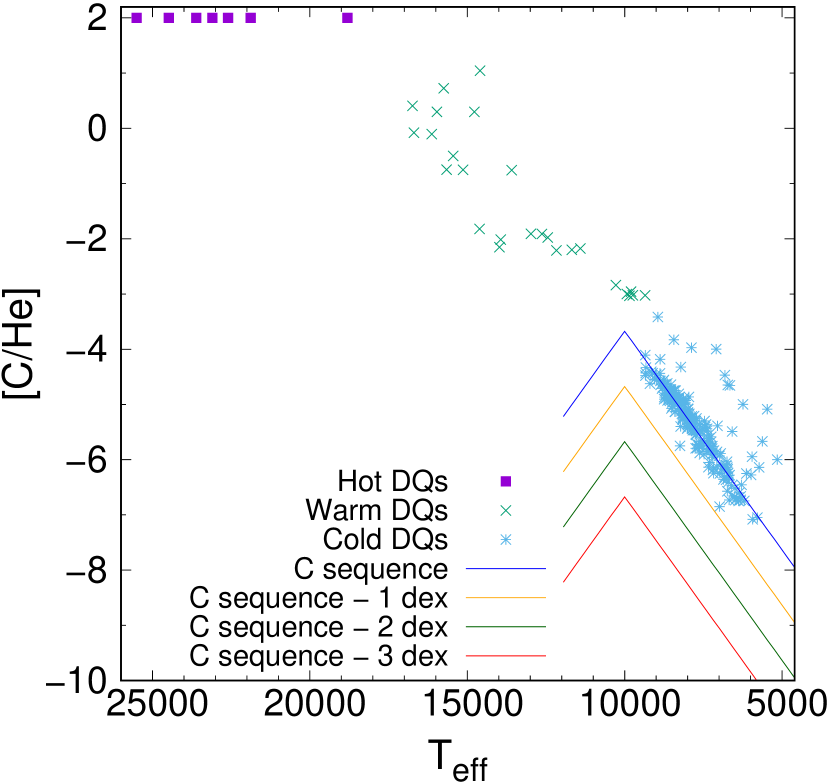
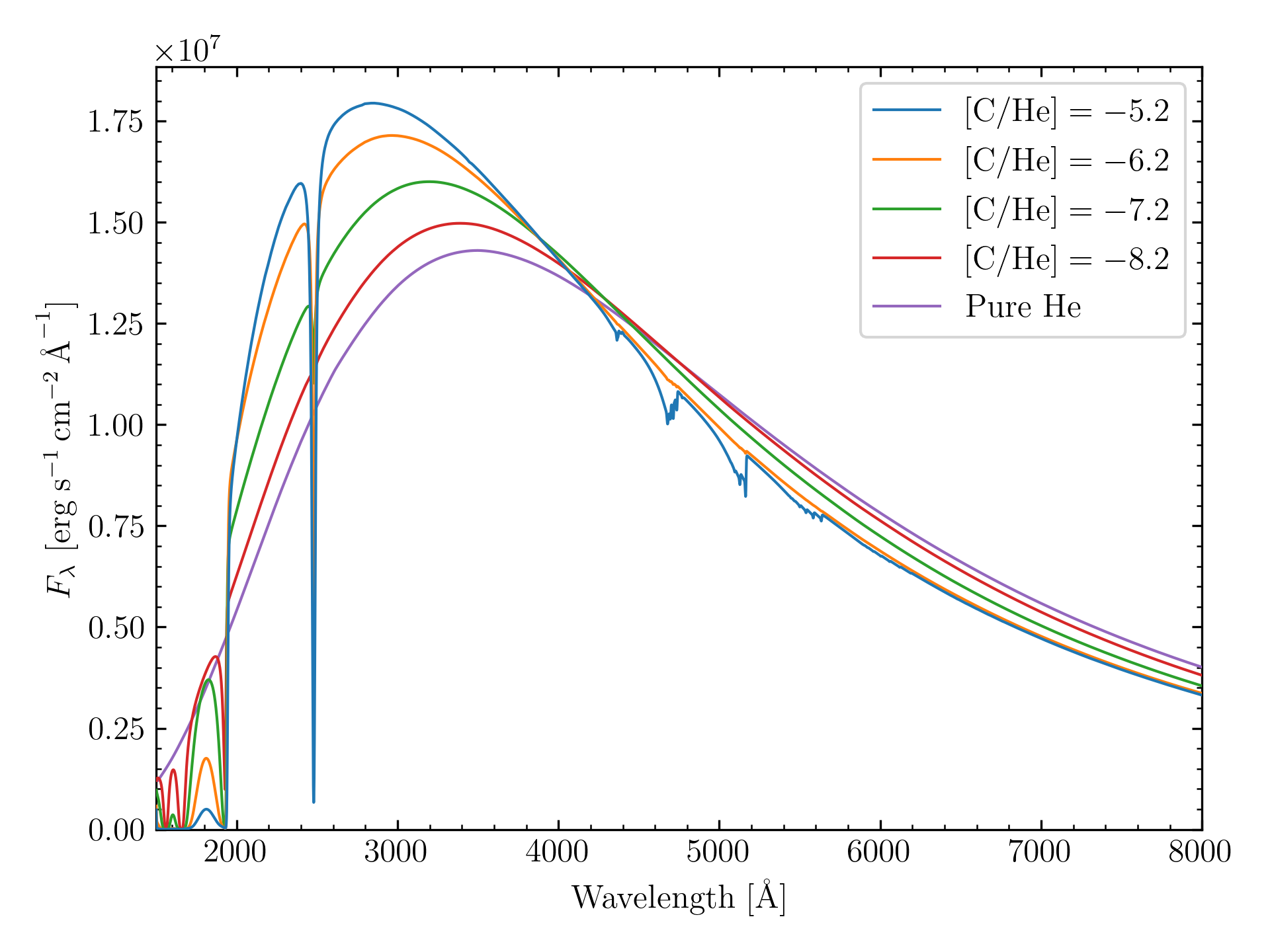
The ESA Gaia space mission has revealed a bifurcation of the white dwarf (WD) sequence on the color magnitude diagram in two branches: A and B. While the A branch consists mostly of WDs with H-rich atmospheres, the B branch is not completely understood. Although invoked to be populated mainly by He-rich WDs, the B branch overlaps a $\sim 0.8M_\odot$ evolutionary track with a pure He envelope, fact that would imply an unexpected peak in the WD mass distribution. In cold He-rich WDs, it is expected that the outer convective zone penetrates into deep C-rich layers, thus leading to a slight C contamination in their surfaces at $\sim 10,000$K. Here we aim at studying the Gaia bifurcation as the natural consequence of C dredge-up by convection in cold He-dominated WDs. Relying on accurate atmosphere models, we provide a new set of evolutionary models for He-rich WDs employing different prescriptions for the C enrichment. On the basis of these models, we made a population synthesis study of the Gaia 100pc WD sample to constrain the models that best fit the bifurcation. Our study shows that He-rich WD models with a slight C contamination below the optical detection limit can accurately reproduce the Gaia bifurcation. We refer to these stars as stealth DQ WDs because they do not exhibit detectable C signatures in their optical spectra, but the presence of C in their atmosphere produces a continuum absorption favouring the emission in bluer wavelengths, thereby creating the B branch of the bifurcation. Also, we show that the mass distribution for He-rich WDs obtained when a stealth C contamination is considered is consistent with the mass distribution for H-rich WDs and with the standard evolutionary channels for their formation. We conclude that stealth DQ WDs can account for the lower branch in the Gaia bifurcation. The C signatures of these stars could be detectable in Ultra-Violet spectra.
研究动机与目标
- 解释盖亚白矮星颜色-星等图分叉现象中B分支的起源,该现象无法用纯氦丰富模型解释。
- 解决白矮星质量分布中的不一致问题:纯氦丰富模型预测峰值位于约0.8 M⊙,与观测到的DA型白矮星质量冲突。
- 研究氦丰富白矮星大气中微量碳是否能在无明显光学光谱特征的情况下产生观测到的测光偏移。
- 将非DA型白矮星的观测质量分布与标准演化路径(特别是晚期热脉冲)相协调。
- 提出可检验的预测:在B分支白矮星的紫外光谱中应能探测到碳特征。
提出的方法
- 为富含氦的白矮星开发了新的演化模型,采用不同碳富集方案,模拟来自深层富碳层的对流上翻过程。
- 使用精确的大气模型计算富含氦的白矮星在微量碳存在下的合成测光和光谱能量分布。
- 对盖亚100秒差距白矮星样本进行群体合成,变化初始-最终质量关系(IFMR)、DA与非DA比例以及大气成分。
- 将合成的颜色-星等图与盖亚DR3观测数据进行比较,采用χ²最小化方法评估模型拟合度。
- 在演化模型中插值盖亚G和G<sub>BP</sub>−G<sub>RP</sub>星等,以推断单个白矮星的质量。
- 评估多种碳富集方案,包括C序列和C序列−1 dex方案,并在群体中随机分布碳含量。
实验结果
研究问题
- RQ1在光学光谱中无明显碳线的情况下,氦丰富白矮星大气中的微量碳是否能解释B分支的测光偏移?
- RQ2在包含‘隐性DQ’白矮星(碳含量不可见)的情况下,是否能重现100秒差距样本中观测到的白矮星质量分布?
- RQ3当考虑碳污染时,非DA型白矮星质量分布中约0.6 M⊙的观测峰值是否与标准演化路径一致?
- RQ4哪种碳富集方案最符合颜色-星等图中的盖亚分叉现象?
- RQ5紫外光谱能否探测到B分支白矮星中的碳特征,从而为隐性DQ假说提供观测验证?
主要发现
- 在光学检测极限以下存在微量碳污染的富含氦白矮星模型,能准确重现盖亚分叉现象中的B分支。
- ‘隐性DQ’模型——其中碳导致连续谱吸收,使蓝端辐射增强——产生质量分布峰值在约0.6 M⊙,与DA型白矮星及标准演化理论一致。
- 纯氦大气模型无法重现观测数据,其结果在约0.8 M⊙处出现虚假峰值,与观测不符。
- 最佳拟合模型采用C序列参数化方案进行碳富集,尽管C序列−1 dex方案也表现出良好一致性。
- 在群体中随机分布碳富集的模型表现几乎同样出色,表明异质但微量的碳污染是合理的。
- 本研究预测,B分支白矮星的紫外光谱中应显示强烈的碳特征,为隐性DQ假说提供了直接的观测检验途径。
阅读本论文
在 Nubint 阅读器中打开原文,边读边就任意段落提问。
在 Nubint 中阅读本论文本解读由 AI 根据论文原文生成,引用前请核对原文。