
[论文解读] A lanthanide-rich kilonova in the aftermath of a long gamma-ray burst
论文报告了在长时间伽马射线爆发 GRB 230307A 之后的 kilonova,最好由两组富镧元素的喷出组成描述,晚期总辐射衰减并有 r-过程元素产生的证据。
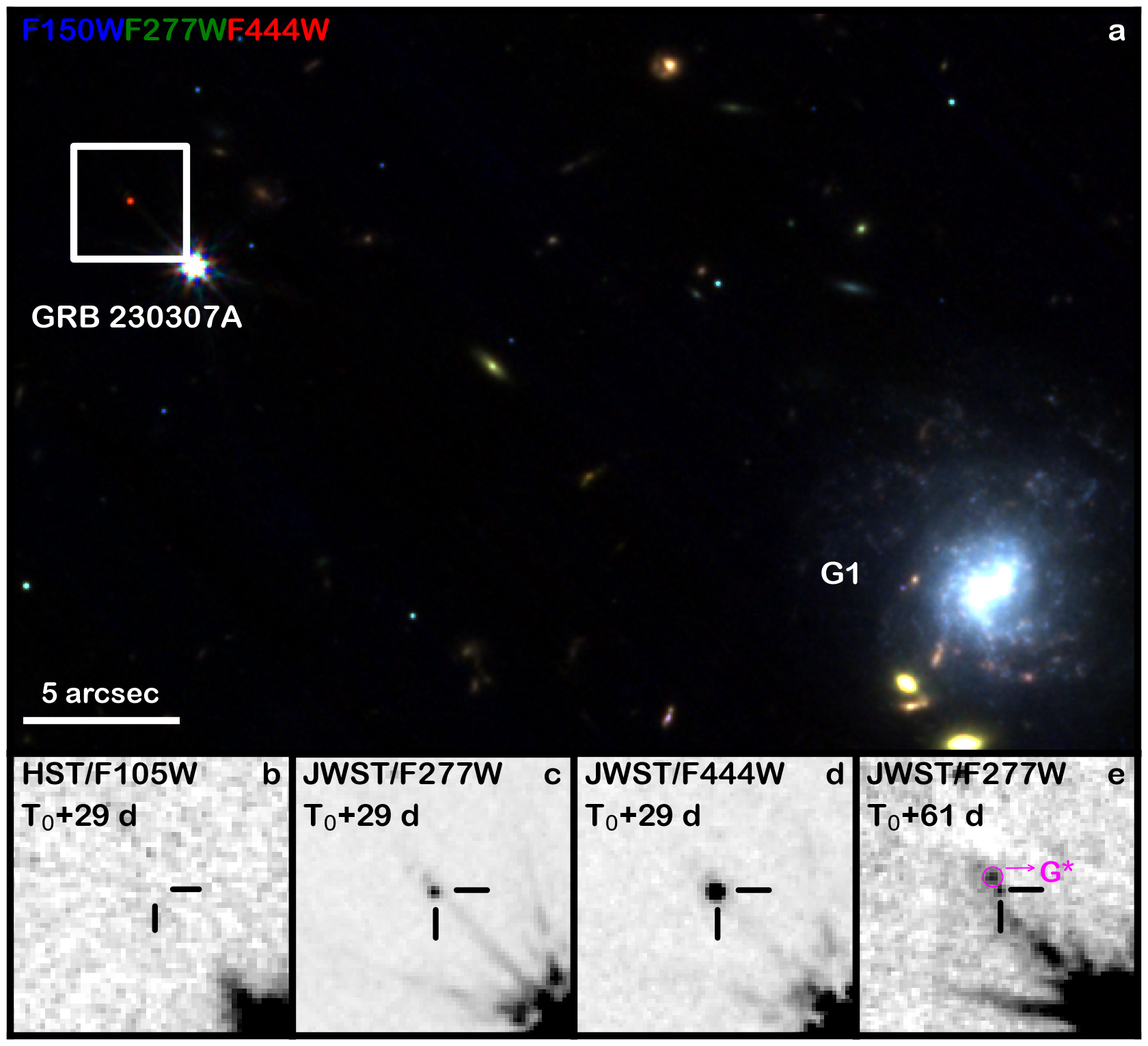
Kilonovae are a rare class of astrophysical transients powered by the radioactive decay of nuclei heavier than iron, synthesized in the merger of two compact objects. Over the first few days, the kilonova evolution is dominated by a large number of radioactive isotopes contributing to the heating rate. On timescales of weeks to months, its behavior is predicted to differ depending on the ejecta composition and merger remnant. However, late-time observations of known kilonovae are either missing or limited. Here we report observations of a luminous red transient with a quasi-thermal spectrum, following an unusual gamma-ray burst of long duration. We classify this thermal emission as a kilonova and track its evolution up to two months after the burst. At these late times, the recession of the photospheric radius and the rapidly-decaying bolometric luminosity ($L_{ m bol}\propto t^{-2.7\pm 0.4}$) support the recombination of lanthanide-rich ejecta as they cool.
研究动机与目标
- 推动寻找与长伽马射线爆发相关的 kilonova,并检验此类事件是否合成重的 r-过程元素。
- 表征晚期发射以区分 kilonova 热成分与非热 afterglow。
- 约束喷出物属性(质量、速度、光学率、成分)并评估镧系富材料在驱动光曲线中的作用。
- 研究 GRB 前体情景和宿主星系环境,以评估 230307A 的紧凑双星并合起源。
提出的方法
- 使用 XSPEC 对光学、近红外和 X 射线数据进行联合谱能分布建模,采用幂律加黑体分量(包括 zphabs/zdust 和 zigm 以提高对红移敏感性)。
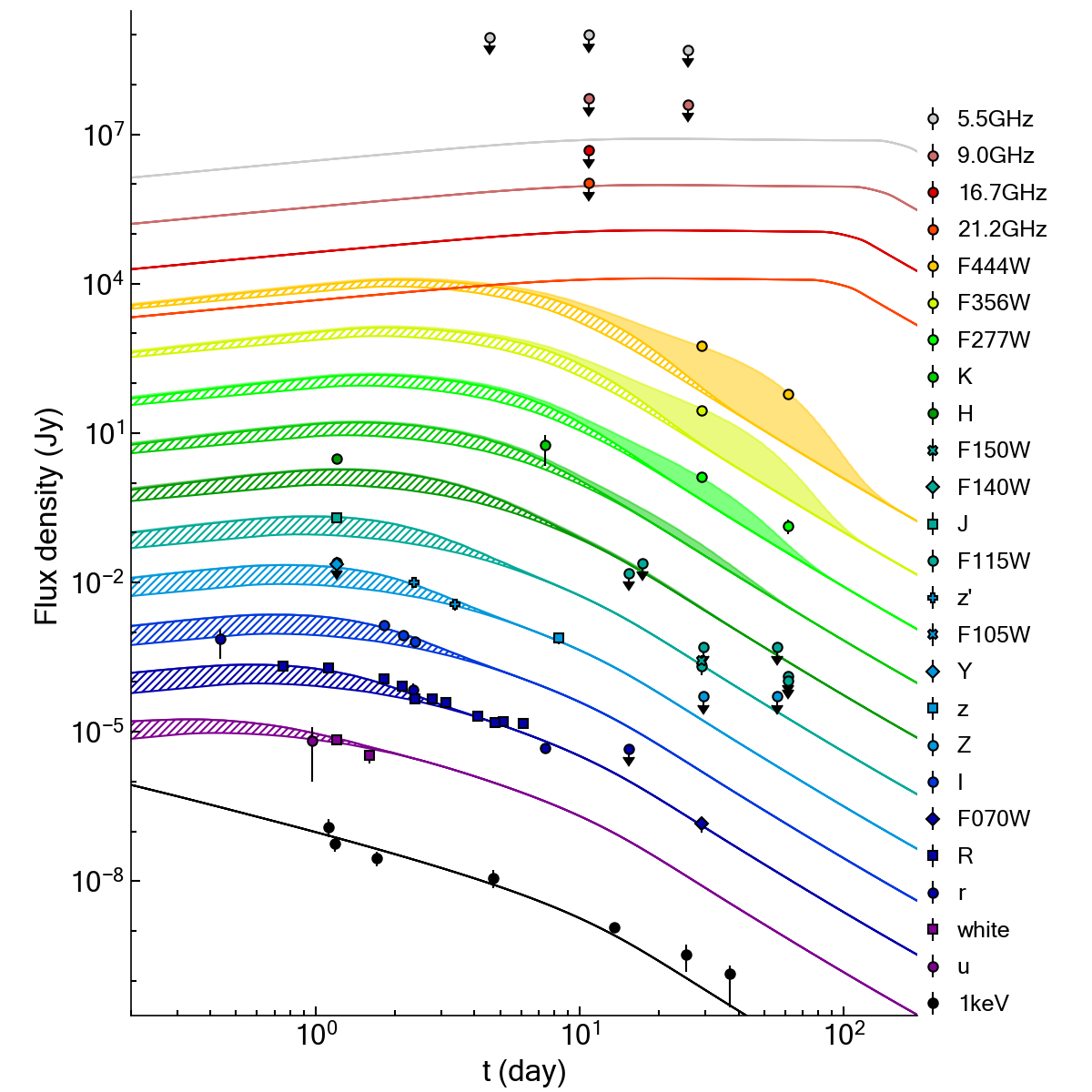
- 使用 kilonova/X-ray/IR 光曲线对喷出物质量、速度和光学率进行变化的两组件 kilonova 模型建模;与单组分 KN 和 afterglow 模型进行比较。
- 使用外部前向冲激框架(afterglowpy)进行 afterglow 建模,以及来自 gwemlightcurves 的 kilonova 光曲线来拟合多波段数据。
- 通过 MCMC/巢状采样(pymultinest)进行贝叶斯推断,推导最优拟合参数并评估模型证据(ΔBIC)。
- 通过黑体拟合推断总辐射光度、光球半径和温度的演化,以跟踪喷发物的冷却与重组。
- 基于 JWST/HST 观测对宿主星系属性和红移约束进行评估,以为距离尺度和前体解释提供信息。
实验结果
研究问题
- RQ1GRB 230307A 的宿主是否包含由 r-过程增强、富镧喷出物驱动的 kilonova?
- RQ2为重现观测到的光曲线和光谱,kilonova 喷出物的质量、速度和光学率是多少?
- RQ3是否需要一个两分量的 kilonova 来解释光学/NIR/IR 的演变,这对喷出物的组成和电离状态意味着什么?
- RQ4结合宿主环境和初始发射特征,这一事件对 GRB 前体(紧凑双星并合 vs 巨大恒星坍缩)的意义是什么?
- RQ5晚期总辐射光度和光球演化如何约束能量沉积(如缺乏强磁星/裂变信号)以及镧系元素的存在?
主要发现
- afterglow 加 kilonova 模型比仅有 afterglow 的模型拟合显著更好(ΔBIC > 140)。
- 偏好两组 kilonova 组分:一组快速、低光学率喷出物(v ~ 0.2c,M ≈ 0.03 M_sun,κ ≲ 3 cm^2 g^-1),支配早期辐射;另一组较慢、高光学率组分(v ~ 0.03c,M ≈ 0.05 M_sun,κ ≳ 13 cm^2 g^-1),支配晚期辐射。
- 总辐射光度随时间衰减,L_bol ∝ t^-2.7 ± 0.4,从约 29 d 至约 61 d,温度降至低于约 2000 K,符合镧系富喷出物的重组和光球后退。
- 晚期的 COs/nIR 演化和高光学率暗示了超出第一峰(A ≳ 85)的 r-过程元素生成,与并合喷出物中镧系元素的合成一致。
- 宿主分析支持一个邻近的 (z ≈ 0.0647;D_L ≈ 291 Mpc) 天体(G1)作为最可能的宿主,其属性指示低质量、低SFR、相对较老的恒星群;环境与长 GRB 的紧凑双星并合前体相容。
- 初始发射属性和 Amati 关系定位支持多种红移情景;来自 SED 的 z < 3.3 约束,加上宿主关联提示,更倾向于近距离起源,而非极高红移的 GRB。
- 数据支持紧凑双星并合作为前体,其 kilonova 特征在其他近距离 GRB(如 GRB 211211A)中观测到的性质相似,并且与镧系富喷出物一致。
阅读本论文
在 Nubint 阅读器中打开原文,边读边就任意段落提问。
在 Nubint 中阅读本论文本解读由 AI 根据论文原文生成,引用前请核对原文。