
[论文解读] A Leptonic Model for Neutrino Emission From Active Galactic Nuclei
本文提出了一种纯粹的轻子机制,用于解释活动星系核(AGN)中TeV能量尺度的中微子辐射。该机制中,相对论性电子产生的高能同步辐射光子与keV波段的X射线发生散射,产生μ+μ−对,其衰变产物即为中微子,且不涉及质子。在合理的物理参数下,该模型成功再现了IceCube对NGC 1068观测到的中微子能谱,为强子π介子衰变模型提供了一种替代方案。
It is often stated that the observation of high-energy neutrinos from an astrophysical source would constitute a smoking gun for the acceleration of hadronic cosmic rays. Here, we point out that there exists a purely leptonic mechanism to produce TeV-scale neutrinos in astrophysical environments. In particular, very high-energy synchrotron photons can scatter with X-rays, exceeding the threshold for muon-antimuon pair production. When these muons decay, they produce neutrinos without any cosmic-ray protons or nuclei being involved. In order for this mechanism to be efficient, the source in question must produce very high-energy photons which interact in an environment that is dominated by keV-scale radiation. As an example, we consider the active galaxy NGC 1068, which IceCube has recently detected as a source of TeV-scale neutrinos. We find that the neutrino emission observed from this source could potentially be generated through muon pair production for reasonable choices of physical parameters.
研究动机与目标
- 挑战传统观点,即高能中微子必然意味着AGN中存在强子宇宙射线加速。
- 在天体物理环境中提出一种纯粹的轻子机制,用于解释TeV能量尺度中微子的产生。
- 检验NGC 1068观测到的中微子通量是否可通过高能光子与X射线辐射场的相互作用产生μ+μ−对来解释。
- 评估该机制在光学厚AGN核心中的可行性,其中强子模型受到伽马射线通量的限制。
提出的方法
- 通过强磁场(B ~ 0.03–2000 G)中相对论性电子的同步辐射过程建模高能光子的产生。
- 计算极高能光子(Eγ ~ 1–100 TeV)与keV波段X射线发生光-光碰撞时产生μ+μ−对的阈值能量。
- 利用μ子衰变的相对论性运动学预测中微子能谱,其中Eν ≈ Eγ/6。
- 将电子注入谱归一化为dNe/dEe ∝ Ee−2 exp(−Ee/300 TeV),以匹配1 TeV以上观测到的能量注入率(~1042–1043 erg/s)。
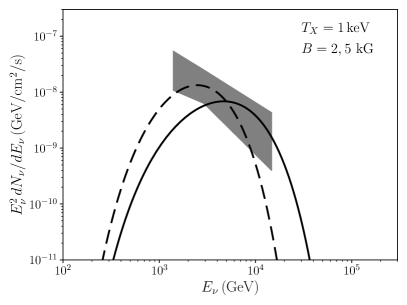
- 计算不同磁场强度和冕层温度下的中微子通量,与IceCube对NGC 1068(距离14.4 Mpc)观测到的通量进行比较。
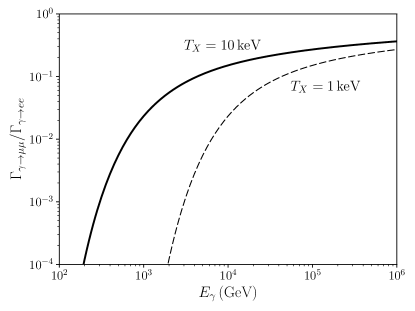
- 评估在eV–keV光子主导的环境中,电子-正电子对产生对本机制的抑制效应,该效应在某些环境中强于keV X射线的影响。
实验结果
研究问题
- RQ1TeV能量尺度的中微子是否可在AGN核心中通过完全不涉及质子加速的纯轻子机制产生?
- RQ2通过高能光子与X射线散射产生μ+μ−对,是否可作为解释IceCube观测到NGC 1068中微子过量的可行替代方案,替代π介子衰变机制?
- RQ3该机制产生可探测中微子通量所需的物理条件(如磁场强度、X射线辐射密度)是什么?
- RQ4μ子衰变产生的中微子味比(νe:νμ:ντ)与π介子衰变相比有何不同?该差异是否可用于区分产生机制?
- RQ5该机制的效率受何种能量阈值限制?该阈值如何影响中微子能谱的低能端?
主要发现
- 该模型产生的中微子能谱与IceCube对NGC 1068观测到的79个事件(~1–10 TeV)一致,显著性达4.2σ。
- 当磁场强度在0.03–2000 G之间、冕层温度为10–100 keV时,若电子注入功率为~2–12×1042 erg/s(1 TeV以上),预测的中微子通量与观测值相符。
- 在eV–keV光子主导的环境中,该机制受到抑制,因为电子-正电子对产生过程占主导,而非μ+μ−对产生。
- 中微子产生仅在高于~0.3 TeV × (10 keV/T)的阈值能量以上才有效,因此若X射线温度较高,中微子能谱在低能端预计会出现截断。
- μ子衰变产生的中微子味比(νe:νμ:ντ ≈ 1.2:0.9:0.9,经振荡后)与π介子衰变(≈1:1:1)不同,提供了潜在的观测区分依据。
- 该机制无法解释IceCube观测到的全部弥漫中微子通量,因为在~100 TeV以上能量时效率较低。
阅读本论文
在 Nubint 阅读器中打开原文,边读边就任意段落提问。
在 Nubint 中阅读本论文本解读由 AI 根据论文原文生成,引用前请核对原文。