
[论文解读] A machine-learning pipeline for real-time detection of gravitational waves from compact binary coalescences
本文提出Aframe,首个完全基于机器学习的实时引力波检测流水线,用于探测致密双星并合(CBC)信号,采用一维卷积神经网络并结合激进的数据增强技术。该方法在高质质量双黑洞系统的灵敏度方面达到当前最先进水平,且延迟比传统匹配滤波流水线低多个数量级。
The promise of multi-messenger astronomy relies on the rapid detection of gravitational waves at very low latencies ($\mathcal{O}$(1\,s)) in order to maximize the amount of time available for follow-up observations. In recent years, neural-networks have demonstrated robust non-linear modeling capabilities and millisecond-scale inference at a comparatively small computational footprint, making them an attractive family of algorithms in this context. However, integration of these algorithms into the gravitational-wave astrophysics research ecosystem has proven non-trivial. Here, we present the first fully machine learning-based pipeline for the detection of gravitational waves from compact binary coalescences (CBCs) running in low-latency. We demonstrate this pipeline to have a fraction of the latency of traditional matched filtering search pipelines while achieving state-of-the-art sensitivity to higher-mass stellar binary black holes.
研究动机与目标
- 开发一种完全基于机器学习的流水线,实现实时生产环境中对致密双星并合(CBC)引力波信号的低延迟检测。
- 克服神经网络在引力波天体物理学中部署所面临的基础设施与灵敏度验证挑战。
- 证明深度学习模型可实现与匹配滤波流水线相当的灵敏度,尤其在高质质量双黑洞系统中表现优异。
- 建立可扩展、模块化的软件架构,支持引力波探测中新型机器学习模型的快速原型设计、测试与部署。
提出的方法
- 流水线使用一维卷积神经网络(CNN)处理来自两个LIGO探测器的时间序列引力波数据。
- 应用广泛的**数据增强**技术,以模拟多样的信号与噪声条件,提升模型泛化能力。
- 模型在嵌入真实LIGO探测器噪声(来自LIGO开放科学中心)的模拟CBC信号上进行端到端训练。
- 基于ml4gw库构建的自定义数据加载与预处理流水线,实现对白化应变数据的高效GPU处理及功率谱密度估计。
- 通过Triton推理服务器与hermes库部署模型推理,实现在IaaS环境中的低延迟、可扩展推理。
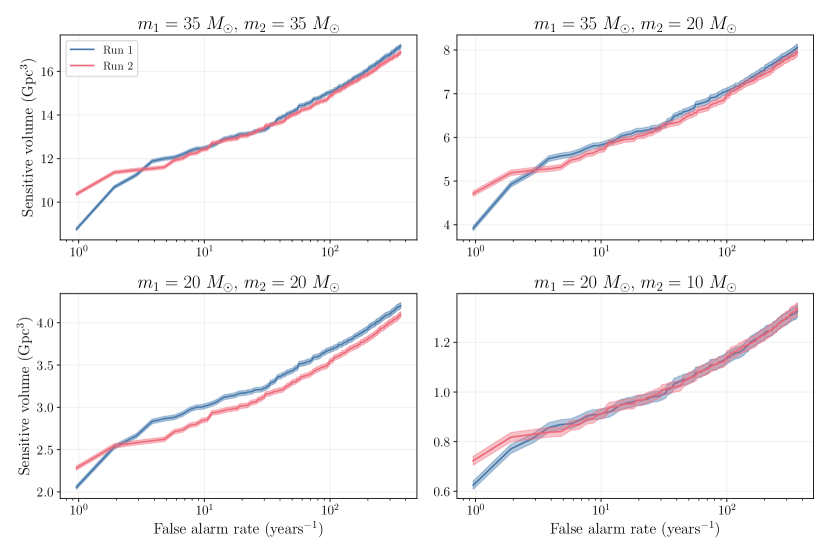
- 性能通过误报率(FAR)与灵敏度体积计算进行评估,并与GstLAL、PyCBC-BBH和cWB等成熟流水线进行对比。
实验结果
研究问题
- RQ1完全端到端的深度学习流水线是否能在真实引力波探测生产环境中实现对致密双星并合信号的实时、低延迟检测?
- RQ2学习模型的灵敏度与传统匹配滤波流水线相比如何,特别是在高质质量双黑洞系统中?
- RQ3激进的数据增强与稳健的软件基础设施在实现引力波探测中神经网络的可靠、低延迟推理中起到何种作用?
- RQ4基于机器学习的流水线是否可在LIGO/Virgo/KAGRA网络中实现规模化部署与维护,且性能可与现有方法比肩或更优?
主要发现
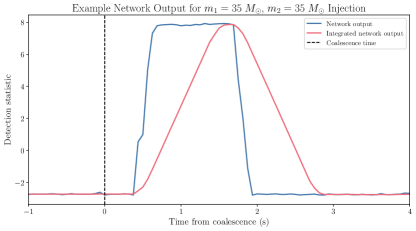
- Aframe的延迟约为100–200毫秒,比传统匹配滤波流水线低多个数量级。
- 对于高质质量双黑洞(如GW190521),Aframe的灵敏度体积与GstLAL和PyCBC-BBH等成熟流水线相比具有竞争力或更优。
- 对于GW190521,模型的误报率为每年0.0013,与PyCBC-BBH报告的每年0.0045相近,表明其具有极强的灵敏度。
- 模型在高质质量系统(如GW190521,总质量98.4 M☉)中表现优于低质质量系统,后者灵敏度仍不理想。
- 数据增强与稳健的软件基础设施(ml4gw、hermes)共同实现了模型在生产IaaS环境中的可靠、低延迟部署。
- 该框架具备可扩展性,支持未来集成Virgo与KAGRA等更多探测器,并可适配更长时标的信号(如双中子星并合)。
阅读本论文
在 Nubint 阅读器中打开原文,边读边就任意段落提问。
在 Nubint 中阅读本论文本解读由 AI 根据论文原文生成,引用前请核对原文。