
[论文解读] A massive, neutral gas reservoir permeating a galaxy proto-cluster after the reionization era
本研究利用詹姆斯·韦布空间望远镜/NIRSpec光谱仪,首次探测到红移 z ≈ 5.4(大爆炸后约10亿年)的星系原星系团中存在一个巨大、空间上一致的冷中性原子氢(H i)储层。观测显示,在多个背景星系中,H i柱密度高达 10²³.⁵ cm⁻²,表明存在一个致密、大尺度的气体高密度区,这一发现挑战了当前的宇宙学模拟,并对宇宙再电离的拓扑结构具有重大影响。
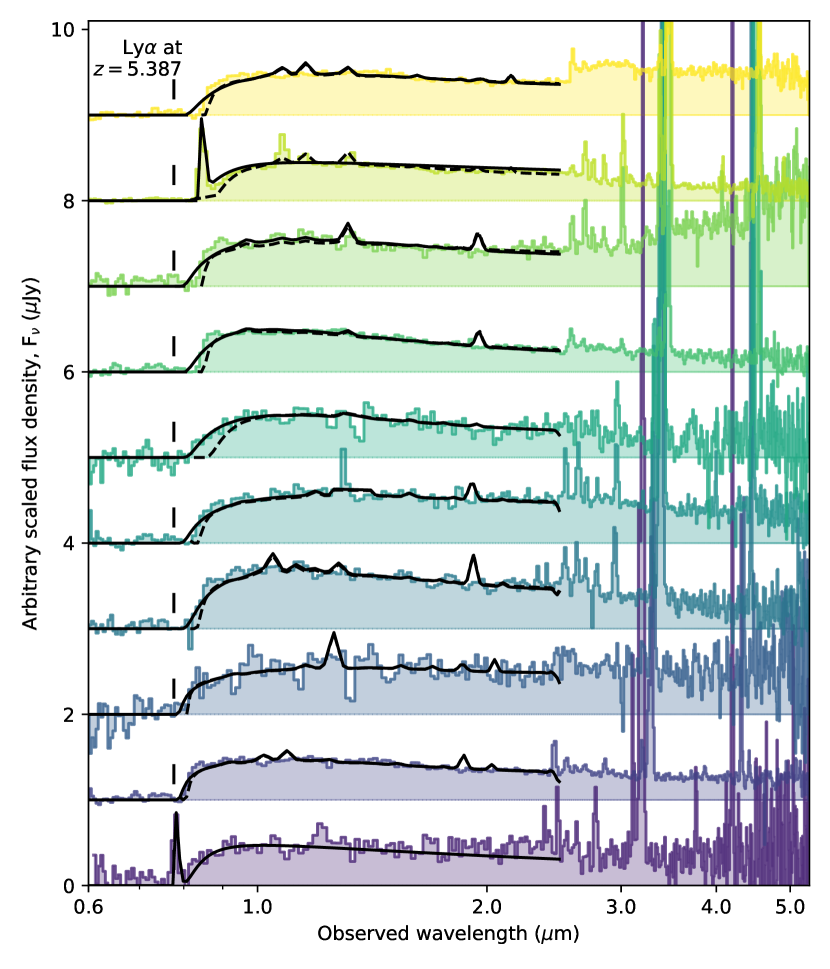
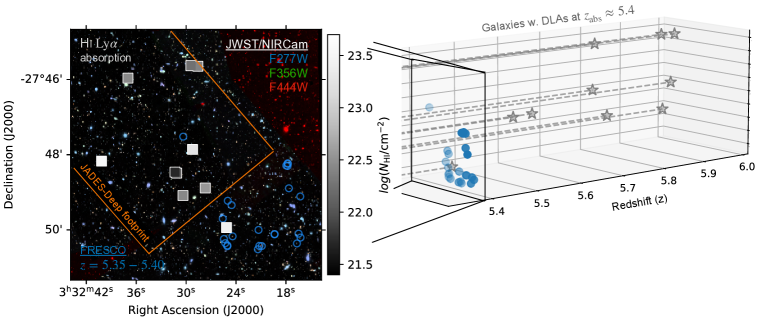
Galaxy clusters are the most massive, gravitationally-bound structures in the Universe, emerging through hierarchical structure formation of large-scale dark matter and baryon overdensities. Early galaxy ``proto-clusters'' are believed to be important physical drivers of the overall cosmic star-formation rate density and serve as ``hotspots'' for the reionization of the intergalactic medium. Our understanding of the formation of these structures at the earliest cosmic epochs is, however, limited to sparse observations of their galaxy members, or based on phenomenological models and cosmological simulations. Here we report the detection of a massive neutral, atomic hydrogen (HI) gas reservoir permeating a galaxy proto-cluster at redshift $z=5.4$, observed one billion years after the Big Bang. The presence of this cold gas is revealed by strong damped Lyman-$α$ absorption features observed in several background galaxy spectra taken with JWST/NIRSpec in close on-sky projection. While overall the sightlines probe a large range in HI column densities, $N_{ m HI} = 10^{21.7}-10^{23.5}$ cm$^{-2}$, they are similar across nearby sightlines, demonstrating that they probe the same dense, neutral gas. This observation of a massive, large-scale overdensity of cold neutral gas challenges current large-scale cosmological simulations and has strong implications for the reionization topology of the Universe.
研究动机与目标
- 表征红移 z ≈ 5.4 时一个稀有、大质量星系原星系团中冷、致密中性气体的重子含量与分布。
- 确定在背景星系中观测到的强衰减莱曼阿尔法吸收特征是否源于一个共同的大尺度 H i 储层,而非单个星系的贡献。
- 评估如此巨大、一致的 H i 高密度区对早期宇宙再电离拓扑结构的影响。
- 检验当前宇宙学模拟是否能够再现观测到的极端气体高密度区及柱密度分布。
- 利用统计建模与模拟,量化原星系团环境中高柱密度 H i 气体的覆盖分数与空间一致性。
提出的方法
- 利用 JWST/NIRSpec 棱镜模式光谱仪,在红移 z = 5.4–6.0 的10个背景星系中探测强衰减莱曼阿尔法(DLA)吸收特征。
- 结合 FRESCO 巡天项目中 JWST/NIRCam 的无狭缝光栅观测,识别并确定原星系团成员的红移,范围为 z ≈ 5.35–5.40。
- 应用测光先验条件,并要求 H α 与 [N II] 发射线在 ≥5σ 水平上被检测到,以确认红移并筛选星系成员。
- 使用红移与柱密度作为自由参数对 DLA 吸收进行建模,对大多数视线方向,排除了宿主星系来源(置信度 >3σ)。
- 绘制 H i 柱密度在原星系团中心投影距离上的空间分布,发现在小投影距离处柱密度值高度相似。
- 将观测结果与曼哈顿模拟套件(Manhattan Suite)的高分辨率宇宙学模拟进行比较,分析 z = 5.4 时的覆盖分数与高密度区特征。
实验结果
研究问题
- RQ1在多个背景星系中观测到的强衰减莱曼阿尔法吸收,是源于一个共同的大尺度 H i 储层,还是来自单个星系的贡献?
- RQ2该原星系团中中性气体的空间一致性与高密度区特征如何?与宇宙学模拟的预测相比有何差异?
- RQ3当前模拟在多大程度上能够再现 z ≈ 5.4 时观测到的 H i 柱密度分布与覆盖分数?
- RQ4如此巨大、寒冷的 H i 储层的存在,如何影响早期星系高密度区的再电离拓扑结构与电离光子预算?
- RQ5该中性气体储层的物理尺度与质量隐含为何?其与原星系团晕质量及恒星形成历史有何关联?
主要发现
- 在红移 z ≈ 5.4 的多个背景星系中,探测到一个巨大、空间上一致的 H i 储层,其柱密度范围为 10²¹.⁷ 至 10²³.⁵ cm⁻²。
- 距原星系团中心投影距离小于 100 kpc 的视线方向,H i 柱密度高度一致,表明存在一个共同的致密气体结构。
- 观测到的 H i 高密度区意味着中性气体分数 f_HI(1+δ) ≈ 10³–10⁴,远超当前宇宙学模拟在 z ≈ 5.5 时的典型值。
- 模拟中 H i 柱密度 N_HI > 10²¹.⁷ cm⁻² 的覆盖分数最高可达 15%,但曼哈顿模拟套件中并未重现此类极端、空间一致的高密度区。
- 该原星系团的总晕质量为 log(M_halo/M☉) ≈ 12.6–12.8,与未来在 z = 0 时形成质量 M₂₀₀,c ≈ 10¹⁵ M☉ 的大质量星系团一致。
- 观测到的 H i 储层与不包含详细星系形成物理过程的模型不一致,凸显了改进模拟以准确捕捉早期结构形成中致密中性气体的必要性。
阅读本论文
在 Nubint 阅读器中打开原文,边读边就任意段落提问。
在 Nubint 中阅读本论文本解读由 AI 根据论文原文生成,引用前请核对原文。