
[论文解读] A Multi-Agent Conversational Recommender System
本文提出 MACRS,一种基于多智能体的对话推荐系统,通过四个基于大语言模型(LLM)的智能体,利用结构化的对话行为规划和一种反馈感知的反思机制,动态适应用户偏好,从而控制对话流程。实验表明,与仅使用 LLM 的基线模型相比,MACRS 显著提升了推荐准确率和用户参与度,尤其在低频次商品上表现更优。
Due to strong capabilities in conducting fluent, multi-turn conversations with users, Large Language Models (LLMs) have the potential to further improve the performance of Conversational Recommender System (CRS). Unlike the aimless chit-chat that LLM excels at, CRS has a clear target. So it is imperative to control the dialogue flow in the LLM to successfully recommend appropriate items to the users. Furthermore, user feedback in CRS can assist the system in better modeling user preferences, which has been ignored by existing studies. However, simply prompting LLM to conduct conversational recommendation cannot address the above two key challenges. In this paper, we propose Multi-Agent Conversational Recommender System (MACRS) which contains two essential modules. First, we design a multi-agent act planning framework, which can control the dialogue flow based on four LLM-based agents. This cooperative multi-agent framework will generate various candidate responses based on different dialogue acts and then choose the most appropriate response as the system response, which can help MACRS plan suitable dialogue acts. Second, we propose a user feedback-aware reflection mechanism which leverages user feedback to reason errors made in previous turns to adjust the dialogue act planning, and higher-level user information from implicit semantics. We conduct extensive experiments based on user simulator to demonstrate the effectiveness of MACRS in recommendation and user preferences collection. Experimental results illustrate that MACRS demonstrates an improvement in user interaction experience compared to directly using LLMs.
研究动机与目标
- 为解决基于大语言模型(LLM)的对话推荐系统(CRS)中对话流程失控的问题,即未经引导的生成导致无关或偏离目标的交互。
- 克服现有仅使用 LLM 的 CRS 在有效捕捉和利用用户反馈以优化对话策略与偏好建模方面的局限性。
- 设计一种协作式多智能体框架,通过为不同对话行为分配专业化角色的 LLM 智能体,实现结构化、目标导向的对话。
- 通过反馈感知反思机制实现更深层次的用户偏好挖掘,从而提升推荐性能,特别是针对低频次商品。
- 通过基于隐式用户反馈和偏好演变动态调整对话策略,提升用户体验。
提出的方法
- 一种包含四个专业化 LLM 智能体的多智能体行为规划框架:规划智能体负责选择对话行为,三个响应智能体分别负责生成提问、推荐和闲聊类对话的回应。
- 规划智能体基于对话策略和当前用户上下文,评估响应智能体提供的候选回应,选择最合适的对话行为以维持目标导向的对话流程。
- 一种用户反馈感知的反思机制,通过分析用户反馈检测先前对话轮次中的错误,并为未来规划生成策略级建议。
- 该反思机制在两个层面运行:信息层面反思用于从隐式语义中提取高层次用户偏好;策略层面反思用于建议改进的对话策略。
- 通过更新用户偏好表示并相应调整未来对话行为的选择,将反馈整合到对话规划中。
- 该框架在基准 CRS 数据集上通过用户模拟器进行评估,与仅使用 LLM 的基线模型(如 ChatGPT)进行对比。
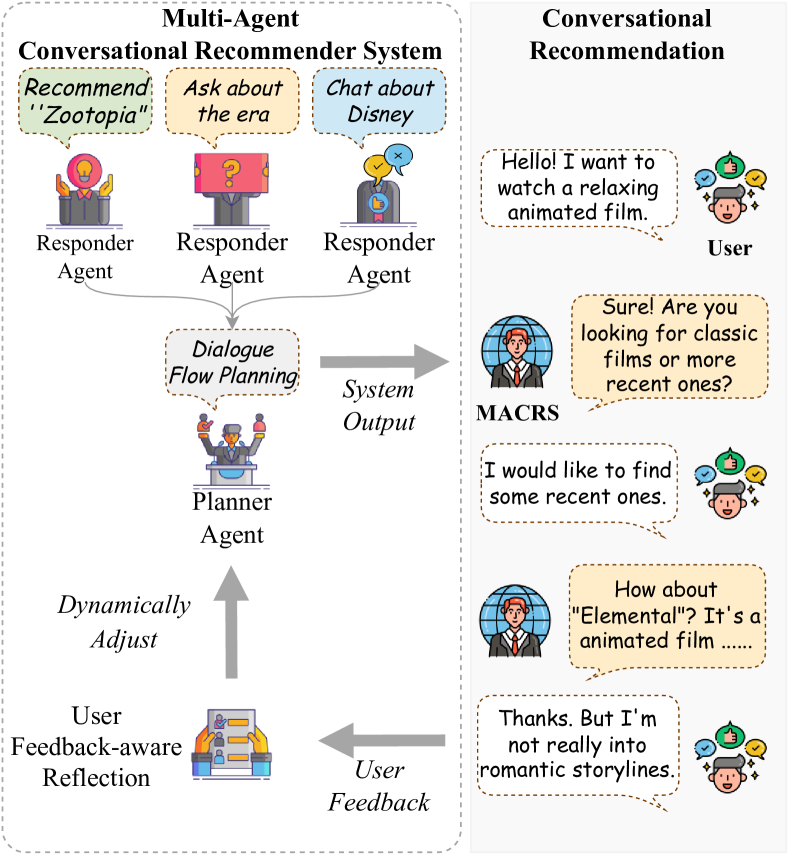
实验结果
研究问题
- RQ1多智能体框架在多大程度上能改善基于大语言模型的对话推荐系统中的对话流程控制?
- RQ2在 CRS 中,用户反馈能在多大程度上被用于优化对话策略并提升偏好建模?
- RQ3协作式多智能体架构是否能在推荐准确率和用户参与度方面超越单个 LLM 智能体?
- RQ4在偏好模糊性更高的低频次商品上,系统表现如何?
- RQ5策略层面的反思对响应质量与对话有效性有何影响?
主要发现
- 在响应质量对比中,MACRS 相较于 ChatGPT 的胜率高达 45.4%,平局占 33.0%,失败率为 21.6%,表明其在推荐准确率、用户信息获取量、简洁性与参与度等方面均表现出更优的响应质量。
- 系统显著提升了推荐准确率,尤其在低频次商品上,得益于反馈感知反思机制带来的更优偏好挖掘。
- 通过有效调度对话行为,MACRS 减少了达成推荐所需的对话轮次,提升了效率。
- 策略层面的反思机制显著提升了响应质量,评审者在 45.4% 的对比中更偏好其输出。
- 用户反馈在识别隐式偏好方面至关重要——例如识别出对某位导演作品的不满——使系统能够动态调整并优化推荐。
- 基线模型的累计推荐成功率随时间推移而下降,而 MACRS 因持续的偏好建模能力,始终保持更高性能。

阅读本论文
在 Nubint 阅读器中打开原文,边读边就任意段落提问。
在 Nubint 中阅读本论文本解读由 AI 根据论文原文生成,引用前请核对原文。