
[论文解读] A multiple-circuit approach to quantum resource reduction with application to the quantum lattice Boltzmann method
本文提出了一种用于量子格子玻尔兹曼方法(QLBM)的双电路量子算法,将二维不可压缩纳维-斯托克斯方程的求解分解为独立的流函数与涡度量子线路。通过解耦这两个分量,与单线路方法相比,该方法将 CNOT 门数量减少了 35%,整体电路深度降低了 16%,并因支持并行执行而获得额外增益,显著提升了近期量子硬件上的量子资源效率。
This work proposes a multi-circuit quantum lattice Boltzmann method (QLBM) algorithm that leverages parallel quantum computing to reduce quantum resource requirements. Computational fluid dynamics (CFD) simulations often entail a large computational burden on classical computers. At present, these simulations can require up to trillions of grid points and millions of time steps. To reduce costs, novel architectures like quantum computers may be intrinsically more efficient for these computations. Current quantum algorithms for solving CFD problems are based on single quantum circuits and, in many cases, use lattice-based methods. Current quantum devices are adorned with sufficient noise to make large and deep circuits untenable. We introduce a multiple-circuit algorithm for a quantum lattice Boltzmann method (QLBM) solve of the incompressible Navier--Stokes equations. The method, called QLBM-frugal, aims to create more practical quantum circuits and strategies for differential equation-based problems. The presented method is validated and demonstrated for 2D lid-driven cavity flow. The two-circuit algorithm shows a marked reduction in CNOT gates, which consume the majority of the runtime on quantum devices. Compared to the baseline QLBM technique, a two-circuit strategy shows increasingly large improvements in gate counts as the qubit size, or problem size, increases. For 64 lattice sites, the CNOT count was reduced by 35%, and the gate depth decreased by 16%. This strategy also enables concurrent circuit execution, further halving the seen gate depth.
研究动机与目标
- 为解决现有单线路量子算法在通过量子格子玻尔兹曼方法求解纳维-斯托克斯方程时面临的高量子资源消耗问题。
- 通过将流函数与涡度分量解耦,减少 CNOT 门数量与电路深度——这是当前含噪声中等规模量子(NISQ)设备中的关键瓶颈。
- 通过提升资源效率并支持并行电路执行,使流体动力学的更实用近期量子模拟成为可能。
- 通过与经典 LBM 结果在基准二维顶盖驱动涡流问题上的对比,验证该方法的准确性,同时降低量子开销。
提出的方法
- 该方法采用流函数-涡度形式表述二维纳维-斯托克斯方程,消除压力项,将问题简化为求解一个对流-扩散方程和一个泊松方程。
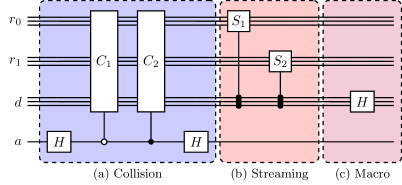
- 实现两个独立的量子电路:一个用于求解涡度输运方程,另一个用于求解泊松方程以恢复流函数。
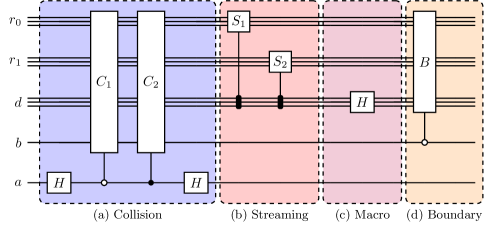
- 通过经典预计算边界条件,减少电路深度与 CNOT 门数量,提升资源效率。
- 两个电路被设计为在每个时间步并行执行,有效将观测到的门深度减半,相较于串行执行。
- 量子电路通过 Qiskit 的编译器合成,将高层操作转换为适用于硬件的单量子比特门与 CNOT 门。
- 算法采用 D2Q5 格子模型,网格尺寸为 64×64,量子态准备与测量通过状态矢量模拟完成,以验证正确性。
实验结果
研究问题
- RQ1将流函数与涡度分量解耦为独立的量子电路,是否能减少 QLBM 模拟纳维-斯托克斯方程所需的总 CNOT 门数量?
- RQ2在近期量子硬件上,并行执行两个电路在多大程度上能降低有效电路深度并提升运行效率?
- RQ3与完整量子编码边界条件相比,经典预计算边界条件对 QLBM 算法的量子资源成本有何影响?
- RQ4对于二维顶盖驱动涡流问题,双电路 QLBM 相较于经典 LBM 模拟的准确性如何?
- RQ5该双电路方法是否保持与先前单电路 QLBM 方法相同的量子比特扩展方式,从而具备潜在的近期实现可行性?
主要发现
- 与单电路实现相比,双电路 QLBM 在 64×64 网格下将总 CNOT 门数量减少了 35%。
- 当流函数与涡度电路并行执行时,组合电路深度降低了 16%,有效将观测深度减半。
- 经典预计算边界条件使 CNOT 门数量至少减少 35%,其中涡度电路的 CNOT 门数量减少达 75%。
- 量子模拟与经典 LBM 模拟在流函数与涡度上的相对误差可忽略不计,顶盖驱动涡流测试案例中误差低于 1%。
- 该方法保持了 O(log M) 的量子比特扩展方式,其中 M 为网格尺寸,相较于线性扩展更具优势,提升了近期实现的可行性。
- 双电路方法通过将不同物理分量的求解模块化并独立执行,简化了算法设计,并提升了容错能力。
阅读本论文
在 Nubint 阅读器中打开原文,边读边就任意段落提问。
在 Nubint 中阅读本论文本解读由 AI 根据论文原文生成,引用前请核对原文。