
[论文解读] A Novel Approach to Industrial Defect Generation through Blended Latent Diffusion Model with Online Adaptation
The paper introduces AdaBLDM, a diffusion-model-based defect generator that uses a defect trimap, cross-modal prompts, and online decoder adaptation to synthesize diverse, high-quality industrial defects for improved anomaly detection.
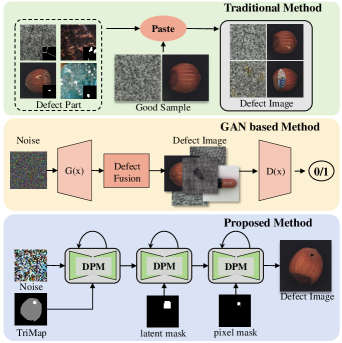
Effectively addressing the challenge of industrial Anomaly Detection (AD) necessitates an ample supply of defective samples, a constraint often hindered by their scarcity in industrial contexts. This paper introduces a novel algorithm designed to augment defective samples, thereby enhancing AD performance. The proposed method tailors the blended latent diffusion model for defect sample generation, employing a diffusion model to generate defective samples in the latent space. A feature editing process, controlled by a ``trimap" mask and text prompts, refines the generated samples. The image generation inference process is structured into three stages: a free diffusion stage, an editing diffusion stage, and an online decoder adaptation stage. This sophisticated inference strategy yields high-quality synthetic defective samples with diverse pattern variations, leading to significantly improved AD accuracies based on the augmented training set. Specifically, on the widely recognized MVTec AD dataset, the proposed method elevates the state-of-the-art (SOTA) performance of AD with augmented data by 1.5%, 1.9%, and 3.1% for AD metrics AP, IAP, and IAP90, respectively. The implementation code of this work can be found at the GitHub repository https://github.com/GrandpaXun242/AdaBLDM.git
研究动机与目标
- 解决工业场景中缺陷样本稀缺的问题,以实现有效的异常检测(AD)。
- 提出一个基于 blended latent diffusion model (BLDM) 的缺陷生成框架,定制用于缺陷合成。
- Incorporate a defect trimap and cross-modal prompts to control defect location and appearance.
- 引入一个缺陷分割地图和跨模态提示,以控制缺陷的位置和外观。
- Demonstrate improved AD performance on multiple benchmarks using generated data.
提出的方法
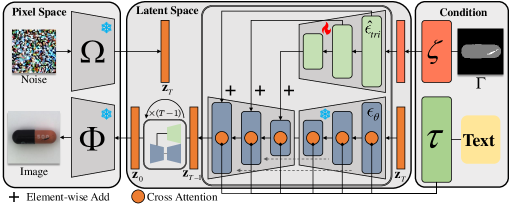
- 以潜在扩散模型(LDM)作为骨干,并通过跨模态提示和缺陷分割地图扩展,以控制缺陷区域。
- 使用来自 CLIP/BLIP 的语言提示来描述影响生成的对象和缺陷类型。
- 引入一个缺陷分割地图,通过嵌入和定制的分割地图特征编码器将缺陷限定在目标区域。
- 实现分阶段去噪与内容编辑:自由扩散阶段、潜在空间编辑和像素空间混合,以塑造缺陷。
- 提出在线解码器自适应,为每个生成样本微调解码器,在缺陷真实感和保持正常区域之间取得平衡。
- 以两阶段方案训练模型:在领域数据上预训练去噪模型,然后在真实缺陷数据上微调分割地图编码器和卷积块。
实验结果
研究问题
- RQ1基于扩散的缺陷生成是否能产生多样且高质量的合成缺陷,从而在超越现有 SOTA 方法的同时提升 AD 性能?
- RQ2 跨模态提示和缺陷分割地图如何影响生成缺陷的真实感与定位准确性?
- RQ3 在线解码器自适应是否进一步提升合成缺陷的质量及下游 AD 指标?
- RQ4 与基于 GAN 的以及其他扩散式缺陷生成方法相比,AdaBLDM 在多个工业数据集上的表现如何?
主要发现
- AdaBLDM 在带增强数据的 MVTec AD 上达到新的 SOTA 异常检测性能,超越 DeSTseg:AP 提升 1.5%,IAP 提升 1.9%,IAP90 提升 3.1%。
- 与 SOTA 缺陷生成器(DFM、DCDGANc 变体)相比,AdaBLDM 提供的缺陷样本质量更高、多样性更丰富,AD 指标证据显示。
- 三阶段推理加上在线解码器自适应带来更高的样本保真度和更丰富的缺陷模式变化。
- 在多个子类别中,基于 SVM 的 AD 使用 AdaBLDM 生成的数据显示出强的异常检测率,基于 DeSTseg 的 AD 也从 AdaBLDM 数据中获益。
- 该方法在 MVTEC AD、BTAD 与 KSDD2 上的纹理与对象类别显示出鲁棒性。
阅读本论文
在 Nubint 阅读器中打开原文,边读边就任意段落提问。
在 Nubint 中阅读本论文本解读由 AI 根据论文原文生成,引用前请核对原文。