
[论文解读] A parsimonious neural network approach to solve portfolio optimization problems without using dynamic programming
本文提出一种简洁的神经网络方法,用于在不依赖动态规划或强化学习的情况下求解动态投资组合优化问题。通过将问题表述为对神经网络的单一优化,其参数与再平衡频率无关,该方法在一般条件下实现对最优策略的收敛,并成功恢复了在均值-方差、CVaR 和 Sortino 启发式目标下的一致时间策略与预先承诺策略,适用于参数化、重采样及 GAN 生成的收益模型。
We present a parsimonious neural network approach, which does not rely on dynamic programming techniques, to solve dynamic portfolio optimization problems subject to multiple investment constraints. The number of parameters of the (potentially deep) neural network remains independent of the number of portfolio rebalancing events, and in contrast to, for example, reinforcement learning, the approach avoids the computation of high-dimensional conditional expectations. As a result, the approach remains practical even when considering large numbers of underlying assets, long investment time horizons or very frequent rebalancing events. We prove convergence of the numerical solution to the theoretical optimal solution of a large class of problems under fairly general conditions, and present ground truth analyses for a number of popular formulations, including mean-variance and mean-conditional value-at-risk problems. We also show that it is feasible to solve Sortino ratio-inspired objectives (penalizing only the variance of wealth outcomes below the mean) in dynamic trading settings with the proposed approach. Using numerical experiments, we demonstrate that if the investment objective functional is separable in the sense of dynamic programming, the correct time-consistent optimal investment strategy is recovered, otherwise we obtain the correct pre-commitment (time-inconsistent) investment strategy. The proposed approach remains agnostic as to the underlying data generating assumptions, and results are illustrated using (i) parametric models for underlying asset returns, (ii) stationary block bootstrap resampling of empirical returns, and (iii) generative adversarial network (GAN)-generated synthetic asset returns.
研究动机与目标
- 开发一种基于神经网络的动态投资组合优化方法,避免使用动态规划和强化学习。
- 确保网络参数数量与再平衡事件数量无关,从而在长期投资和频繁再平衡场景下具备可扩展性。
- 在广泛条件下证明数值解收敛于理论最优策略,适用于一大类目标函数。
- 展示该方法根据问题表述的不同,能够恢复一致时间策略与预先承诺最优策略的能力。
- 在多种数据假设下验证该方法的有效性,包括参数模型、块自举重采样和 GAN 生成的收益。
提出的方法
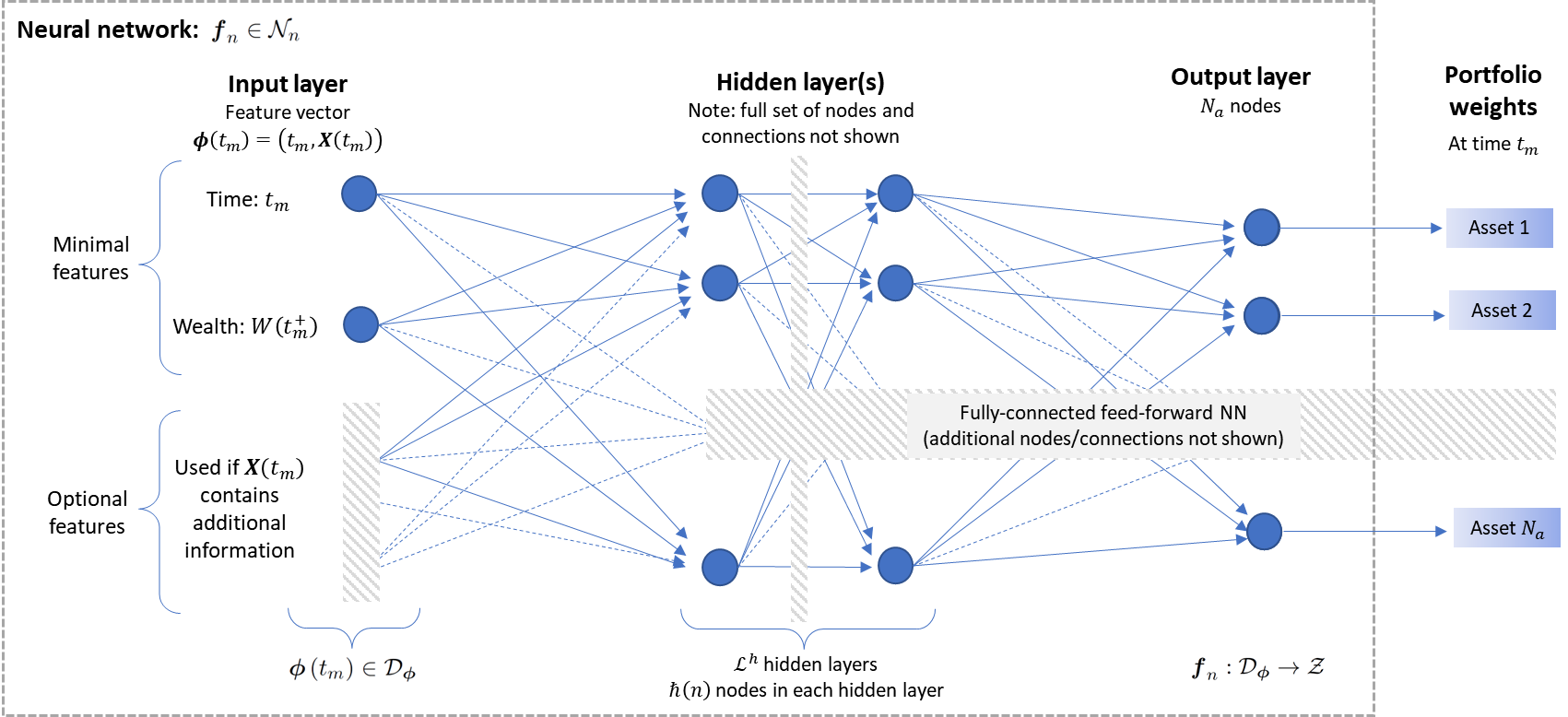
- 该方法将投资组合优化问题表述为对神经网络的单一优化,直接将投资策略参数化为时间与财富的函数。
- 网络架构设计简洁,参数数量与再平衡事件数量无关,避免了动态规划带来的计算负担。
- 通过直接优化目标泛函,避免了强化学习中估计高维条件期望这一关键挑战。
- 该方法对底层数据生成过程保持无偏,可适用于参数模型、通过平稳块自举法获得的经验收益,或 GAN 生成的合成收益。
- 在相当一般化的条件下证明了解的收敛性,包括具有多个约束和路径相关目标的问题。
- 该方法被应用于均值-方差、均值-CVaR 和均值-半方差(Sortino 启发式)目标,数值实验验证了其准确性和鲁棒性。
实验结果
研究问题
- RQ1神经网络方法是否能够在不依赖动态规划或强化学习的情况下求解动态投资组合优化问题?
- RQ2当再平衡事件数量增加时,所提出的方法是否仍保持计算可行性与收敛性?
- RQ3该方法是否能根据目标函数的可分性,恢复一致时间策略与预先承诺最优策略?
- RQ4在不同数据假设下(包括经验收益与 GAN 生成的合成数据),该方法表现如何?
- RQ5该方法是否能有效求解非标准目标,如受 Sortino 比率启发的均值-半方差优化?
主要发现
- 当目标泛函在动态规划意义下可分时,所提出的神经网络方法成功恢复了正确的、一致时间最优策略。
- 当目标不可分时,该方法恢复了正确的预先承诺(时间不一致)最优策略,证明了其理论合理性。
- 数值实验确认了在各种数据假设下,该方法对均值-方差和均值-CVaR 问题的解能收敛至真实解。
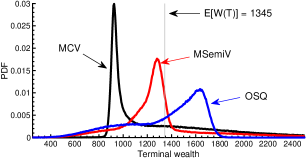
- 该方法在均值-半方差(Sortino 启发式)目标下也取得了准确结果,生成了具有显著下行保护特征且终端财富分布左偏的策略。
- 在使用参数模型、经验收益的平稳块自举重采样以及 GAN 生成的合成收益时,该方法依然保持鲁棒性和准确性。
- 无论再平衡事件数量如何,网络参数数量保持恒定,确保了在长期投资期限和频繁交易场景下的可扩展性。
阅读本论文
在 Nubint 阅读器中打开原文,边读边就任意段落提问。
在 Nubint 中阅读本论文本解读由 AI 根据论文原文生成,引用前请核对原文。