
[论文解读] A random-key GRASP for combinatorial optimization
本文提出了一种与问题无关的GRASP元启发式算法——随机键GRASP(RK-GRASP),该算法使用解码器将连续单位超立方体中的解映射到离散组合优化问题空间。在五个NP难问题上,RK-GRASP结合随机变邻域下降(RVND)的方法在97%的THLP实例、100%的SSP实例以及75%的NCGPP实例中,优于BRKGA和多起点方法。
This paper proposes a problem-independent GRASP metaheuristic using the random-key optimizer (RKO) paradigm. GRASP (greedy randomized adaptive search procedure) is a metaheuristic for combinatorial optimization that repeatedly applies a semi-greedy construction procedure followed by a local search procedure. The best solution found over all iterations is returned as the solution of the GRASP. Continuous GRASP (C-GRASP) is an extension of GRASP for continuous optimization in the unit hypercube. A random-key optimizer (RKO) uses a vector of random keys to encode a solution to a combinatorial optimization problem. It uses a decoder to evaluate a solution encoded by the vector of random keys. A random-key GRASP is a C-GRASP where points in the unit hypercube are evaluated employing a decoder. We describe random key GRASP consisting of a problem-independent component and a problem-dependent decoder. As a proof of concept, the random-key GRASP is tested on five NP-hard combinatorial optimization problems: traveling salesman problem, tree of hubs location problem, Steiner triple covering problem, node capacitated graph partitioning problem, and job sequencing and tool switching problem.
研究动机与目标
- 开发一种基于随机键范式的与问题无关的GRASP元启发式算法,用于组合优化。
- 通过将求解器与问题特定逻辑解耦,实现单一求解器框架在多种组合优化问题中的复用。
- 通过采用不同的局部搜索策略,评估RK-GRASP在一系列NP难组合优化问题上的有效性。
- 基于运行时间和解质量指标,对比RK-GRASP与BRKGA及多起点方法的性能表现。
- 通过在基准实例上的实证测试,证明随机键GRASP框架的可行性与优越性。
提出的方法
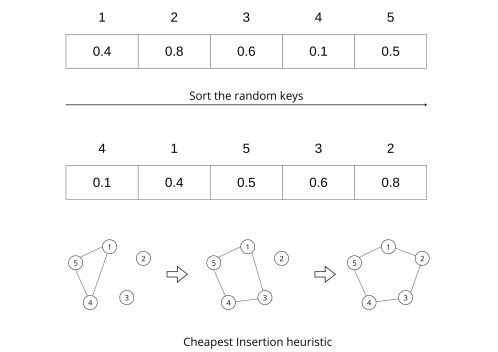
- RK-GRASP在连续单位超立方体中运行,解以[0,1)区间内的随机键向量表示。
- 特定问题的解码器将每个随机键向量映射到离散问题空间中的可行解,并评估其代价。
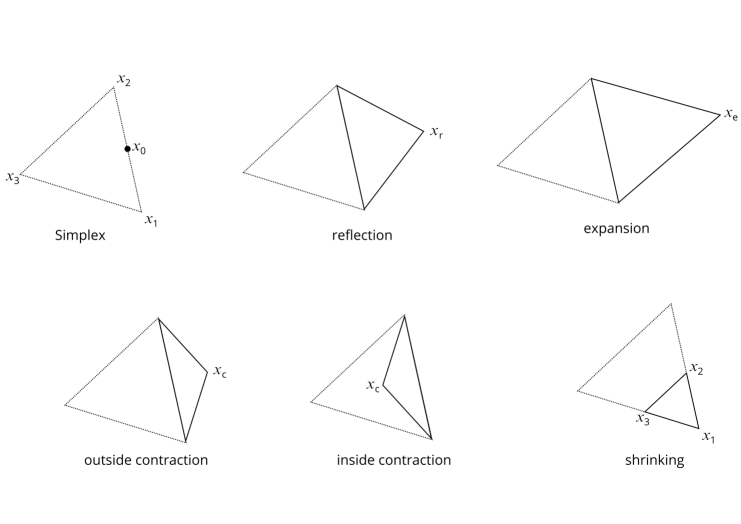
- 该算法结合了贪婪随机构造阶段与局部搜索方法,包括网格搜索、Nelder-Mead搜索以及随机变邻域下降(RVND)。
- 在多次迭代中寻找最优解,并通过局部搜索提升解的质量。
- 该框架将元启发式(求解器)与问题特定逻辑(解码器)分离,从而可在不同优化问题中复用。
- 性能通过基于CPU时间和解差距的性能轮廓进行评估,收敛阈值为1%。
实验结果
研究问题
- RQ1能否基于随机键优化器(RKO)范式,有效设计一种与问题无关的GRASP元启发式算法?
- RQ2在多种NP难组合优化问题中,RK-GRASP在性能和解质量方面与BRKGA及多起点方法相比表现如何?
- RQ3在RK-GRASP框架中,哪种局部搜索策略——网格搜索、Nelder-Mead或RVND——表现最佳?
- RQ4RK-GRASP在NP难问题的基准实例上,能在多大程度上获得新的最优已知解?
- RQ5随机键编码与基于解码器的映射是否能够实现在不同问题领域中的高效且可扩展的优化?
主要发现
- 在97%的枢纽树定位问题(THLP)实例中,RK-GRASP结合RVND在CPU时间上优于BRKGA和多起点方法;在100%的作业排序与工具切换问题(SSP)实例中表现更优;在75%的节点容量图划分问题(NCGPP)实例中表现更优。
- 在旅行商问题(TSP)中,BRKGA与RK-GRASP结合RVND均在95%的实例中达到性能比4以内,但RK-GRASP结合RVND在累积性能轮廓中表现出更强的主导性。
- RK-GRASP结合RVND在THLP、SSP和NCGPP问题中获得了新的最优已知解,证明了其在寻找高质量解方面的有效性。
- 在斯坦纳三元覆盖问题(STCP)中,BRKGA与RK-GRASP结合RVND均在40%的实例中达到性能比4以内,未观察到明显主导优势。
- 性能轮廓分析显示,RK-GRASP结合RVND在TSP、THLP和SSP问题中,于性能比4以内的解的累积分布最高。
- 该框架的与问题无关设计允许通过仅替换不同解码器,复用同一求解器,从而实现对新组合优化问题的高效适应。
阅读本论文
在 Nubint 阅读器中打开原文,边读边就任意段落提问。
在 Nubint 中阅读本论文本解读由 AI 根据论文原文生成,引用前请核对原文。