
[论文解读] A red giant orbiting a black hole
本文识别出Gaia BH2,一个质量为8.9±0.3 M☉的休眠黑洞,围绕一颗1 M☉的红巨星在1277天、中等偏心率的轨道上运行。光谱和测光后续观测证实了Gaia DR3中的天体测量解,而X射线和射电的非探测结果支持低效率吸积模型,表明Gaia BH2是目前已知距离第二近的黑洞,并凸显了一类宽轨道、静默状态的黑洞双星系统,这类系统未被X射线巡天所探测到。
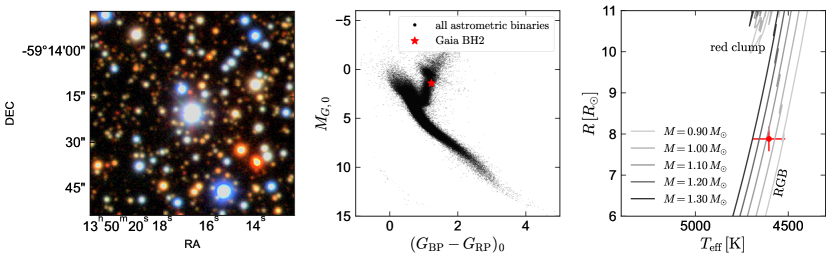
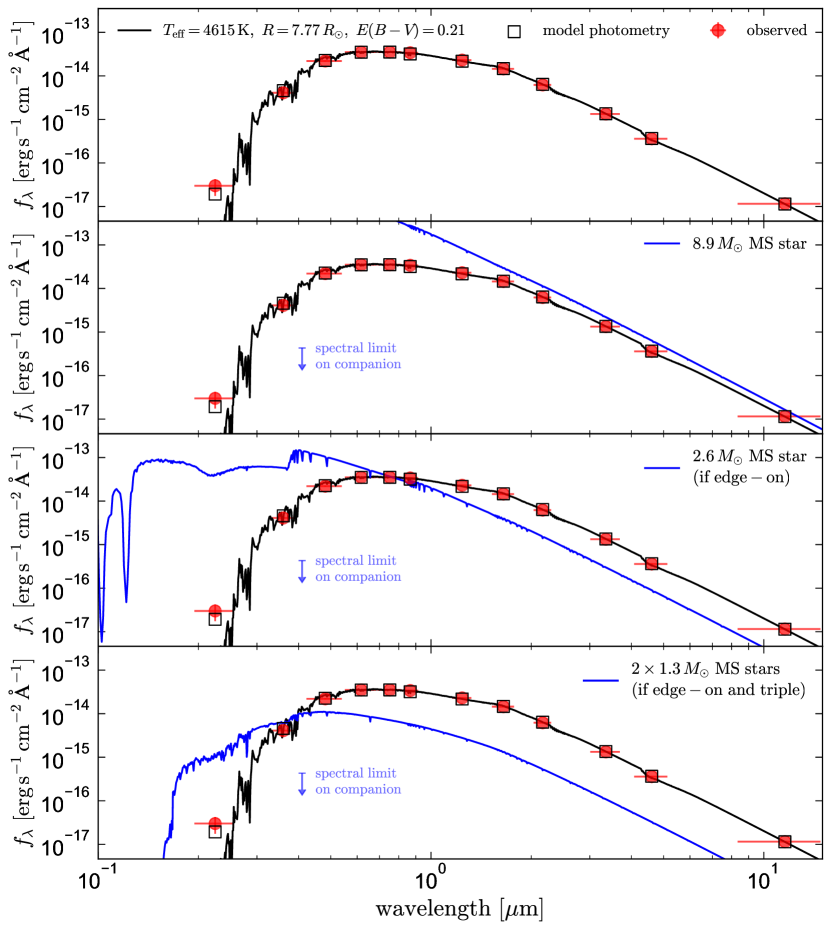
We report spectroscopic and photometric follow-up of a dormant black hole (BH) candidate from Gaia DR3. The system, which we call Gaia BH2, contains a $\sim 1M_{\odot}$ red giant and a dark companion with mass $M_2 = 8.9\pm 0.3\,M_{\odot}$ that is very likely a BH. The orbital period, $P_{ m orb} = 1277$ days, is much longer than that of any previously studied BH binary. Our radial velocity (RV) follow-up over a 7-month period spans more than 90% of the orbit's dynamic range in RV and is in excellent agreement with predictions of the Gaia solution. UV imaging and high-resolution optical spectra rule out all plausible luminous companions that could explain the orbit. The star is a bright ($G=12.3$), slightly metal-poor ($ m [Fe/H]=-0.22$) low-luminosity giant ($T_{ m eff}=4600\, m K$; $R = 7.8\,R_{\odot}$; $\log\left[g/\left({ m cm\,s^{-2}} ight) ight] = 2.6$). The binary's orbit is moderately eccentric ($e=0.52$). The giant is strongly enhanced in $α-$elements, with $ m [α/Fe] = +0.26$, but the system's Galactocentric orbit is typical of the thin disk. We obtained X-ray and radio nondetections of the source near periastron, which support BH accretion models in which the net accretion rate at the horizon is much lower than the Bondi-Hoyle-Lyttleton rate. At a distance of 1.16 kpc, Gaia BH2 is the second-nearest known BH, after Gaia BH1. Its orbit -- like that of Gaia BH1 -- seems too wide to have formed through common envelope evolution. Gaia BH1 and BH2 have orbital periods at opposite edges of the Gaia DR3 sensitivity curve, perhaps hinting at a bimodal intrinsic period distribution for wide BH binaries. Dormant BH binaries like Gaia BH1 and Gaia BH2 likely significantly outnumber their close, X-ray bright cousins, but their formation pathways remain uncertain.
研究动机与目标
- 通过多波段后续观测,确认Gaia DR3天体测量双星候选体(Gaia BH2)为黑洞双星的性质。
- 确定不可见伴星的轨道参数和动力学质量,排除恒星或致密天体的替代解释。
- 通过X射线和射电非探测结果研究黑洞的吸积状态,评估辐射效率。
- 将Gaia BH2置于黑洞双星形成理论背景下,探讨银河系中更广泛静默黑洞双星群体的特征。
提出的方法
- 在7个月内进行光谱学径向速度监测,以测量轨道运动并确认Gaia DR3天体测量解的正确性。
- 利用高分辨率光学和紫外光谱,排除可能产生类似观测径向速度曲线的明亮伴星。
- 使用Gaia DR3数据进行天体测量分析,推导轨道元素,包括周期、偏心率和轨道倾角。
- 利用钱德拉X射线望远镜和MeerKAT射电望远镜进行X射线和射电观测,以搜寻吸积特征并约束辐射效率。
- 对红巨星进行恒星大气模型拟合,以推导其有效温度、表面重力和金属丰度。
- 将系统的轨道参数与双星演化模型进行比较,以评估其形成路径。
实验结果
研究问题
- RQ1Gaia BH2中的暗伴星是否与黑洞一致?其质量是多少?
- RQ2基于X射线和射电非探测结果,黑洞的吸积状态如何?
- RQ3Gaia BH2的轨道结构与黑洞双星形成的理论预期相比如何?
- RQ4Gaia BH2的存在对银河系中宽轨道、静默黑洞双星群体有何启示?
- RQ5为何Gaia BH1与Gaia BH2的轨道周期分别位于Gaia DR3灵敏度曲线的两端?
主要发现
- 该系统包含一颗质量为8.9±0.3 M☉的黑洞,通过径向速度监测和与Gaia DR3天体测量结果的一致性得到确认。
- 红巨星的质量约为1 M☉,有效温度为4600 K,半径为7.8 R☉,表面重力为log(g) = 2.6 cm s⁻²。
- 轨道周期为1277天,偏心率为0.52,近日点距离为2.4 au,位于红超巨星前身星预期半径之外。
- X射线和射电观测未检测到信号,表明辐射效率低于10⁻⁴,与辐射效率低下吸积模型一致。
- 该系统距离为1.16 kpc,是继Gaia BH1之后目前已知距离第二近的黑洞。
- 轨道参数表明其形成路径可能为大质量主序星风驱动演化或动力学过程,而非标准的共包层演化。
阅读本论文
在 Nubint 阅读器中打开原文,边读边就任意段落提问。
在 Nubint 中阅读本论文本解读由 AI 根据论文原文生成,引用前请核对原文。