
[论文解读] A Simple but Effective Approach to Improve Structured Language Model Output for Information Extraction
本文提出 G&O,一种两阶段提示方法,通过先生成自由形式的自然语言响应,再将其结构化为所需格式,从而提升语言模型在信息抽取任务中的结构化输出质量。该方法在多个大语言模型上显著提升了命名实体识别(NER)和关系抽取(RE)任务的零样本性能,相较于单步提示方法,F1 分数最高提升 14.5%,同时保持简单且可与其他技术组合使用。
Large language models (LLMs) have demonstrated impressive abilities in generating unstructured natural language according to instructions. However, their performance can be inconsistent when tasked with producing text that adheres to specific structured formats, which is crucial in applications like named entity recognition (NER) or relation extraction (RE). To address this issue, this paper introduces an efficient method, G&O, to enhance their structured text generation capabilities. It breaks the generation into a two-step pipeline: initially, LLMs generate answers in natural language as intermediate responses. Subsequently, LLMs are asked to organize the output into the desired structure, using the intermediate responses as context. G&O effectively separates the generation of content from the structuring process, reducing the pressure of completing two orthogonal tasks simultaneously. Tested on zero-shot NER and RE, the results indicate a significant improvement in LLM performance with minimal additional efforts. This straightforward and adaptable prompting technique can also be combined with other strategies, like self-consistency, to further elevate LLM capabilities in various structured text generation tasks.
研究动机与目标
- 解决大语言模型在生成信息抽取任务结构化输出时表现不一致的问题。
- 通过将内容生成与结构强制分离,降低同时生成内容并保持结构的思维负担。
- 在无需任务特定微调的情况下,提升命名实体识别(NER)和关系抽取(RE)任务的零样本性能。
- 开发一种简单、可泛化的提示策略,提升大语言模型输出质量,同时保持与现有方法(如自一致性)的兼容性。
- 证明将内容生成与结构化分离可显著提升结构化输出的保真度和任务性能。
提出的方法
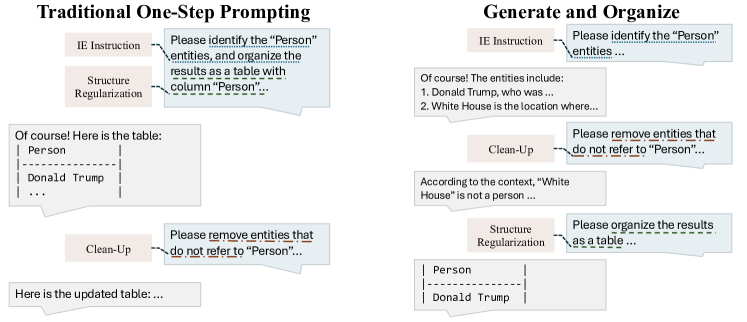
- 该方法将生成过程分为两个阶段:首先,大语言模型对输入提示生成自由形式的自然语言响应。
- 其次,通过另一轮提示,指导同一模型或另一模型将中间的自然语言响应组织成预定义的结构化格式(如 JSON、列表或表格)。
- 在结构化之前,对中间响应应用清理组件,以减少噪声并提升最终输出质量。
- 该方法与现有提示策略(如思维链 CoT 和 few-shot 提示)兼容,支持组合使用。
- 在标准 NER 和 RE 基准上以零样本设置评估该方法,将 G&O 与标准单步提示方法进行对比。
- 该框架已公开发布,以支持可复现性与进一步研究。
实验结果
研究问题
- RQ1将内容生成与结构化格式分离,能否提升大语言模型生成结构化输出的可靠性与准确性?
- RQ2在零样本 NER 和关系抽取任务中,G&O 方法相较于标准单步提示方法表现如何?
- RQ3清理步骤对最终性能提升的贡献程度有多大?
- RQ4G&O 能否有效与自一致性或思维链等其他提示技术结合使用?
- RQ5该两阶段方法是否在不同大语言模型架构及下游信息抽取任务中具有泛化能力?
主要发现
- G&O 显著提升了 NER 任务的零样本 F1 分数,在使用 GPT-3.5 的 NCBI Disease 数据集上,相较于单步提示方法,F1 分数最高提升 14.5%。
- 在 CoNLL-2004 NER 数据集上,使用 GPT-3.5 时,F1 从单步提示的 0.404 提升至 G&O-RE 的 0.447;使用 Llama 2 70B 时,F1 从 0.334 提升至 0.361。
- 在 NYT 关系抽取数据集上,使用 GPT-3.5 时,F1 从单步提示的 0.106 提升至 G&O-RE 的 0.160;使用 Llama 2 70B 时,F1 从 0.152 提升至 0.156。
- 清理组件对性能有显著贡献,在 GPT-3.5 上对 NCBI Disease 数据集的 F1 提升了 0.042(从 0.6475 提升至 0.6935)。
- 该方法在多个大语言模型(包括 GPT-3.5、Llama 2 7B/70B、Mistral 7B 和 Mixtral 8x7B)上均实现了稳定提升,涵盖 NER 和 RE 任务。
- 在某些场景下,G&O 的表现甚至优于微调基线模型,例如在 PolyIE 任务中使用 Mixtral 8x7B 时,G&O 的 F1 达到 0.5275,而微调模型为 0.5210。
阅读本论文
在 Nubint 阅读器中打开原文,边读边就任意段落提问。
在 Nubint 中阅读本论文本解读由 AI 根据论文原文生成,引用前请核对原文。