
[论文解读] A Survey for Biomedical Text Summarization: From Pre-trained to Large Language Models
对生物医学文本摘要(BTS)的系统综述,聚焦预训练语言模型(PLMs)和大型语言模型(LLMs),覆盖数据集、方法、评估、挑战与未来方向,以及可用的开放资源。
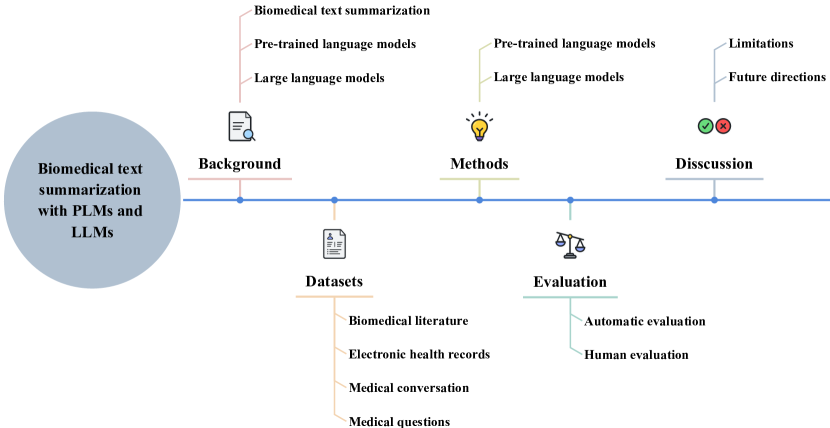
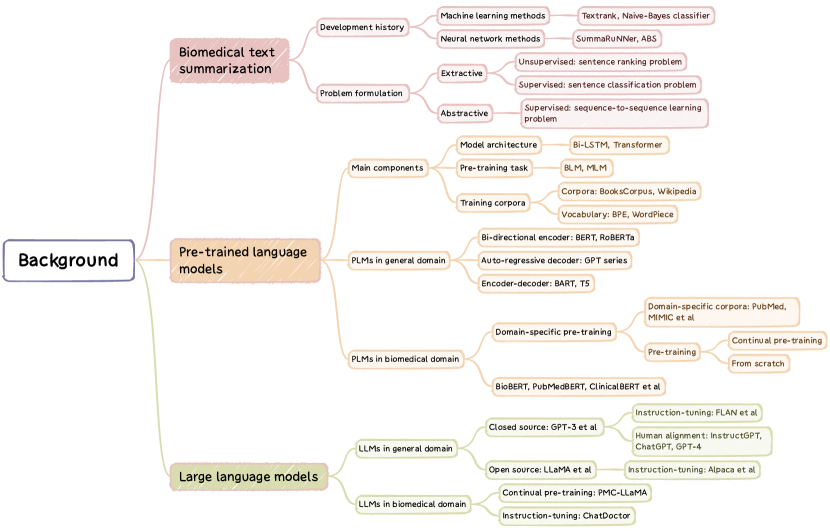
The exponential growth of biomedical texts such as biomedical literature and electronic health records (EHRs), poses a significant challenge for clinicians and researchers to access clinical information efficiently. To tackle this challenge, biomedical text summarization (BTS) has been proposed as a solution to support clinical information retrieval and management. BTS aims at generating concise summaries that distill key information from single or multiple biomedical documents. In recent years, the rapid advancement of fundamental natural language processing (NLP) techniques, from pre-trained language models (PLMs) to large language models (LLMs), has greatly facilitated the progress of BTS. This growth has led to numerous proposed summarization methods, datasets, and evaluation metrics, raising the need for a comprehensive and up-to-date survey for BTS. In this paper, we present a systematic review of recent advancements in BTS, leveraging cutting-edge NLP techniques from PLMs to LLMs, to help understand the latest progress, challenges, and future directions. We begin by introducing the foundational concepts of BTS, PLMs and LLMs, followed by an in-depth review of available datasets, recent approaches, and evaluation metrics in BTS. We finally discuss existing challenges and promising future directions in the era of LLMs. To facilitate the research community, we line up open resources including available datasets, recent approaches, codes, evaluation metrics, and the leaderboard in a public project: https://github.com/KenZLuo/Biomedical-Text-Summarization-Survey/tree/master. We believe that this survey will be a useful resource to researchers, allowing them to quickly track recent advancements and provide guidelines for future BTS research within the research community.
研究动机与目标
- 澄清基础 BTS 概念以及 PLMs 和 LLMs 在生物医学文本摘要中的作用。
- 整理并分析跨生物医学文献、电子健康记录(EHRs)和对话的基准 BTS 数据集。
- 回顾现有利用 PLMs 与 LLMs 的 BTS 方法,突出优点与局限性。
- 讨论在 LLMs 时代的评估指标、当前挑战以及未来方向。
提出的方法
- 自 2018 年以来聚焦于 PLMs 和 LLMs 的 BTS 研究的系统文献综述。
- 按 extractive 与 abstractive 在 PLM/LLM 时代的方法进行分类。
- 汇编基准数据集及其任务设定(单文档 vs 多文档)。
- 讨论评估指标和排行榜,强调开放资源。
- 在 LLMs 下识别 BTS 的局限性和未来方向。
实验结果
研究问题
- RQ1在 PLMs 和 LLMs 的 BTS 中使用的基准数据集和评估标准有哪些?
- RQ2PLMs 和 LLMs 如何应用于生物医学领域的 extractive 和 abstractive BTS 任务?
- RQ3在 LLMs 时代,BTS 的当前局限性和有前景的未来方向是什么?
主要发现
- PLMs 和 LLMs 已成为 BTS 的主导方法,能够改进对生物医学文本的编码和摘要。
- 存在覆盖生物医学文献、EHRs、医疗对话和问题的广泛公共 BTS 数据集,包含单文档和多文档任务。
- LLMs 在某些设定下能够实现零-shot 和指令微调能力,达到甚至超越较小的 PLMs 的 BTS 任务表现。
- 强调开源和公开数据集、代码与排行榜,以支持 BTS 研究的快速进展。
- 专为生物医学的 PLMs(如 BioBERT、PubMedBERT)解决常规领域 PLMs 的词汇和术语差距。
阅读本论文
在 Nubint 阅读器中打开原文,边读边就任意段落提问。
在 Nubint 中阅读本论文本解读由 AI 根据论文原文生成,引用前请核对原文。