
[论文解读] A Survey of Application of Machine Learning in Wireless Indoor Positioning Systems
本综述对基于机器学习(ML)的无线室内定位系统进行了全面分析,评估了基于RSSI、TDOA、AoA和CSI的指纹定位、基于时间以及基于角度的方法。研究识别出ML模型如MLP、RBF和RNN在非视 Line-of-sight(NLoS)及噪声环境下的定位精度与鲁棒性方面表现优异,其中基于CSI的指纹定位相比RSSI展现出更高的抗干扰能力和性能,成为更优的替代方案。
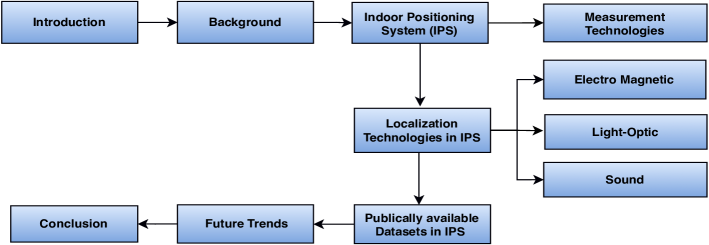
Indoor human positioning has become increasingly important for applications such as health monitoring, breath monitoring, human identification, safety and rescue operations, and security surveillance. However, achieving robust indoor human positioning remains challenging due to various constraints. Numerous attempts have been made in the literature to develop efficient indoor positioning systems (IPSs), with a growing focus on machine learning (ML) based techniques. This paper aims to compare and analyze current ML-based wireless techniques and approaches for indoor positioning, providing a comprehensive review of enabling technologies for human detection, positioning, and activity recognition. The study explores different input measurement data, including RSSI, TDOA, etc., for various IPSs. Key positioning techniques such as RSSI-based fingerprinting, Angle-based, and Time-based approaches are examined in conjunction with various ML methods. The survey compares the positioning accuracy, scalability, and algorithm complexity, with the goal of determining the suitable technology in various services. Finally, the paper compares distinct datasets focused on indoor localization, which have been published using diverse technologies. Overall, the paper presents a comprehensive comparison of existing techniques and localization models.
研究动机与目标
- 系统性地回顾并对比基于机器学习的无线室内定位系统方法。
- 分析不同输入信号类型(RSSI、TDOA、AoA、CSI)在各类机器学习模型中的性能表现。
- 评估机器学习技术在真实室内环境中定位精度、可扩展性及算法复杂度的表现。
- 识别设备异构性、NLoS条件和数据稀缺性等挑战,并评估机器学习在缓解这些问题中的作用。
- 整理并对比公开可用的室内定位数据集,以支持可复现的研究与基准测试。
提出的方法
- 系统检索2010至2023年期间发表的关于机器学习在无线室内定位中应用的同行评审文献。
- 将室内定位技术分类为基于RSSI的指纹定位、基于时间的(ToA/TDoA)方法以及基于角度的(AoA)方法。
- 评估用于定位任务的机器学习模型,包括多层感知机(MLP)、径向基函数(RBF)、k近邻(k-NN)以及循环神经网络(RNN)。
- 分析CSI、CIR及信号特征向量等信号特性,以提升对传统RSSI的鲁棒性。
- 通过RMSE、MAE及不同环境下定位精度等指标,比较不同数据集上的性能表现。
- 整合多传感器融合方法,结合视觉、声音、惯性传感器及运动检测技术,以增强定位性能,尤其针对残障用户。
实验结果
研究问题
- RQ1在非视 Line-of-sight(NLoS)及多径条件下,哪些机器学习模型能实现最高的定位精度?
- RQ2基于CSI的指纹定位与基于RSSI的指纹定位在鲁棒性与定位精度方面有何差异?
- RQ3大规模部署基于机器学习的室内定位系统面临的主要挑战是什么?如何有效缓解?
- RQ4结合无线信号与视觉或惯性传感的混合系统如何提升性能与可访问性?
- RQ5最具代表性且公开可用的室内定位数据集有哪些?它们在数据类型与应用范围上存在哪些差异?
主要发现
- RBF和RNN等机器学习模型通过有效建模复杂室内环境中非线性信号畸变,显著提升了定位精度。
- 基于CSI的指纹定位因具备更高的信号分辨率及对多径衰落和NLoS效应更强的抗干扰能力,优于基于RSSI的方法。
- 神经网络能够从原始信号数据中有效提取特征,从而提升三维定位与楼层识别任务的性能。
- 融合视觉、声音与惯性传感器的混合系统在提升残障人士定位能力及低信号环境下的性能方面展现出巨大潜力。
- 尽管存在硬件与数据限制,基于机器学习的系统在受控环境中仍可实现亚米级精度,部分研究使用CSI与深度学习技术实现RMSE低于0.5米。
- 毫米波雷达与IEEE 802.11ay结合实现被动感知,为未来高精度、隐私保护型室内定位系统提供了潜在解决方案。
阅读本论文
在 Nubint 阅读器中打开原文,边读边就任意段落提问。
在 Nubint 中阅读本论文本解读由 AI 根据论文原文生成,引用前请核对原文。