
[论文解读] A Survey of Graph Retrieval-Augmented Generation for Customized Large Language Models
这个综述分析用于定制 LLM 的图检索增强生成(GraphRAG),提出一个分类体系、检索与整合技术、领域应用、挑战及未来方向。
Large language models (LLMs) have demonstrated remarkable capabilities in a wide range of tasks, yet their application to specialized domains remains challenging due to the need for deep expertise. Retrieval-Augmented generation (RAG) has emerged as a promising solution to customize LLMs for professional fields by seamlessly integrating external knowledge bases, enabling real-time access to domain-specific expertise during inference. Despite its potential, traditional RAG systems, based on flat text retrieval, face three critical challenges: (i) complex query understanding in professional contexts, (ii) difficulties in knowledge integration across distributed sources, and (iii) system efficiency bottlenecks at scale. This survey presents a systematic analysis of Graph-based Retrieval-Augmented Generation (GraphRAG), a new paradigm that revolutionizes domain-specific LLM applications. GraphRAG addresses traditional RAG limitations through three key innovations: (i) graph-structured knowledge representation that explicitly captures entity relationships and domain hierarchies, (ii) efficient graph-based retrieval techniques that enable context-preserving knowledge retrieval with multihop reasoning ability, and (iii) structure-aware knowledge integration algorithms that leverage retrieved knowledge for accurate and logical coherent generation of LLMs. In this survey, we systematically analyze the technical foundations of GraphRAG and examine current implementations across various professional domains, identifying key technical challenges and promising research directions. All the related resources of GraphRAG, including research papers, open-source data, and projects, are collected for the community in https://github.com/DEEP-PolyU/Awesome-GraphRAG.
研究动机与目标
- 解释为什么需要 GraphRAG 来将 LLMs 针对专业领域进行定制。
- 给出一个结构化的分类(Knowledge-based、Index-based、Hybrid GraphRAG),并将其与传统的 RAG 进行比较。
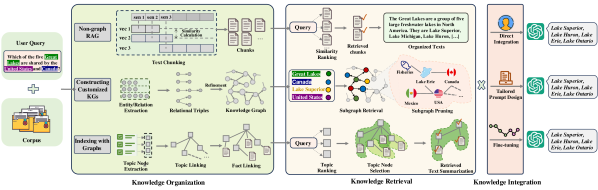
- 描述核心组件:知识组织、检索与整合在 GraphRAG 中。
- 调研跨领域的实际实现、数据集、基准测试以及开源资源。
- 确定关键挑战并提出 GraphRAG 系统的有前景的研究方向。
提出的方法
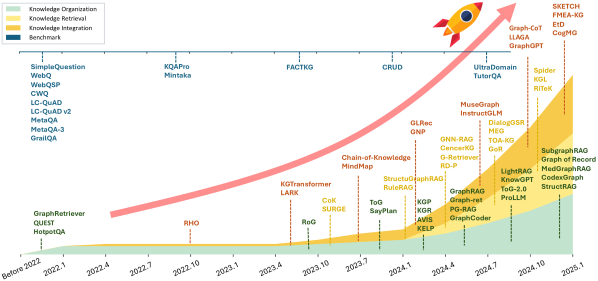
- 概述从传统 RAG 到 GraphRAG 的演变并形式化 GraphRAG 的定义。
- 将 GraphRAG 方法分为三类:Knowledge-based、Index-based、Hybrid GraphRAG。
- 评述检索技术,包括基于图的规划器和用于结构化知识的多跳推理。
- 讨论在节点、路径和子图层面对知识整合策略,以及对上下文学习的增强。
- 汇编开源项目、数据集和由基准支持的领域案例研究。
- 指出知识质量、检索效率、泛化和安全方面的局限性及未来方向。
实验结果
研究问题
- RQ1GraphRAG 是什么,以及它在知识组织、检索和整合方面与传统 RAG 有何不同?
- RQ2主要的 GraphRAG 范式(Knowledge-based、Index-based、Hybrid)及其各自的权衡?
- RQ3用于图结构化知识的检索技术和规划器有哪些,包括多跳和推理能力?
- RQ4如何在不同层级(节点、路径、子图)有效地将检索得到的图知识整合到 LLM 提示中?
- RQ5目前的领域应用、数据集、基准以及开源资源有哪些,GraphRAG 还存在哪些挑战?
主要发现
- GraphRAG 利用图结构知识捕捉复杂关系并实现上下文保留的多跳检索。
- 存在三方分类法:Knowledge-based GraphRAG、Index-based GraphRAG 和 Hybrid GraphRAG,每种有不同的目标和机制。
- 相比于扁平文本的 RAG,GraphRAG 提升了检索效率和对分布式知识源的推理能力。
- 该调研整合了开源项目、数据集和领域特定案例研究,以促进实际部署。
- 它识别出关键挑战如知识质量、检索效率、系统泛化和安全性,并提出未来研究方向。
阅读本论文
在 Nubint 阅读器中打开原文,边读边就任意段落提问。
在 Nubint 中阅读本论文本解读由 AI 根据论文原文生成,引用前请核对原文。