
[论文解读] A Survey on Deep Neural Network Pruning-Taxonomy, Comparison, Analysis, and Recommendations
一份关于深度神经网络剪枝的全面综述,提出分类法,对不同剪枝范式进行比较分析,并提供建议和未来方向。
Modern deep neural networks, particularly recent large language models, come with massive model sizes that require significant computational and storage resources. To enable the deployment of modern models on resource-constrained environments and accelerate inference time, researchers have increasingly explored pruning techniques as a popular research direction in neural network compression. However, there is a dearth of up-to-date comprehensive review papers on pruning. To address this issue, in this survey, we provide a comprehensive review of existing research works on deep neural network pruning in a taxonomy of 1) universal/specific speedup, 2) when to prune, 3) how to prune, and 4) fusion of pruning and other compression techniques. We then provide a thorough comparative analysis of eight pairs of contrast settings for pruning and explore emerging topics, including pruning for large language models, large multimodal models, post-training pruning, and different supervision levels for pruning to shed light on the commonalities and differences of existing methods and lay the foundation for further method development. To facilitate future research, we build a curated collection of datasets, networks, and evaluations on different applications. Finally, we provide valuable recommendations on selecting pruning methods and prospect several promising research directions. We build a repository at https://github.com/hrcheng1066/awesome-pruning.
研究动机与目标
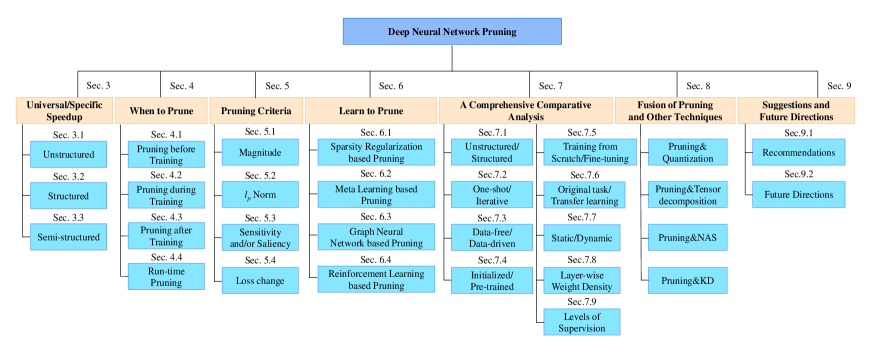
- 提供一个统一的深度神经网络剪枝分类法,覆盖加速普适性、时序与剪枝准则或基于学习的剪枝。
- 比较七对剪枝设置(无结构 vs 结构化、一次性 vs 迭代、无数据 vs 数据驱动、初始化权重 vs 预训练权重),并分析其影响。
- 评审剪枝在训练前、训练中、训练后以及动态运行时剪枝,以阐明实际流程。
- 总结剪枝的应用、数据集、网络和评估基准,以指导从业者。
- 提出方法选择的建议,并强调神经网络剪枝研究的有前景方向。
提出的方法
- 构建一个围绕三个问题组织的分类法:普适加速与特定加速之间的界限、何时剪枝(训练前/训练中/训练后,静态 vs 动态),以及剪枝准则与基于学习的方法。
- 提供无结构、半结构和结构化剪枝的形式定义与分类,包括剪枝掩码、逐层 vs 全局剪枝,以及动态 vs 静态剪枝的概念。
- 分析前期工作中的代表性剪枝方法与实验设置,包括数据无关与数据驱动的准则、稀疏性正则化,以及动态稀疏训练范式。
- 综合多种剪枝范式的对比分析,并讨论对训练、推理与硬件兼容性的影响。
- 整理应用、数据集、网络与评估资源,并维护一个开放源代码剪枝论文与代码的在线仓库。
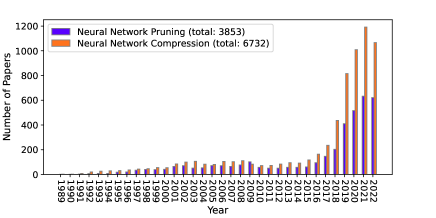
实验结果
研究问题
- RQ1哪些核心维度(加速普遍性、时序和剪枝准则)能够有效地对深度神经网络剪枝方法进行分类?
- RQ2在不同训练流程下,无结构、半结构和结构化剪枝在性能、硬件兼容性和精度方面的比较如何?
- RQ3在训练前、训练中或训练后剪枝的实际含义,包括静态与动态剪枝?
- RQ4比较数据无关与数据驱动剪枝以及初始化权重剪枝与预训练权重剪枝,得到哪些洞见?
- RQ5在各应用场景中选择剪枝方法与未来研究方向方面,有哪些建议?
主要发现
- 剪枝可以分为无结构(按权重)、半结构(基于模式)和结构化(粗粒度)剪枝,普遍的加速只有通过完全结构化剪枝才能实现。
- 静态剪枝流程(训练前/训练中/训练后)与动态运行时剪枝形成对比,每种在效率与精度上有不同的权衡。
- 剪枝准则(如幅值、梯度、基于正则化的分数)与基于学习的剪枝方法各有不同优势,包括数据无关与数据驱动的方法。
- 总结了广泛的剪枝应用与基准,并提供一个剪枝论文与代码的仓库以支持后续研究。
- 综述包含七对对比设定的比较实验,以揭示实际表现和鲁棒性差异。
阅读本论文
在 Nubint 阅读器中打开原文,边读边就任意段落提问。
在 Nubint 中阅读本论文本解读由 AI 根据论文原文生成,引用前请核对原文。