
[论文解读] A Survey on Graph Neural Networks for Time Series: Forecasting, Classification, Imputation, and Anomaly Detection
对用于时间序列预测、分类、异常检测和插补的图神经网络的全面综述,提出统一的任务-与方法导向框架及未来方向。
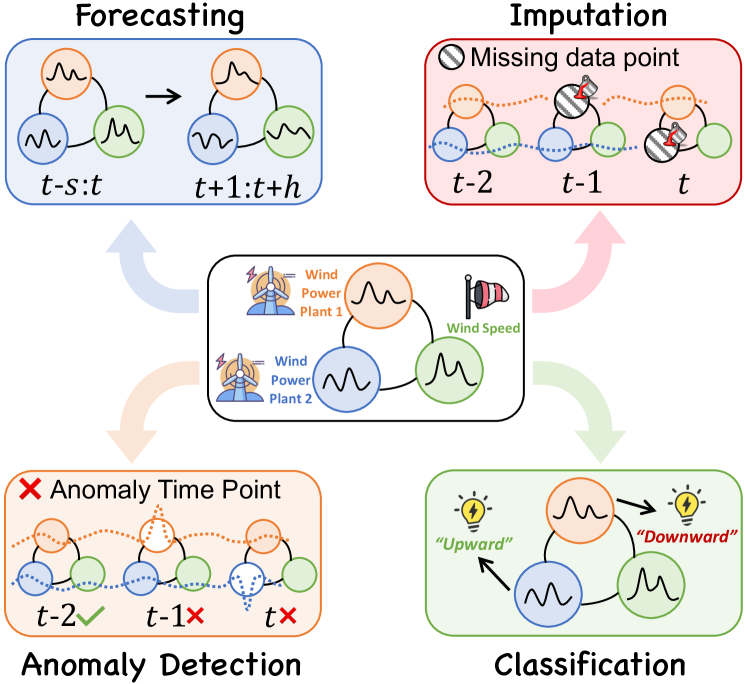
Time series are the primary data type used to record dynamic system measurements and generated in great volume by both physical sensors and online processes (virtual sensors). Time series analytics is therefore crucial to unlocking the wealth of information implicit in available data. With the recent advancements in graph neural networks (GNNs), there has been a surge in GNN-based approaches for time series analysis. These approaches can explicitly model inter-temporal and inter-variable relationships, which traditional and other deep neural network-based methods struggle to do. In this survey, we provide a comprehensive review of graph neural networks for time series analysis (GNN4TS), encompassing four fundamental dimensions: forecasting, classification, anomaly detection, and imputation. Our aim is to guide designers and practitioners to understand, build applications, and advance research of GNN4TS. At first, we provide a comprehensive task-oriented taxonomy of GNN4TS. Then, we present and discuss representative research works and introduce mainstream applications of GNN4TS. A comprehensive discussion of potential future research directions completes the survey. This survey, for the first time, brings together a vast array of knowledge on GNN-based time series research, highlighting foundations, practical applications, and opportunities of graph neural networks for time series analysis.
研究动机与目标
- 为时间序列分析中的 GNNs 提供面向任务的分类法(预测、异常检测、插补、分类)。
- 提出一个统一的方法框架(时空GNNs)用于将时间序列数据编码成图并学习表示。
- 对跨领域的代表性工作和应用进行综述,以指导 GNN4TS 系统的设计与实现。
- 讨论未解挑战和未来方向,促进基于 GNN 的时间序列研究。
提出的方法
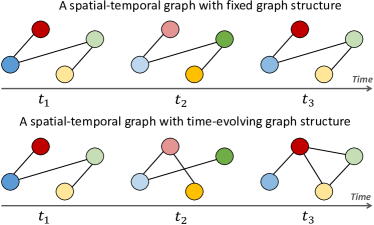
- 将时空图定义为表示多变量时间序列的属性图序列。
- 按任务(预测、异常检测、插补、分类)以及时空建模选择(谱方法与空间GNN、时间域与频域、离散与连续架构)对方法进行分类。
- 提出统一的工作流程:数据处理与图构建、基于 STGNN 的表示学习,以及下游任务预测器。
- 评述基于启发式和基于学习的图构建方法(邻近性、连通性、相似性、功能依赖性,以及学习得到的图)。
- 描述架构模式(分解式与耦合式 STGNNs)和时序模块(RNN、TCN、Transformer 与混合)。
- 总结具有代表性的模型及其面向任务的特定公式(如预测损失、插补损失、分类损失)。
实验结果
研究问题
- RQ1在基于 GNN 的时间序列分析中,主要的任务类别有哪些?如何对其进行建模?
- RQ2如何将时空图和 STGNN 架构统一以处理多样化的时间序列任务?
- RQ3用于时间序列的核心图构建策略(启发式与学习型)有哪些,它们如何影响性能?
- RQ4在时间序列预测、异常检测、插补和分类的 STGNNs 中,常见的架构模式(离散与连续、分解式与耦合式)有哪些?
- RQ5对 GNN 在时间序列研究中的关键方向与未解挑战是什么?
主要发现
- 该综述提供了首个关于基于 GNN 的时间序列分析在预测、分类、异常检测和插补方面的全面、最新回顾。
- 它从任务和方法论角度提供了统一、结构化的分类法,并引入三部分框架(时空模块、时序模块、总体架构)。
- 它强调了应用领域的广度和 GNN4TS 在建模变量间及时序依赖方面的通用性。
- 它讨论了启发式和基于学习的图构建策略,详细说明何时各自适用。
- 它概述了未来的研究方向和待解决的问题,以指导后续的 GNN4TS 工作。
阅读本论文
在 Nubint 阅读器中打开原文,边读边就任意段落提问。
在 Nubint 中阅读本论文本解读由 AI 根据论文原文生成,引用前请核对原文。