
[论文解读] A Survey on LLM-Generated Text Detection: Necessity, Methods, and Future Directions
本综述综合了对由大型语言模型生成文本的检测进展,涵盖检测器、数据集、评估、挑战与未来方向。
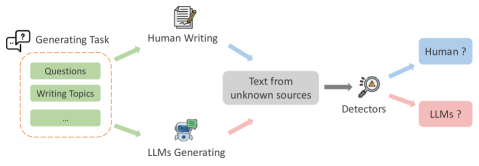
The powerful ability to understand, follow, and generate complex language emerging from large language models (LLMs) makes LLM-generated text flood many areas of our daily lives at an incredible speed and is widely accepted by humans. As LLMs continue to expand, there is an imperative need to develop detectors that can detect LLM-generated text. This is crucial to mitigate potential misuse of LLMs and safeguard realms like artistic expression and social networks from harmful influence of LLM-generated content. The LLM-generated text detection aims to discern if a piece of text was produced by an LLM, which is essentially a binary classification task. The detector techniques have witnessed notable advancements recently, propelled by innovations in watermarking techniques, statistics-based detectors, neural-base detectors, and human-assisted methods. In this survey, we collate recent research breakthroughs in this area and underscore the pressing need to bolster detector research. We also delve into prevalent datasets, elucidating their limitations and developmental requirements. Furthermore, we analyze various LLM-generated text detection paradigms, shedding light on challenges like out-of-distribution problems, potential attacks, real-world data issues and the lack of effective evaluation framework. Conclusively, we highlight interesting directions for future research in LLM-generated text detection to advance the implementation of responsible artificial intelligence (AI). Our aim with this survey is to provide a clear and comprehensive introduction for newcomers while also offering seasoned researchers a valuable update in the field of LLM-generated text detection. The useful resources are publicly available at: https://github.com/NLP2CT/LLM-generated-Text-Detection.
研究动机与目标
- 动机:推动对 LLM-generated text detectors 的需求,以减轻滥用并保持 AI 支持文本的完整性。
- 汇总并分析最新的检测器方法、数据集和评估实践。
- 识别当前的局限性并绘制未来研究方向,以加强检测。
- 为新来者提供清晰、最新的介绍,并为研究人员提供简明更新。
提出的方法
- 遵循 Kitchenham 指南进行系统性文献综述(SLR),以评审 LLM-generated text detection 文献。
- 使用有针对性的检索词: “LLM-generated text detection” OR “machine-generated text detection” OR “AI-written text detection” OR “deepfake text detection”。
- 检索来源包括 Google Scholar、ArXiv、Scopus、Web of Science、IEEE Xplore、Springer Link、ACL Anthology、ACM DL 等。
- 应用纳入标准:(i)综述聚焦于检测方法,(ii)提出检测方法学,(iii)讨论挑战和未来方向,(iv)阐明必要性及应用。
- 筛选了82篇相关论文并分析数据、检测器、度量、问题及未来方向。
实验结果
研究问题
- RQ1检测 LLM-generated text 的主要方法及其相关挑战是什么?
- RQ2现存的 LLM-generated text 检测数据集与基准是什么,它们有哪些局限?
- RQ3使用了哪些评估指标,检测器在不同条件下的表现如何?
- RQ4关键挑战(如分布之外、攻击、数据歧义)以及健壮检测器的未来方向是什么?
主要发现
- 在2023年,LLM-generated text detection 的研究激增。
- 本综述的检测器目录涵盖 watermarking、zero-shot、微调 LM 方法、对抗学习、LLMs 作为检测器,以及人类辅助方法。
- 存在广泛的数据集和基准(如 HC3、CHEAT、基于 GROVER 的数据集、TweepFake、GPT-2 Output Dataset 等),并指出了局限性与需要改进之处。
- 评估指标包括准确率、AUROC、召回率和 F1-分数,并讨论了分布外和数据歧义等挑战。
- 本文讨论了对检测器的攻击等问题,以及在低资源环境和数据歧义下需要鲁棒检测器。
- 未来方向强调构建对攻击鲁棒的检测器、提升零样本检测器,以及多代理系统等。

阅读本论文
在 Nubint 阅读器中打开原文,边读边就任意段落提问。
在 Nubint 中阅读本论文本解读由 AI 根据论文原文生成,引用前请核对原文。