
[论文解读] A Survey on Spectral Graph Neural Networks
本研究系统性地回顾了谱GNNs,将方法按特征值或特征向量进行分类,分析理论和应用,并在多个数据集上基准性能。
Graph neural networks (GNNs) have attracted considerable attention from the research community. It is well established that GNNs are usually roughly divided into spatial and spectral methods. Despite that spectral GNNs play an important role in both graph signal processing and graph representation learning, existing studies are biased toward spatial approaches, and there is no comprehensive review on spectral GNNs so far. In this paper, we summarize the recent development of spectral GNNs, including model, theory, and application. Specifically, we first discuss the connection between spatial GNNs and spectral GNNs, which shows that spectral GNNs can capture global information and have better expressiveness and interpretability. Next, we categorize existing spectral GNNs according to the spectrum information they use, \ie, eigenvalues or eigenvectors. In addition, we review major theoretical results and applications of spectral GNNs, followed by a quantitative experiment to benchmark some popular spectral GNNs. Finally, we conclude the paper with some future directions.
研究动机与目标
- 区分空间图神经网络和谱图神经网络,并突出谱方法的独特挑战。
- 将谱GNNs分类为基于特征值和基于特征向量的类别,并细分子类别。
- 总结主要理论结果(表达能力、鲁棒性、可迁移性)以及关键应用。
- 在标准数据集上对流行的谱GNN进行定量基准测试,并讨论未来方向。
提出的方法
- 通过图傅里叶变换和本征空间定义谱图卷积。
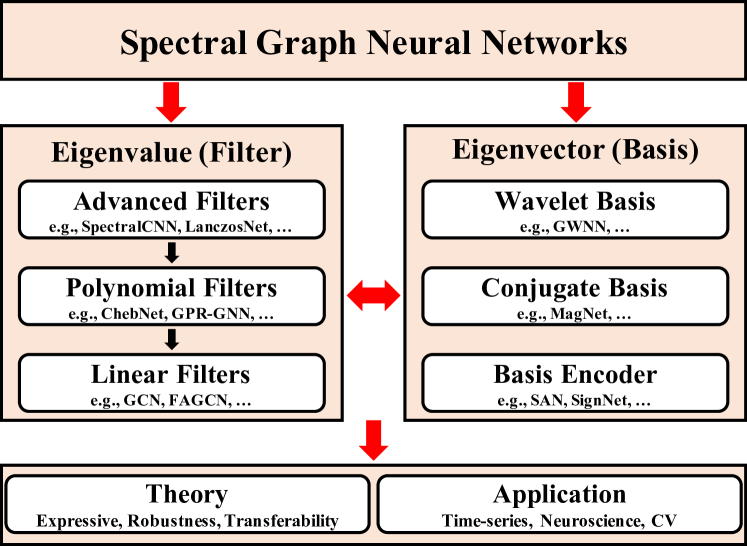
- 将谱GNNs分为基于特征值的(高级、多项式、线性滤波器)和基于特征向量的(小波、共轭/基编码器)方法。
- 讨论关于表达能力、鲁棒性和可迁移性的理论结果。
- 回顾在多变量时间序列预测、神经科学和计算机视觉中的主要应用。
- 在六个数据集上进行基准测试,使用统一框架比较谱GNNs。
实验结果
研究问题
- RQ1谱GNNs 采用的主要谱信息来源(特征值与特征向量)有哪些,它们的权衡是什么?
- RQ2与空间GNNs相比,谱GNNs 在表达能力、可扩展性和可解释性方面有何差异?
- RQ3在表达能力、鲁棒性和可迁移性方面,谱GNNs 存在哪些理论保证?
- RQ4谱GNNs 在同质图和异质图以及现实任务中的经验表现如何?
主要发现
- 谱GNNs 捕捉全局信息,并通过学习的频率分量提供可解释性。
- 存在两大谱类别:基于特征值的滤波器(高级、多项式、线性)和基于特征向量的基(小波、共轭基、基编码器)。
- 多项式和线性滤波器使在大规模图上的学习具有可扩展性,但在表达能力上有权衡;高级滤波器可能强大但计算量大。
- 基于特征向量的方法(例如图小波、厄米拉普拉斯算子)提供局部化和方向信息,但研究较少。
- 本文讨论关于表达能力、对扰动的鲁棒性和可迁移性的理论,并给出基准结果,指示跨数据集的性能差异。
阅读本论文
在 Nubint 阅读器中打开原文,边读边就任意段落提问。
在 Nubint 中阅读本论文本解读由 AI 根据论文原文生成,引用前请核对原文。