
QUICK REVIEW
[论文解读] A Survey on Transformers in Reinforcement Learning
Wenzhe Li, Hao Luo|arXiv (Cornell University)|Jan 8, 2023
一句话总结
对 Transformer 架构在强化学习中的应用的全面综述,涵盖表示、世界模型、序列决策,以及通用智能体,提供分类法与未来方向。
ABSTRACT
Transformer has been considered the dominating neural architecture in NLP and CV, mostly under supervised settings. Recently, a similar surge of using Transformers has appeared in the domain of reinforcement learning (RL), but it is faced with unique design choices and challenges brought by the nature of RL. However, the evolution of Transformers in RL has not yet been well unraveled. In this paper, we seek to systematically review motivations and progress on using Transformers in RL, provide a taxonomy on existing works, discuss each sub-field, and summarize future prospects.
研究动机与目标
- 激励在 RL 中研究 Transformer 架构,并识别与监督学习相比的独特挑战。
- 提供基于 Transformer 的 RL 方法的分类法,并对各子领域的代表性工作进行总结。
- 分析 Transformer 在 RL 中用于状态表示、世界建模以及直接的序列决策的方式。
- 讨论实际挑战,如非平稳性、样本效率和计算/内存需求,并概述未来方向。
提出的方法
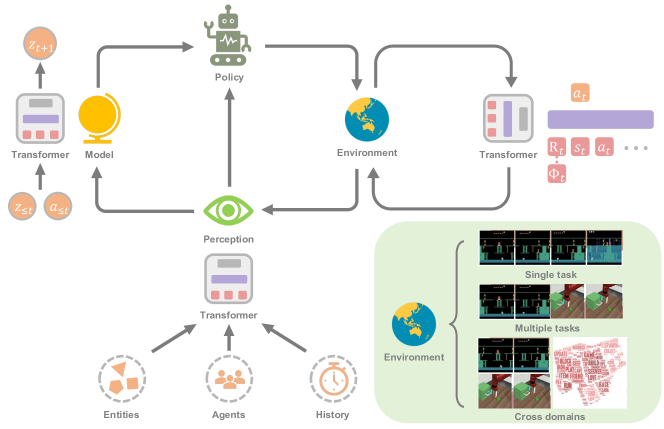
- 对 RL 中的 Transformer 相关文献进行综述,并将其组织为一个结构化的分类法(表示学习、模型学习、序列决策、通用智能体)。
- 描述 Transformer 如何作为编码器用于局部逐步时间步和时序序列,包括多实体观测和基于记忆的策略。
- 解释以历史为条件、能够在基于模型的 RL 中进行规划的 Transformer 基世界模型。
- 概述将 RL 视为条件序列建模的离线 RL 形式(Decision Transformer 及其变体)。
- 突出架构改进和条件化策略(return-to-go、hindsight 信息)以及鲁棒性策略(分离的世界/策略模型)。
- 讨论挑战(非平稳性、数据效率、计算/内存成本)并提出未来方向。
实验结果
研究问题
- RQ1将 Transformer 架构应用于强化学习的动机和收益是什么?
- RQ2在 RL 中基于 Transformer 的方法如何分类(表示、模型学习、序列决策、通用智能体),在每个类别中有哪些代表性方法?
- RQ3哪些条件信号和结构修改可以提升 Transformer 基于 RL 的性能与鲁棒性?
- RQ4阻碍 Transformer 在 RL 中应用的主要挑战是什么,离线 RL 及相关范式如何应对?
- RQ5哪些未来方向可以将 Transformers 巩固为 RL 的基础模型?
主要发现
- Transformers 已被应用为表示学习者,也作为完整的序列决策者在 RL 中取得显著成功,特别是在记忆、关系推理和长序任务方面。
- 基于 Transformer 架构的、以历史为条件的世界模型可以在基于模型的 RL 中提高数据效率和长期预测。
- Decision Transformer 及相关工作将 RL 重述为条件序列建模,使在离线数据框架内实现规划与模仿成为可能。
- 各种条件信号(return-to-go、hindsight 信息、任务特定线索)和架构变体(内部/外部 Transformer、分离的世界/策略模型)在不同 RL 场景中提升鲁棒性和性能。
- 离线 RL 以及利用 Transformer 的离线到在线策略解决了 RL 固有的非平稳性和样本效率挑战。
- 尽管有改进,RL 中的 Transformer 仍面临高计算/内存成本和数据需求旺盛的问题,促使关注效率的研究和偏向离线的方法。

阅读本论文
在 Nubint 阅读器中打开原文,边读边就任意段落提问。
在 Nubint 中阅读本论文本解读由 AI 根据论文原文生成,引用前请核对原文。