
[论文解读] Absence of altermagnetic spin splitting character in rutile oxide RuO$_2$
本研究利用自旋和角度分辨光电子能谱(SARPES)研究金红石相RuO₂的电子结构与自旋结构,挑战了其被提出的d波反磁性态。与理论预测的最高达1.4 eV的自旋分裂相反,实验结果未显示动量依赖的自旋分裂,而是揭示了在高对称平面附近具有反对称性的面内自旋极化,表明其为非磁性行为,排除了RuO₂中存在反磁性的可能性。
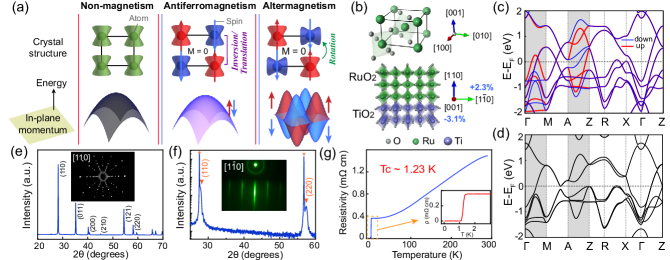
Rutile RuO$_2$ has been posited as a potential $d$-wave altermagnetism candidate, with a predicted significant spin splitting up to 1.4 eV. Despite accumulating theoretical predictions and transport measurements, direct spectroscopic observation of spin splitting has remained elusive. Here, we employ spin- and angle-resolved photoemission spectroscopy to investigate the band structures and spin polarization of thin-film and single-crystal RuO$_2$. Contrary to expectations of altermagnetism, our analysis indicates that RuO$_2$'s electronic structure aligns with those predicted under non-magnetic conditions, exhibiting no evidence of the hypothesized spin splitting. Additionally, we observe significant in-plane spin polarization of the low-lying bulk bands, which is antisymmetric about the high-symmetry plane and contrary to the $d$-wave spin texture due to time-reversal symmetry breaking in altermagnetism. These findings definitively challenge the altermagnetic order previously proposed for rutile RuO$_2$, prompting a reevaluation of its magnetic properties.
研究动机与目标
- 通过实验验证金红石相RuO₂中提出的d波反磁性态,该理论预测可产生高达1.4 eV的强自旋分裂。
- 解决理论预测与实验观测在RuO₂中自旋分裂问题上的长期矛盾。
- 确定RuO₂电子结构中是否存在时间反演对称性破缺及反磁性特征的自旋纹理。
- 探究RuO₂中观测到的自旋极化的起源,特别是其对称性特征以及可能的表面或缺陷贡献。
提出的方法
- 使用21.2 eV光子能量的氦灯对薄膜和单晶RuO₂样品进行自旋和角度分辨光电子能谱(SARPES)测量。
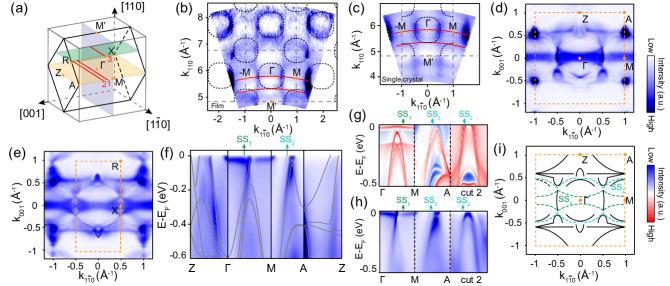
- 在X–R平面附近沿切片进行自旋积分ARPES测量,以绘制体相能带色散,识别出α能带为主要特征。
- 分析自旋分辨光电子发射强度及极化随动量和结合能的变化,以提取自旋纹理和对称性特征。
- 采用格林函数和薄膜模型模拟表面与界面效应,特别关注因表面态或氧空位导致的反演对称性破缺。
- 将实验SARPES数据与反磁性态和非磁性态的理论预测进行比较,尤其关注自旋极化在高对称平面上的对称性。
- 通过多个样品验证结果,确保观测到的自旋极化特征具有鲁棒性和可重复性。
实验结果
研究问题
- RQ1金红石相RuO₂是否表现出理论模型所预测的反磁性特征d波自旋分裂?
- RQ2RuO₂中观测到的自旋极化是否与时间反演对称性破缺和反磁性序一致,还是表明其具有其他起源?
- RQ3自旋极化的对称性——特别是其关于Γ–Z–M′平面的反对称性——与反磁性体系中预期的自旋纹理有何关联?
- RQ4表面效应(如反演对称性破缺或氧空位)是否可解释RuO₂中观测到的类似Rashba效应的自旋极化?
- RQ5实验结果在多大程度上挑战了当前将RuO₂归类为d波反磁性候选材料的观点?
主要发现
- 在RuO₂体相α能带中未观测到动量依赖的自旋分裂,与理论预测的反磁性态中高达1.4 eV的自旋分裂相矛盾。
- 观测到的面内自旋极化(S₀₀₁)关于Γ–Z–M′高对称平面呈反对称性,这与反磁性中时间反演对称性破缺所预期的对称自旋纹理不一致。
- 该自旋极化模式在多个薄膜和单晶样品中均保持稳定,表明其源于体相或本征性质,而非表面效应。
- 利用格林函数和薄膜模型的模拟表明,表面或氧空位引起的反演对称性破缺可产生类似Rashba效应的自旋分裂,与实验观测一致。
- 结果强烈表明,观测到的自旋极化源于表面或界面的对称性破缺效应,而非本征的反磁性序。
- 研究结果明确排除了RuO₂中存在反磁性序的可能性,要求对其磁性分类及理论模型进行重新评估。
阅读本论文
在 Nubint 阅读器中打开原文,边读边就任意段落提问。
在 Nubint 中阅读本论文本解读由 AI 根据论文原文生成,引用前请核对原文。