
[论文解读] Accelerating Guided Diffusion Sampling with Splitting Numerical Methods
本文提出 STSP4,一种分裂数值方法,通过将条件函数与扩散过程解耦,实现高阶数值求解器的重用,从而加速引导式扩散采样。该方法在仅使用 32–58% 步数的情况下,实现了与 250 步 DDIM 基线相当的 ImageNet256 生成质量,在文本到图像、图像着色、图像修复和超分辨率等任务中均表现出一致的性能提升。
Guided diffusion is a technique for conditioning the output of a diffusion model at sampling time without retraining the network for each specific task. One drawback of diffusion models, however, is their slow sampling process. Recent techniques can accelerate unguided sampling by applying high-order numerical methods to the sampling process when viewed as differential equations. On the contrary, we discover that the same techniques do not work for guided sampling, and little has been explored about its acceleration. This paper explores the culprit of this problem and provides a solution based on operator splitting methods, motivated by our key finding that classical high-order numerical methods are unsuitable for the conditional function. Our proposed method can re-utilize the high-order methods for guided sampling and can generate images with the same quality as a 250-step DDIM baseline using 32-58% less sampling time on ImageNet256. We also demonstrate usage on a wide variety of conditional generation tasks, such as text-to-image generation, colorization, inpainting, and super-resolution.
研究动机与目标
- 为解决引导式扩散采样缺乏加速技术的问题,尽管无引导扩散采样已取得进展,但其采样速度仍然较慢。
- 探究为何高阶数值方法在引导设置中会失效,其中条件函数会破坏稳定性与收敛性。
- 开发一种方法,使高阶求解器可重用于扩散项,同时通过算子分裂独立处理条件函数项。
- 在多种条件生成任务(包括文本到图像、图像修复和超分辨率)中,展示一致的性能提升。
- 提供一个理论基础坚实、稳定且高效的采样框架,减少采样时间而不损失生成质量。
提出的方法
- 该方法使用 Strang 分裂法将引导式扩散 ODE 分解为两部分:标准扩散项与条件梯度项。
- 对扩散项应用高阶数值求解器(如 PLMS4),因其行为良好,适合此类方法。
- 条件函数项则使用低阶方法(如 Euler)单独求解,以确保其非光滑或快速变化的性质下仍保持稳定。
- 分裂框架允许对每个组件独立优化数值方法,从而提升整体稳定性与收敛性。
- 通过在采样过程中插入任务特定的条件函数,该方法可推广至多种条件生成任务。
- 基于线性测试方程进行理论稳定性分析,推导出数值解保持有界且收敛的条件。

实验结果
研究问题
- RQ1为何高阶数值方法在引导式扩散采样中会失效,尽管其在无引导设置中表现成功?
- RQ2算子分裂方法是否能通过将高阶求解器应用于条件函数项来稳定引导式扩散中的高阶求解器?
- RQ3在不损害稳定性的前提下,高阶求解器在扩散组件上可重用到何种程度?
- RQ4在多种条件生成任务中,所提方法与 DDIM 等基线采样方法相比,在质量和速度方面表现如何?
- RQ5在不同步数和条件函数强度下,基于分裂的数值方案的理论稳定性极限是什么?
主要发现
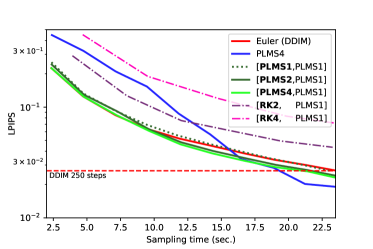
- 所提出的 STSP4 方法在 ImageNet256 上实现了与 250 步 DDIM 基线相当的图像质量,同时将采样时间减少了 32–58%。
- 在相同采样步数下,STSP4 在 FID、LPIPS 以及感知/召回率指标上均优于基线方法。
- 该方法在多种条件任务中均保持高质量生成,包括文本到图像、图像着色、图像修复和超分辨率。
- 稳定性分析表明,STSP4 即使在低步数下仍能保持收敛,且理论保证其收敛性可达最小步数。
- STSP4 的失效阈值低于 Euler 和 PLMS2,表明其在步数减少时具有更强的鲁棒性。
- 算子分裂成功地将行为不良的条件函数与行为良好的扩散项解耦,从而实现了高阶求解器的有效重用。
阅读本论文
在 Nubint 阅读器中打开原文,边读边就任意段落提问。
在 Nubint 中阅读本论文本解读由 AI 根据论文原文生成,引用前请核对原文。